
Question 133 marksMedium
Competency: Application
A laboratory model of a vibrating-wire load sensor is shown in the figure. A steel wire of fixed vibrating length runs from a rigid support to a clamp, and a load hangs from the clamp, so the tension in the wire equals the weight of the load. A pick-up coil plucks the wire magnetically and measures its fundamental frequency. With a load the frequency is . Ignore the weight of the wire and the clamp, and the small stretching of the wire. (Hypothetical data.)
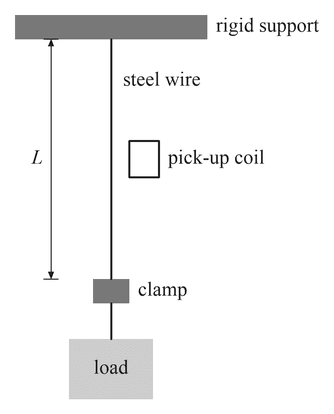
(a) Explain why the frequency rises when a heavier load is hung.
(b) An unknown load gives a frequency of . Find its mass.
(c) The frequency meter reads to . Estimate the smallest change in the unknown load that the sensor can detect.