
Question 462 marksEasy
How should two waves superpose each other such that there is (i) constructive interference and (ii) destructive interference.
Confirming your payment
Sign up now and get 250 free tokens.
Principle of Superposition of Waves · Question 46 of 86
How should two waves superpose each other such that there is (i) constructive interference and (ii) destructive interference.
Solution:
Concept: When two waves of amplitudes and meet with a phase difference , the resultant amplitude is given by ; it is largest when and smallest when .
Step 1 — State the condition for constructive interference. The waves must meet in phase, crest on crest and trough on trough, so that their displacements add, as in part (a) of the figure:
The resultant amplitude is then .
(i) Constructive interference: the waves superpose in phase.
Step 2 — State the condition for destructive interference. The waves must meet in opposite phase, the crest of one on the trough of the other, as in part (b) of the figure:
The resultant amplitude is then ; the cancellation is complete only if the two amplitudes are equal.
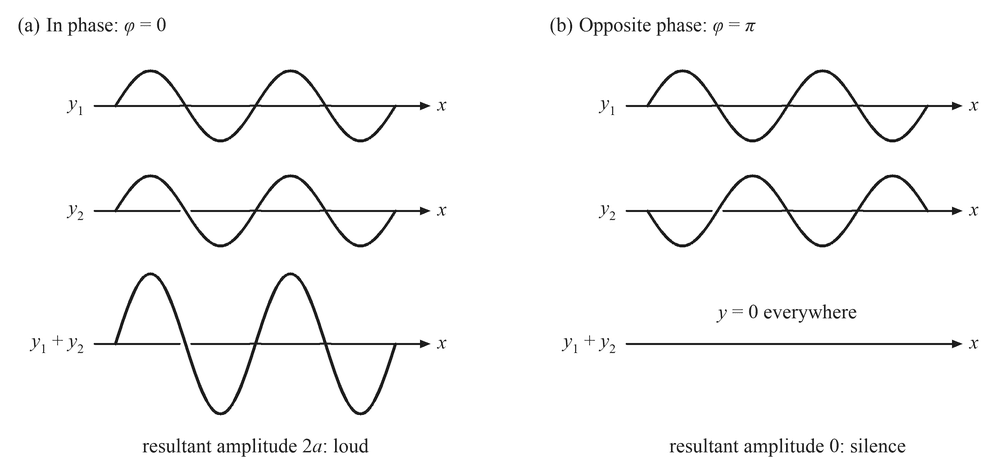
(ii) Destructive interference: the waves superpose in opposite phase.
Therefore, (i) for constructive interference the waves must meet in phase (phase difference ), and (ii) for destructive interference they must meet in opposite phase (phase difference ), with equal amplitudes for complete cancellation.