
Opening your dashboard
Class 12 Physics Chapter 22: Polarisation of Light Solutions
62 textbook questions with step-by-step answers, free to read, for ISC 2026-27.
Get talked through Ch 22, not just shown the answer
Reading a finished solution is not the same as being able to do it. The AI tutor takes one question at a time and works it with you, in your own words, until you can.
- Ask it out loud, in your own words
- It gives you the next step, not the answer
- Stuck on part (ii)? Start there
62 questions with solutions
1–5 marks · Mixed difficulty
The first 45 solutions are on this page. This chapter is a long one, so the rest open on their own page to keep this one quick to load.
- 11 mark
Question 1
Which of the following phenomenon is not common to light and sound waves?
Solve with AIAnswer
(A) Interference
(B) Diffraction
(C) Coherence
- Correct
(D) Polarisation
Answer: (D) Polarisation
Concept: Interference, diffraction and coherence belong to every kind of wave, but polarisation is possible only for transverse waves.
Step 1 — Compare the two waves. Light is a transverse wave, while sound in air is a longitudinal wave. A longitudinal wave vibrates only along its direction of travel, so its vibrations cannot be confined to one plane.
Step 2 — Check the other options. The other three are shown by both waves:
- (A) This is common: two loudspeakers fed with the same signal give loud and quiet spots, just as two coherent light sources give bright and dark fringes.
- (B) This is common: sound bends round doorways and walls, and light bends round very small obstacles and slits.
- (C) This is common: coherence (a constant phase difference between sources) applies to sources of any wave, sound included.
Therefore, the answer is (D): polarisation is shown by light but not by sound.
- 21 mark
Question 2
A ray of light is incident on the surface of a glass plate at an angle of incidence equal to Brewster's angle . If represents the refractive index of glass w.r.t. air, then angle between the reflected and refracted rays is
Solve with AIAnswer
(A)
(B)
- Correct
(C)
(D)
Answer: (C)
Concept: Brewster's law says that light reflected from a transparent surface is completely plane polarised when the angle of incidence is the polarising angle , given by the relation below.
Here is the refractive index of the reflecting medium with respect to the medium the light comes from. At this angle the reflected and refracted rays are at right angles, so .
Step 1 — Find the angle of refraction. Snell's law, , with gives:
Step 2 — Find the angle between the rays. The reflected ray makes with the surface and the refracted ray makes with it, on the other side, so the angle between them is:
Step 3 — Check the other options. Each of the other options is a different angle:
- (A) This is larger than for any ; the rays at the polarising angle are exactly perpendicular.
- (B) Since , , so this option equals itself, the angle of incidence.
- (D) By Snell's law this is the angle of refraction , measured from the normal, not the angle between the two rays.
Therefore, the answer is (C): the reflected and refracted rays are at .
- 31 mark
Question 3
A polariser is used to
Solve with AIAnswer
(A) increase intensity of light
- Correct
(B) produce polarised light
(C) produce unpolarised light
(D) none of the above
Answer: (B) produce polarised light
Concept: A polariser (for example a polaroid sheet) lets through only the vibrations of the electric vector along its pass axis.
Step 1 — What comes out. Unpolarised light falling on it comes out with vibrations in one plane only, that is, plane polarised.
Step 2 — Check the other options. None of the others describes a polariser:
- (A) A polariser removes the vibrations across its axis, so it lowers the intensity (to half for unpolarised light); it never increases it.
- (C) It does the opposite: it turns unpolarised light into polarised light.
- (D) This is wrong because (B) is correct.
Therefore, the answer is (B): a polariser is used to produce polarised light.
- 41 mark
Question 4
A ray of light strikes a glass plate at an angle of incidence equal to . If the reflected and refracted rays are perpendicular to each other then the refractive index of glass is
Solve with AIAnswer
- Correct
(A)
(B)
(C)
(D)
Answer: (A)
Concept: Brewster's law says that light reflected from a transparent surface is completely plane polarised when the angle of incidence is the polarising angle , given by the relation below.
Here is the refractive index of the reflecting medium with respect to the medium the light comes from. At this angle the reflected and refracted rays are at right angles, so .
Step 1 — Recognise the polarising angle. The reflected and refracted rays are perpendicular, so the angle of incidence, , is the polarising angle.
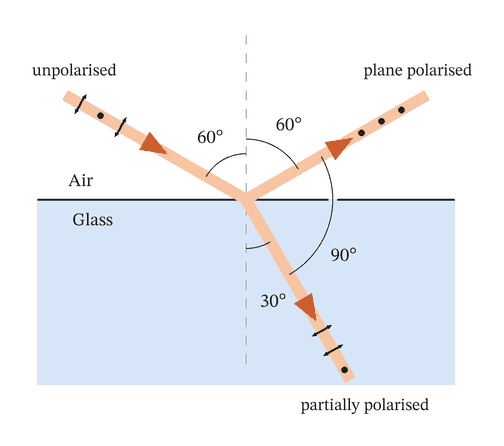
Step 2 — Apply Brewster's law. The refractive index is the tangent of this angle:
Step 3 — Check the other options. Each other option comes from a different function of or is impossible:
- (B) This is ; it is also less than 1, and no glass has a refractive index below 1.
- (C) This is a typical value for glass, but it does not follow from the data: , not .
- (D) This is , and it is less than 1 as well.
Therefore, the answer is (A): the refractive index of the glass is .
- 51 mark
Question 5
If the critical angle of a crystal is , the polarising angle is
Solve with AIAnswer
(A)
(B)
(C)
- Correct
(D)
Answer: (D)
Concept: The critical angle gives the refractive index, , and Brewster's law gives the polarising angle, .
Step 1 — Find the refractive index. We put into the critical-angle relation:
Step 2 — Find the polarising angle. Brewster's law then gives:
This is about .
Step 3 — Check the other options. The other options do not satisfy :
- (A) This is ; its tangent is about 0.58, not .
- (B) This is ; its tangent is , which would need .
- (C) No angle has a cosine greater than 1, so does not exist.
Therefore, the answer is (D): the polarising angle is .
- 61 mark
Question 6
Polarising angle for water is . If light is incident at the angle on the surface of water and reflected, the angle of refraction is
Solve with AIAnswer
(A)
(B)
- Correct
(C)
(D)
Answer: (C)
Concept: At the polarising angle the reflected and refracted rays are perpendicular, so .
Step 1 — Subtract from . The angle of refraction is the complement of the polarising angle:
Step 2 — Check the other options. None of the others is the complement of :
- (A) This is the angle of incidence (and of reflection), not the angle of refraction.
- (B) This is ; an angle of refraction is always less than .
- (D) This would give , not .
Therefore, the answer is (C): the angle of refraction is .
- 71 mark
Question 7
When a plane polarised light is passed through an analyser and the analyser is rotated through , the intensity of the emerging light
Solve with AIAnswer
(A) varies between maximum and minimum
(B) becomes zero
(C) does not vary
- Correct
(D) varies between a maximum and zero
Answer: (D) varies between a maximum and zero
Concept: Malus' law: when completely plane polarised light of intensity falls on an analyser whose pass axis makes an angle with the direction of vibration of the light, the transmitted intensity is
An ideal polaroid lets through exactly half of the intensity of unpolarised light falling on it.
Step 1 — Follow the intensity during the turn. Start with the analyser's pass axis parallel to the vibrations (): the intensity is the maximum, . As the analyser turns, falls, and at (crossed) it is zero.
Step 2 — Name the range. So during a turn of the intensity changes from a maximum to zero (or from zero to a maximum if the turn starts from the crossed position). For plane polarised light the lowest intensity is exactly zero.
Step 3 — Check the other options. The other options are weaker or false:
- (A) This is true but less precise: the minimum here is not just smaller, it is exactly zero, and that is what marks the light as plane polarised.
- (B) The intensity is zero only at the end of the turn; during the turn it changes all the way from the maximum.
- (C) The intensity does change; only unpolarised light would show no change.
Note: The key assumes the turn starts from the parallel (or crossed) position. Starting from any other position, a turn passes through either the maximum or the zero, but not both.
Therefore, the answer is (D): the intensity varies between a maximum and zero.
- 81 mark
Question 8
Consider the following statements A and B. Identify the correct answer.
A. Polarised light can be used to study the helical structure of nucleic acids.
B. Optic axis is a direction and not any particular line in the crystal.
Solve with AIAnswer
- Correct
(A) A and B are correct
(B) A and B are wrong
(C) A is correct but B is wrong
(D) A is wrong but B is correct
Answer: (A) A and B are correct
Concept: Molecules with a helical (screw-like) shape interact differently with polarised light of different handedness, and a crystal's optic axis is a direction fixed by its structure.
Step 1 — Judge statement A. Helical molecules such as DNA and proteins absorb left- and right-circularly polarised light by different amounts, and they rotate the plane of polarisation. Measuring these effects with polarised light is a standard way of studying their helical structure. Statement A is correct.
Step 2 — Judge statement B. The optic axis is a direction in a doubly refracting crystal along which light travels without double refraction. Every line in the crystal parallel to this direction is an optic axis, so it is a direction, not one particular line. Statement B is correct.
Step 3 — Check the other options. Since both statements are correct, the others fail:
- (B) This calls both statements wrong, but Steps 1 and 2 show both are correct.
- (C) This calls statement B wrong, but the optic axis is indeed a direction.
- (D) This calls statement A wrong, but polarised light is used to study helical molecules.
Therefore, the answer is (A): both statements are correct.
- 91 mark
Question 9
Unpolarised light falls first on a polariser () and then on an analyser (). The intensity of the transmitted light from the analyser is th of the incident unpolarised light. What will be the angle between optic axes of and ?
Solve with AIAnswer
(A)
(B)
(C)
- Correct
(D)
Answer: (D)
Concept: Malus' law: when completely plane polarised light of intensity falls on an analyser whose pass axis makes an angle with the direction of vibration of the light, the transmitted intensity is
An ideal polaroid lets through exactly half of the intensity of unpolarised light falling on it.
Step 1 — Light after the polariser. Let the unpolarised light have intensity . The polariser passes half of it:
Step 2 — Apply Malus' law at the analyser. The analyser passes , and this must equal :
Step 3 — Check the other options. Each other angle gives a different fraction of :
- (A) of the incident light.
- (B) of the incident light.
- (C) of the incident light.
Therefore, the answer is (D): the axes of P and A are at .
- 101 mark
Question 10
A ray of light incident on a transparent glass slab of refractive index 1.62. The reflected and refracted rays are mutually perpendicular. The angle of incidence is
Solve with AIAnswer
- Correct
(A)
(B)
(C)
(D)
Answer: (A)
Concept: Brewster's law says that light reflected from a transparent surface is completely plane polarised when the angle of incidence is the polarising angle , given by the relation below.
Here is the refractive index of the reflecting medium with respect to the medium the light comes from. At this angle the reflected and refracted rays are at right angles, so .
Step 1 — Recognise the polarising angle. Mutually perpendicular reflected and refracted rays mean the light falls at the polarising angle.
Step 2 — Apply Brewster's law. We take the inverse tangent of the refractive index:
Step 3 — Check the other options. The tangents of the other angles are not 1.62:
- (B) .
- (C) .
- (D) ; the angle of refraction here is , close to this but not the angle of incidence.
Therefore, the answer is (A): the angle of incidence is .
- 111 mark
Question 11
What evidence is there that sound is not electromagnetic in nature?
Solve with AIWritten solution
Solution:
Concept: Electromagnetic waves are transverse, so they can always be polarised.
Step 1 — Test sound for polarisation. Sound waves cannot be polarised; no arrangement of slits or sheets makes the sound in air vibrate in one plane only.
Step 2 — Draw the conclusion. A wave that cannot be polarised is not transverse, so it cannot be an electromagnetic wave. (Sound also needs a material medium and travels at only about in air, whereas electromagnetic waves cross a vacuum at .)
Therefore, the evidence is that sound waves cannot be polarised (they are longitudinal), whereas electromagnetic waves are transverse and can be polarised.
- 121 mark
Question 12
Will ultrasonic waves show any polarisation? Give reason for your answer.
Solve with AIWritten solution
Solution:
Concept: Only transverse waves can be polarised.
Step 1 — Identify the wave. Ultrasonic waves are sound waves of frequency above about 20 kHz. In air and in liquids they are longitudinal, like ordinary sound.
Step 2 — Conclusion. A longitudinal vibration lies along the direction of travel, so it cannot be confined to a chosen plane.
Note: In solids, ultrasonic waves can also travel as transverse (shear) waves, and those can be polarised; the answer refers to ultrasonic waves in air or liquids.
Therefore, no; ultrasonic waves in air show no polarisation, because they are longitudinal waves.
- 131 mark
Question 13
What is plane polarised light?
Solve with AIWritten solution
Solution:
Concept: In ordinary (unpolarised) light the electric vector vibrates in all directions at right angles to the direction of travel, and its direction changes at random.
Step 1 — Describe what polarisation does to the vibrations. When the vibrations of the electric vector are confined to one fixed direction at right angles to the beam, all of them lie in a single plane that contains the direction of travel.
Step 2 — State the definition. Light in which the vibrations of the electric vector are confined to a single plane containing the direction of travel is called plane polarised light. It can be obtained, for example, by passing ordinary light through a polaroid.
Therefore, plane polarised light is light whose electric vector vibrates in one plane only.
- 141 mark
Question 14
Define polarisation angle for polarisation by reflection.
Solve with AIWritten solution
Solution:
Concept: Light reflected from a transparent surface is in general only partly polarised, and how strongly it is polarised depends on the angle of incidence.
Step 1 — State the definition. The polarising angle is the angle of incidence at which the light reflected from the surface of a transparent medium is completely plane polarised. The vibrations of the reflected light are then perpendicular to the plane of incidence.
Step 2 — Link the angle to the refractive index. Brewster's law gives this angle for a medium of refractive index with respect to the medium the light comes from:
For glass of refractive index 1.5, for example, it is about .
Therefore, the polarisation angle is the angle of incidence for which the reflected light is completely plane polarised; it is given by .
- 151 mark
Question 15
State Brewster's law.
Solve with AIWritten solution
Solution:
Concept: Brewster found how the polarising angle depends on the material of the reflecting surface.
Step 1 — Statement. The tangent of the polarising angle for a transparent medium is equal to the refractive index of the medium:
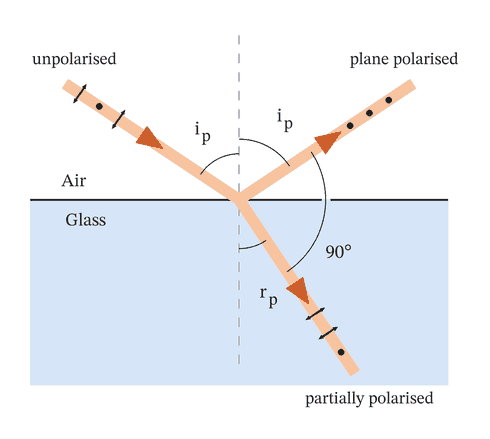
Step 2 — A consequence. At this angle the reflected and refracted rays are at right angles to each other.
Therefore, Brewster's law is , where is the refractive index of the reflecting medium and the polarising angle.
- 161 mark
Question 16
Which plane is defined as the plane of polarisation in a plane polarised electromagnetic wave?
Solve with AIWritten solution
Solution:
Concept: In plane polarised light the electric vector vibrates along one direction. The plane containing this vibration and the direction of travel is the plane of vibration.
Step 1 — Definition used in this chapter. The plane of polarisation is the plane at right angles to the plane of vibration that contains the direction of travel. It contains no vibrations of the electric vector.
Step 2 — The other convention. Many modern books, and the ISC syllabus, instead call the plane that contains the electric vector and the direction of travel the plane of polarisation. Whichever name is used, the electric vector, the magnetic vector and the direction of travel are all at right angles.
Therefore, the plane of polarisation is the plane perpendicular to the plane of vibration, containing the direction of propagation (in the other convention, the plane containing and the direction of propagation).
- 171 mark
Question 17
A ray of light is incident on a medium at polarising angle. What is the angle between the reflected and refracted rays?
Solve with AIWritten solution
Solution:
Concept: Brewster's law says that light reflected from a transparent surface is completely plane polarised when the angle of incidence is the polarising angle , given by the relation below.
Here is the refractive index of the reflecting medium with respect to the medium the light comes from. At this angle the reflected and refracted rays are at right angles, so .
Step 1 — Find the angle each ray makes with the surface. Angles of reflection and refraction are measured from the normal, so the reflected ray (in air) makes with the surface, and the refracted ray (in the medium, on the same side of the normal) makes with it.
Step 2 — Add the two angles. Let be the angle between the reflected and refracted rays. It is the sum of the two angles found in Step 1, and at the polarising angle:
Therefore, the angle between the reflected and refracted rays is .
- 181 mark
Question 18
What is the value of refractive index of a medium of polarising angle ?
Solve with AIWritten solution
Solution:
Concept: Brewster's law says that light reflected from a transparent surface is completely plane polarised when the angle of incidence is the polarising angle , given by the relation below.
Here is the refractive index of the reflecting medium with respect to the medium the light comes from. At this angle the reflected and refracted rays are at right angles, so .
Step 1 — Note the given angle. The polarising angle of the medium is given, , so Brewster's law gives the refractive index directly.
Step 2 — Apply Brewster's law. We take the tangent of the polarising angle:
Therefore, the refractive index is .
- 191 mark
Question 19
Name two commonly used devices which use polarised light.
Solve with AIWritten solution
Solution:
Concept: Devices that use polarised light contain polarising sheets that produce or block it.
Step 1 — First device. A liquid crystal display (LCD) uses two polarising sheets with a liquid crystal between them.
Step 2 — Second device. Polaroid sunglasses block the polarised glare reflected from roads and water.
Therefore, two such devices are the liquid crystal display and polaroid sunglasses.
- 201 mark
Question 20
A ray of light falls on a transparent slab of . If reflected and refracted rays are mutually perpendicular, what is the angle of incidence?
Solve with AIWritten solution
Solution:
Concept: Brewster's law says that light reflected from a transparent surface is completely plane polarised when the angle of incidence is the polarising angle , given by the relation below.
Here is the refractive index of the reflecting medium with respect to the medium the light comes from. At this angle the reflected and refracted rays are at right angles, so .
Step 1 — Recognise the polarising angle. Perpendicular reflected and refracted rays mean the light falls at the polarising angle.
Step 2 — Apply Brewster's law. We find the angle whose tangent is 1.732. To four significant figures this number is the tangent of , so the angle comes out very close to :
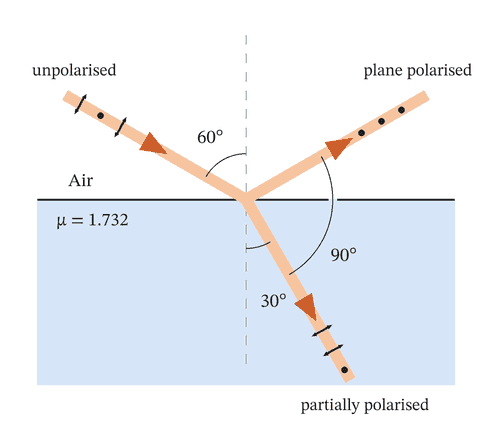
Therefore, the angle of incidence is .
- 211 mark
Question 21
Which among X-rays, sound waves and radio waves can be polarised?
Solve with AIWritten solution
Solution:
Concept: Only transverse waves can be polarised, because only their vibrations, at right angles to the direction of travel, can point in different directions.
Step 1 — Sort the waves by type. X-rays and radio waves are both electromagnetic waves: their electric and magnetic fields vibrate at right angles to the direction of travel, so they are transverse. Sound waves in air are longitudinal: the air particles vibrate along the direction of travel.
Step 2 — Apply the rule to each wave. X-rays and radio waves, being transverse, can be polarised; radio waves from a straight dipole aerial are in fact already plane polarised. Sound in air has only one direction of vibration, along the ray, so there is no plane to select and it cannot be polarised.
Therefore, X-rays and radio waves can be polarised, because they are transverse; sound waves cannot.
- 221 mark
Question 22
Unpolarised light is incident on a plane surface of glass of refractive index at angle . If the reflected lights gets totally polarised, write the relation between the angle and refractive index .
Solve with AIWritten solution
Solution:
Concept: The reflected light is completely polarised only when the angle of incidence is the polarising angle , given by Brewster's law, .
Step 1 — Identify the angle. The reflected light is totally polarised, so the angle of incidence must be the polarising angle of the glass.
Step 2 — Write Brewster's law for this angle. Putting in place of in Brewster's law gives:
Therefore, the relation is (Brewster's law).
- 231 mark
Question 23
Define the term 'linearly polarised light'.
Solve with AIWritten solution
Solution:
Concept: Light is a transverse wave: its electric vector vibrates at right angles to the direction of travel. In unpolarised light the direction of this vibration changes at random.
Step 1 — Describe the vibration. In linearly polarised light the electric vector vibrates along one fixed straight line (one direction) at right angles to the direction of travel, and this direction does not change.
Step 2 — State the definition. Light in which the electric vector vibrates along one fixed direction perpendicular to the direction of travel is called linearly polarised light. Because all its vibrations then lie in one plane containing the ray, it is also called plane polarised light.
Therefore, linearly polarised light is light whose electric vector vibrates along a single fixed direction perpendicular to the direction of propagation.
- 241 mark
Question 24
Is light from a sodium lamp polarised?
Solve with AIWritten solution
Solution:
Concept: Light is plane polarised only if its electric vector keeps vibrating along one fixed direction; in unpolarised light no direction is preferred.
Step 1 — Look at how the lamp emits. The sodium atoms in the lamp are excited in collisions and emit independently, each for a very short time (about s) and with its own random orientation.
Step 2 — Add up the light from all the atoms. The light from a huge number of such atoms has an electric vector whose direction keeps changing at random, with no direction preferred. A polaroid turned in front of the lamp therefore shows no change in brightness.
Therefore, no; light from a sodium lamp is not polarised (it is unpolarised).
- 251 mark
Question 25
What is the angle between the reflected and refracted rays at polarising angle?
Solve with AIWritten solution
Solution:
Concept: At the polarising angle Brewster's law holds, . Together with Snell's law it makes the angles of incidence and refraction add up to , so .
Step 1 — Find the angle each ray makes with the surface. Angles of reflection and refraction are measured from the normal, so the reflected ray (in air) makes with the surface, and the refracted ray (in the medium, on the same side of the normal) makes with it.
Step 2 — Add the two angles. Let be the angle between the reflected and refracted rays. It is the sum of the two angles found in Step 1:
Therefore, the angle between the reflected and refracted rays is .
- 262 marks
Question 26
What is polarisation?
Solve with AIWritten solution
Solution:
Concept: In ordinary light the electric vector vibrates in all directions at right angles to the direction of travel.
Step 1 — Definition. Polarisation is the phenomenon in which the vibrations of the light (of its electric vector) are restricted to a single plane containing the direction of travel. The light so obtained is called (plane) polarised light.
Step 2 — What it tells us. Only transverse waves can be polarised, so polarisation shows that light waves are transverse.
Therefore, polarisation is the confining of the vibrations of light to one plane; it is possible because light is a transverse wave.
- 272 marks
Question 27
Explain the terms polariser and analyser.
Solve with AIWritten solution
Solution:
Concept: A polaroid (or a tourmaline crystal) lets through only the vibrations of the electric vector along its pass axis.
Step 1 — Polariser. A device that turns unpolarised light into plane polarised light is called a polariser. In the figure, P is the polariser.
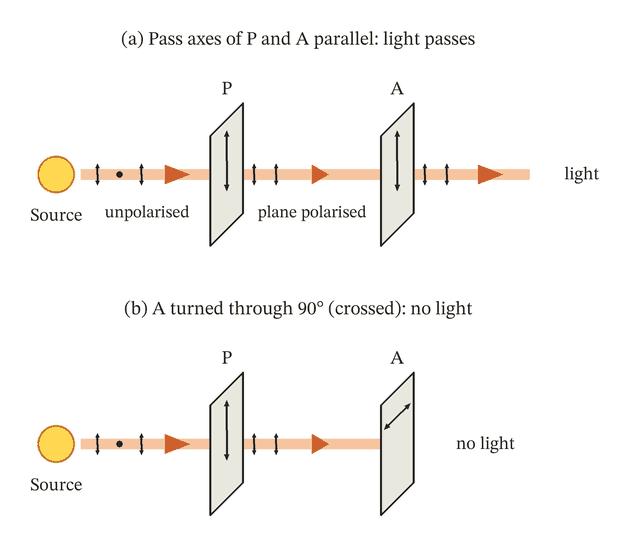
Step 2 — Analyser. A second device used to test whether light is polarised, and to find its plane of vibration, is called the analyser (A in the figure). When A is rotated about the beam, the transmitted light is brightest when its pass axis is parallel to that of P and dark when the two are crossed.
Step 3 — Same device, two roles. The two are identical polaroids; the name depends only on the job each does.
Therefore, the polariser produces plane polarised light, and the analyser detects and analyses it.
- 282 marks
Question 28
Describe an experiment to show polarisation of light.
Solve with AIWritten solution
Solution:
Concept: A polaroid passes only the vibrations along its pass axis, so two polaroids in line can show whether light vibrates in one plane.
Step 1 — Apparatus. Light from a lamp falls on a polaroid P (the polariser). The light from P falls on a second polaroid A (the analyser), and the transmitted light is viewed on a screen or by eye.
Step 2 — Rotate P with A taken out of the beam. First remove A, so that only P is in the beam, and look at the light coming straight out of P. When P is rotated about the beam, the brightness of this light does not change. So the light from the lamp vibrates equally in all directions: it is unpolarised.
Step 3 — Rotate A with P fixed. The light coming through A is brightest when the axes of P and A are parallel. It fades as A is turned and becomes zero when the axes are at (crossed). It becomes brightest again after a further .
Step 4 — Conclusion. The light leaving P therefore vibrates in one plane only: it is plane polarised. The experiment also shows that light is a transverse wave.
Therefore, a polariser and a rotating analyser show polarisation: the brightness through the analyser changes from maximum to zero as it is turned through .
- 292 marks
Question 29
Draw a diagram to show (i) unpolarised light and
(ii) polarised light.
Solve with AIWritten solution
Solution:
Concept: Vibrations in the plane of the page are drawn as double-headed arrows across the ray; vibrations perpendicular to the page are drawn as dots on the ray.
Step 1 — Part (i): unpolarised light. The electric vector vibrates in all directions at right angles to the beam. Seen end-on, it is shown by arrows in every direction; seen from the side, by arrows and dots placed alternately along the ray, so that neither direction of vibration is favoured.
Step 2 — Part (ii): polarised light. The electric vector vibrates in one direction only. Seen end-on, it is a single double-headed arrow; seen from the side, the ray carries only arrows (vibrations in the page) or only dots (vibrations perpendicular to the page).
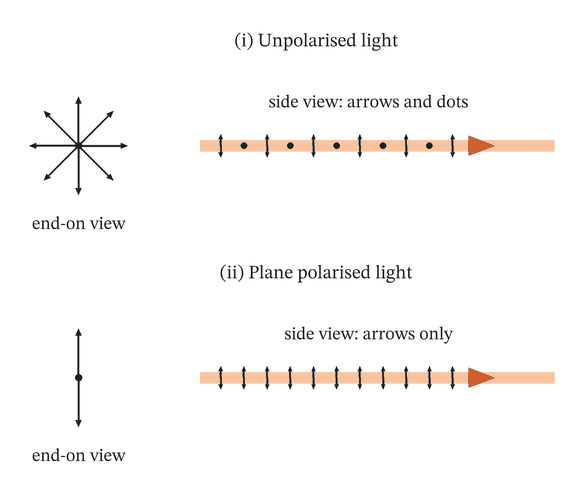
Therefore, (i) unpolarised light is shown by arrows and dots (vibrations in all directions), and (ii) polarised light by arrows only (or dots only), as in the figure.
- 302 marks
Question 30
Is it possible to polarise sound waves? Why?
Solve with AIWritten solution
Solution:
Concept: Only transverse waves can be polarised, because only their vibrations can point in different directions at right angles to the direction of travel.
Step 1 — Type of wave. Sound waves in air are longitudinal: the particles vibrate along the direction of travel.
Step 2 — Why they cannot be polarised. A longitudinal vibration has only one direction, so there is no choice of plane to select; a sound wave looks the same in every plane containing the direction of travel.
Therefore, no; sound waves (in air) cannot be polarised because they are longitudinal waves.
- 312 marks
Question 31
What is polarising angle? Explain Brewster's law.
Solve with AIWritten solution
Solution:
Concept: Light reflected from a transparent surface is partly polarised, and the amount of polarisation depends on the angle of incidence.
Step 1 — Polarising angle. For one particular angle of incidence the reflected light is completely plane polarised, with its vibrations perpendicular to the plane of incidence. This angle of incidence is called the polarising angle .
Step 2 — Brewster's law. The tangent of the polarising angle is equal to the refractive index of the reflecting medium:
Step 3 — What the law means. Since depends on the material and on the wavelength, each material has its own polarising angle for each colour. At the reflected and refracted rays are at right angles to each other.
Therefore, the polarising angle is the angle of incidence giving completely plane polarised reflected light, and Brewster's law states that .
- 322 marks
Question 32
A light ray strikes the surface of transparent material such that the reflected light and refracted rays are mutually perpendicular. What is the nature of (i) the reflected light and
(ii) the refracted light?
Solve with AIWritten solution
Solution:
Concept: Brewster's law says that light reflected from a transparent surface is completely plane polarised when the angle of incidence (the polarising angle) satisfies the relation below.
Here is the refractive index of the reflecting medium with respect to the medium the light comes from. At this angle the reflected and refracted rays are at right angles, so .
Step 1 — Recognise the angle. The reflected and refracted rays are at right angles only when the light falls at the polarising angle, so the angle of incidence here is .
Step 2 — Part (i): the reflected light. At the polarising angle the reflected light is completely plane polarised, with its vibrations perpendicular to the plane of incidence (shown by dots in the figure).
Step 3 — Part (ii): the refracted light. The refracted light carries all the vibrations in the plane of incidence and most of the perpendicular ones (only a small part of these is reflected). So it is partially polarised, with more vibrations in the plane of incidence.
Note: The book's answer calls the refracted light unpolarised; it is in fact partially polarised, as the chapter itself says when it explains the pile of plates.
Therefore, (i) the reflected light is completely plane polarised and (ii) the refracted light is partially polarised.
- 332 marks
Question 33
Using a diagram explain how polarised light is produced by scattering.
Solve with AIWritten solution
Solution:
Concept: When light falls on an air molecule, its electric field makes the electrons of the molecule vibrate along the field, and the vibrating charges send out (scatter) light. A vibrating charge sends no light along its own line of vibration.
Step 1 — The arrangement. Unpolarised sunlight travels horizontally and falls on an air molecule M. An observer looks at the scattered light at right angles to the sunlight, from below M.
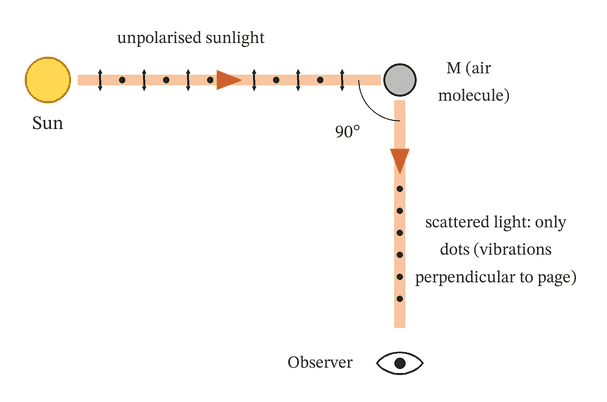
Step 2 — Vibrations in the plane of the page. The incident light has vibrations in the page (up and down, shown by arrows) and perpendicular to the page (dots). The up-and-down vibrations of M lie along the line to the observer, so they send no light towards the observer.
Step 3 — Vibrations perpendicular to the page. The vibrations of M perpendicular to the page are at right angles to the line of sight, so they do send light to the observer.
Step 4 — Conclusion. The light reaching the observer therefore vibrates only perpendicular to the page: it is plane polarised. This is why light from the blue sky, seen at to the sun, shows a change in brightness when viewed through a rotating polaroid.
Therefore, light scattered at to the incident beam is plane polarised, with its vibrations perpendicular to the plane containing the incident and scattered rays.
- 342 marks
Question 34
Explain how plane polarised light is produced using pile of plates.
Solve with AIWritten solution
Solution:
Concept: At the polarising angle, a glass surface reflects part of the vibrations perpendicular to the plane of incidence and none of the vibrations in that plane.
Step 1 — Construction. A pile of plates is a number of thin glass plates (such as microscope cover slips) placed one on another in a tube, inclined so that the light falls on them at the polarising angle (about to for glass).
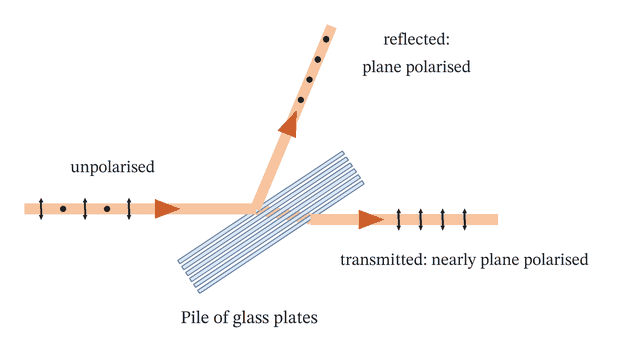
Step 2 — Action at each surface. At every surface the vibrations in the plane of incidence are fully transmitted, while a part of the vibrations perpendicular to the plane of incidence is reflected. The reflected light at each surface is completely plane polarised.
Step 3 — Effect of many plates. After passing many surfaces, almost all the perpendicular vibrations have been reflected away. The transmitted beam then carries almost only the vibrations in the plane of incidence, so it is (nearly) plane polarised, at right angles to the reflected light.
Therefore, a pile of plates at the polarising angle gives plane polarised reflected light and, with enough plates, nearly plane polarised transmitted light vibrating in the plane of incidence.
- 352 marks
Question 35
State Malus law.
Solve with AIWritten solution
Solution:
Concept: An analyser passes only the component of the light's vibration along its pass axis.
Step 1 — Statement. When a completely plane polarised beam of light falls on an analyser, the intensity of the transmitted light is proportional to the square of the cosine of the angle between the plane of transmission of the analyser and that of the polariser:
Step 2 — Meaning of the symbols. Here is the intensity of the polarised light falling on the analyser and the intensity coming out of it.
Therefore, Malus' law is : the transmitted intensity varies as the square of the cosine of the angle between the two planes of transmission.
- 362 marks
Question 36
Explain the working of a polaroid.
Solve with AIWritten solution
Solution:
Concept: Some crystals show dichroism: they absorb light vibrating in one direction strongly and let through light vibrating at right angles to it.
Step 1 — Construction. A polaroid is a thin film containing a very large number of tiny dichroic crystals (or long, iodine-treated polymer molecules) all lined up in one direction, held between two thin protective sheets.
Step 2 — Working. When unpolarised light falls on the polaroid, the component of the electric vector along one direction is absorbed, and the component at right angles to it, along the pass axis, goes through. The light coming out is therefore plane polarised.
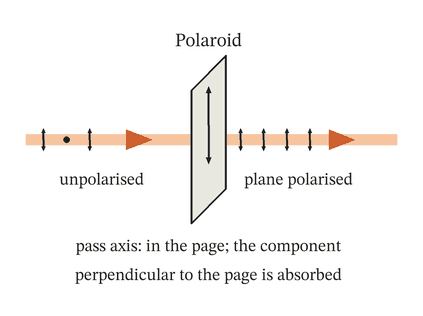
Step 3 — Use as polariser and analyser. The same sheet can test polarised light: rotating it about the beam changes the brightness from maximum to zero.
Therefore, a polaroid works by selective absorption (dichroism): it absorbs the vibrations in one direction and transmits those along its pass axis, giving plane polarised light.
- 372 marks
Question 37
What are the uses of a polaroid?
Solve with AIWritten solution
Solution:
Concept: A polaroid is a cheap, thin and large polarising sheet, so it is used wherever light must be polarised or polarised light must be blocked.
Step 1 — Uses that cut unwanted light. A polaroid stops the vibrations at right angles to its pass axis, so it can remove light that is mostly polarised one way:
(i) Sunglasses: glare from water, wet roads and car bonnets is partly polarised with horizontal vibrations; polaroid sunglasses with a vertical pass axis cut most of it.
(ii) Photographic filters: a polarising filter cuts glare reflected from water and roads, and darkens the blue sky, whose scattered light is partly polarised.
Step 2 — Uses in displays and films. Two polarising sheets, or two differently polarised pictures, decide which light reaches the eye:
(iii) Liquid crystal displays (LCDs): watches, calculators and screens place the liquid crystal between two polarising sheets; each digit or pixel turns dark or bright as the crystal does or does not rotate the plane of polarisation.
(iv) 3-D films: the two pictures are projected with different polarisations and the polaroid spectacles send one picture to each eye.
Step 3 — Uses in testing and controlling light. A pair of polaroids can show changes in polarisation or set how much light passes:
(v) Stress analysis: a model of a structure placed between crossed polaroids shows coloured fringes where it is strained.
(vi) Adjustable windows: two polaroids, one of them rotatable, can control the brightness of the light let in; such windows have been used in some trains and aircraft (many modern aircraft use electronically dimmed windows instead).
Therefore, polaroids are used in sunglasses, LCDs, camera filters, 3-D films, stress analysis and adjustable windows, besides producing and analysing polarised light.
- 382 marks
Question 38
You are given plane polarised light and unpolarised light. How will you identify them?
Solve with AIWritten solution
Solution:
Concept: By Malus' law, the light coming through an analyser depends on the angle between its pass axis and the direction of vibration of plane polarised light, but not on its direction for unpolarised light.
Step 1 — The test. Each beam in turn is looked at through a polaroid (used as an analyser), and the polaroid is rotated about the beam.
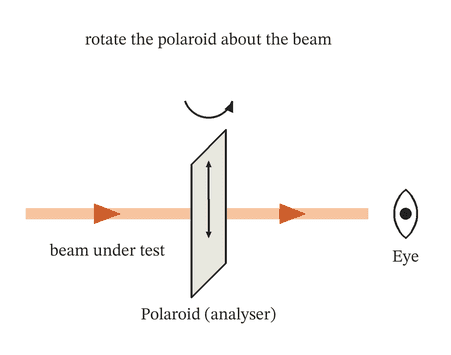
Step 2 — Plane polarised light. The brightness changes, becoming a maximum and then zero twice in each full rotation.
Step 3 — Unpolarised light. The brightness stays the same for every position of the polaroid.
Therefore, the beam whose intensity goes from maximum to zero as the polaroid is rotated is plane polarised, and the beam whose intensity does not change is unpolarised.
- 392 marks
Question 39
If the angle between the pass axis of polariser and analyser is , write the ratio of the intensities of original light and the transmitted light after passing through analyser.
Solve with AIWritten solution
Solution:
Concept: Malus' law: when completely plane polarised light of intensity falls on an analyser whose pass axis makes an angle with the direction of vibration of the light, the transmitted intensity is
An ideal polaroid lets through exactly half of the intensity of unpolarised light falling on it.
Step 1 — Take the original light. Here the original light is the plane polarised light of intensity coming from the polariser and falling on the analyser.
Step 2 — Apply Malus' law. We put :
Step 3 — Form the ratio. Dividing the original intensity by the transmitted one:
Note: If "original light" is read as the unpolarised light falling on the polariser, the polariser first halves it, so the transmitted light is a quarter of it and the ratio is 4 : 1.
Therefore, the ratio of the intensity of the original (polarised) light to that of the transmitted light is 2 : 1.
- 402 marks
Question 40
Discuss the intensity of transmitted light when a polaroid sheet is rotated between two crossed polaroids.
Solve with AIWritten solution
Solution:
Concept: Malus' law: when completely plane polarised light of intensity falls on an analyser whose pass axis makes an angle with the direction of vibration of the light, the transmitted intensity is
An ideal polaroid lets through exactly half of the intensity of unpolarised light falling on it.
Step 1 — The arrangement. Let and be the crossed polaroids (axes at ), and let be the intensity of the polarised light coming out of . The middle sheet has its axis at to that of , so its axis is at to that of .

Step 2 — Light through . Malus' law gives the intensity after :
Step 3 — Light through . The light from meets at the angle :
Step 4 — Discuss the result. As is rotated, the intensity is zero when (the middle sheet parallel to one of the crossed sheets). It is a maximum, , when . So in one full rotation the light rises to a maximum and falls to zero four times.
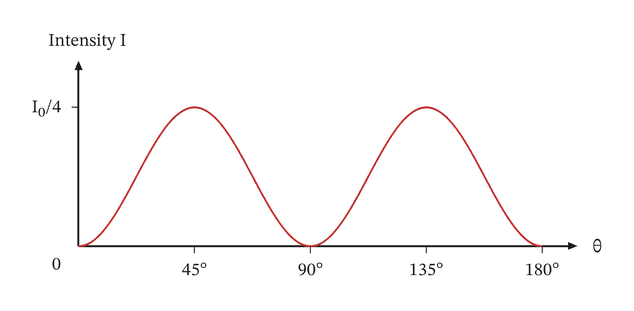
Therefore, the transmitted intensity is : zero when the middle sheet is parallel to either crossed polaroid and a maximum, , at (and every after that).
- 412 marks
Question 41
When an unpolarised light is incident on a plane glass plate at polarising angle show that the reflected and refracted rays are perpendicular to each other.
Solve with AIWritten solution
Solution:
Concept: Snell's law, , holds for every ray; Brewster's law, , holds at the polarising angle.
Step 1 — Draw the rays. The ray meets the glass at the polarising angle ; it is reflected at and refracted at .
Step 2 — Combine the two laws. Let the ray fall on the surface at the polarising angle and be refracted at the angle . Snell's law gives:
Brewster's law gives:
Equating the two expressions for gives:
Cancelling (it is not zero) leaves:
Since , this means:
The angle of reflection equals . The reflected ray makes with the surface above it and the refracted ray makes with the surface below it, so the angle between them is:
Therefore, at the polarising angle , so the reflected and refracted rays are perpendicular to each other.
- 422 marks
Question 42
A beam of unpolarised light is made to fall from air on its boundary with another transparent medium of refractive index . The reflected light is viewed through a rotating analyser. Show, on a graph, the variation in intensity of light transmitted through the analyser with the angle between the pass axis of the analyser and the direction of the reflected beam.
Solve with AIWritten solution
Solution:
Concept: Light falling at the polarising angle is completely plane polarised on reflection. For completely plane polarised light, an analyser obeys Malus' law, .
Step 1 — Read the question. The pass axis of an analyser always lies at right angles to the beam, so the angle meant is the angle between the pass axis and the direction of vibration of the reflected light. We take the light to fall at the polarising angle, so the reflected beam is completely plane polarised; let its intensity be .
Step 2 — Apply Malus' law. The transmitted intensity is:
Step 3 — Find the key points. The intensity is a maximum, , where is 1, at , and .
It is zero where is 0, at and . Between these the intensity changes smoothly as .
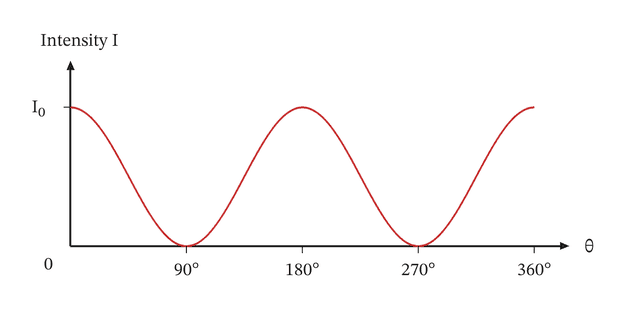
Note: At any other angle of incidence the reflected light is only partly polarised; the graph then has the same shape but its minima are not zero.
Therefore, the graph of against is a curve: maximum at , and , and zero at and .
- 432 marks
Question 43
Mention the uses of polarised light.
Solve with AIWritten solution
Solution:
Concept: Polarised light can be produced, blocked or turned in a controlled way, so it is used to reduce glare, to show images and to study materials.
Step 1 — Uses that cut unwanted light. Light that is mostly polarised one way can be removed by a polaroid crossed with it:
(i) Polaroid sunglasses and camera filters cut the polarised glare reflected from roads and water; a camera filter also darkens the blue sky, whose scattered light is partly polarised.
Step 2 — Uses in displays and films. Polarised light decides which light, or which picture, reaches the eye:
(ii) Liquid crystal displays in watches, calculators and computer screens use polarised light to make the digits and pictures visible.
(iii) 3-D films use two differently polarised pictures, one for each eye.
Step 3 — Uses in studying materials. Many materials change the polarisation of light passing through them, and this shows up between crossed polaroids:
(iv) Stress analysis (photoelasticity): a transparent model placed between crossed polaroids shows the pattern of stress in an engineering structure.
(v) Polarised light in microscopes shows up crystals and fibres in rocks and living tissue.
Therefore, polarised light is used in sunglasses and camera filters, LCDs, stress analysis, 3-D films and polarising microscopes.
- 443 marks
Question 44
State Brewster's law of polarisation and draw a ray diagram to illustrate it.
Solve with AIWritten solution
Solution:
Concept: Light reflected from a transparent surface is completely plane polarised at one angle of incidence, the polarising angle.
Step 1 — Statement. Brewster's law: the tangent of the polarising angle for a transparent medium is numerically equal to the refractive index of the medium:
Step 2 — Ray diagram. Unpolarised light (arrows and dots) falls on glass at the polarising angle . The reflected ray carries only dots: it is completely plane polarised, with vibrations perpendicular to the plane of incidence. The refracted ray, at the angle , is partially polarised.
Step 3 — Feature of the diagram. At the polarising angle the reflected and refracted rays are at right angles. Snell's law, , and Brewster's law, , together give:
Therefore, Brewster's law is ; at this angle the reflected light is completely plane polarised and the reflected and refracted rays are perpendicular, as the diagram shows.
- 453 marks
Question 45
What is meant by polarising angle? Show that when a ray of light is incident on a transparent surface at the polarising angle, the reflected and the refracted rays are at right angles to each other.
Solve with AIWritten solution
Solution:
Concept: Snell's law, , holds for every ray; Brewster's law, , holds at the polarising angle.
Step 1 — Polarising angle. The polarising angle is the angle of incidence at which the light reflected from a transparent surface is completely plane polarised (vibrations perpendicular to the plane of incidence).
Step 2 — Proof that the rays are perpendicular. Let the ray fall on the surface at the polarising angle and be refracted at the angle . Snell's law gives:
Brewster's law gives:
Equating the two expressions for gives:
Cancelling (it is not zero) leaves:
Since , this means:
The angle of reflection equals . The reflected ray makes with the surface above it and the refracted ray makes with the surface below it, so the angle between them is:
Therefore, the polarising angle is the angle of incidence giving completely polarised reflected light, and at this angle , so the reflected and refracted rays are at right angles.
- 463 marks
Question 46
What is meant by plane polarised light? Give a method for producing a beam of plane-polarised light. Show how you will detect the presence of plane polarised light.
- 473 marks
Question 47
How can a pile of glass plates be used to produce polarised light?
- 483 marks
Question 48
You are provided with a narrow and parallel beam of light. State how you will determine experimentally whether it is a beam of ordinary (unpolarised) light, partially polarised light or completely plane polarised light.
- 493 marks
Question 49
Describe briefly how a given beam of light can be analysed to determine whether it is linearly polarised or unpolarised?
- 505 marks
Question 50
(a) Describe an experiment to show that light waves are electromagnetic waves.
(b) How will you produce plane polarised light by (i) reflection and (ii) by scattering?
(c) What are the uses of polarised light?
- 515 marks
Question 51
(a) State and explain Malus law.
(b) What is dichroism? Explain the working of a polaroid. Mention the uses of polaroids.
- 523 marks
Question 52
When a ray of light from air is incident on the surface of glass with angle of incidence equal to the angle of polarisation it suffers a deviation of on entering glass. Calculate the angle of polarisation.
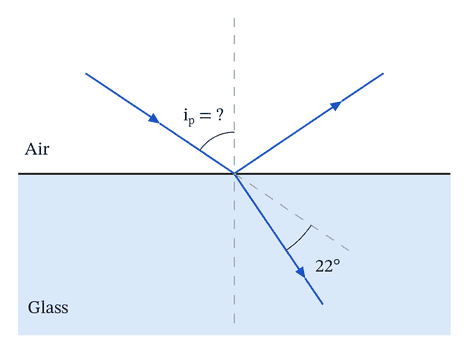
- 533 marks
Question 53
Calculate the polarising angle for a ray travelling from air to perspex. Given, refractive index .
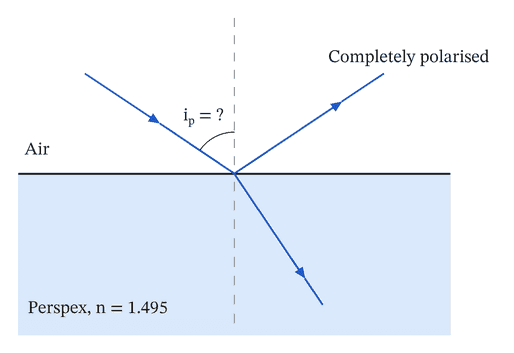
- 543 marks
Question 54
A particular transparent medium is surrounded by air. Show that the critical angle for total internal reflection and the polarising angle are related by .
- 553 marks
Question 55
The sunlight reflected from the surface of water in a pond is completely polarised. If the refractive index of water is 1.33, find the angle between the Sun and the horizon.
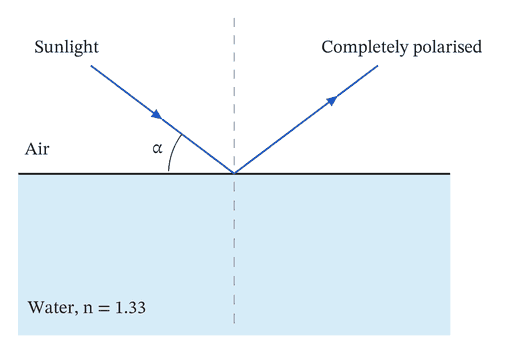
- 563 marks
Question 56
When a beam of light of wavelength 5893 Å is incident on the surface of a liquid at grazing angle , the reflected light is completely plane polarised. Calculate the wavelength of the refracted ray.
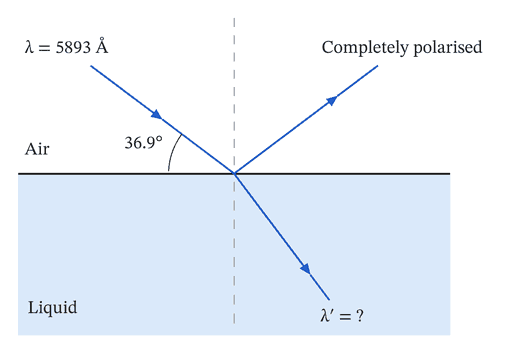
- 573 marks
Question 57
A beam of unpolarised light is passed through 8 polaroids, which are arranged in succession, coaxially such that each polaroid is turned through with respect to the preceding one. What fraction of the incident intensity passes through the system?

- 583 marks
Question 58
Green light is incident at the polarising angle on a certain glass plate. The angle of refraction is . What are (i) the polarising angle and (ii) the index of refraction of glass?
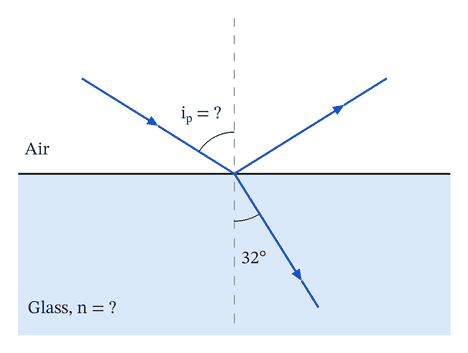
- 593 marks
Question 59
If the polarising angle for air-glass interface is , what will be the angle of refraction in glass?

- 603 marks
Question 60
A certain monochromatic light traveling in air is incident on a glass plate at the polarising angle. Angle of refraction in glass is found to be . Calculate (i) the polarising angle (ii) refractive index of glass.
- 613 marks
Question 61
A ray of ordinary light is travelling in air. It is incident on air glass pair at the polarising angle of . Find the angle of refraction in glass.
- 623 marks
Question 62
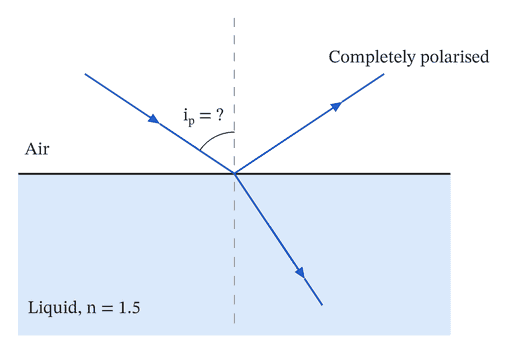
Find the Brewster angle for a transparent liquid having refractive index 1.5.
What Class 12 Physics Ch 22 covers
The sections of the chapter, in the order the book takes them. Every question above comes from one of these.
- 01Transverse Nature of Light and Polarisation
- 02Unpolarised and Plane Polarised Light
- 03Polarisation by Reflection - Brewster's Law
- 04Polarisation by Scattering
- 05Malus' Law
- 06Polaroids and Their Uses
More ways to study this chapter
The same chapter asked three other ways. Practise it, revise it, and see what the board has set on Ch 22 before.
- Competency-Based Questions (CBQ)Case study questions: a situation, and the part of the chapter that answers it.40questionsOpen
- Previous Year QuestionsQuestions that have actually appeared in board papers, each tagged with its year.6questionsOpen
- Practice QuestionsExtra questions per chapter, for when one attempt at a method is not enough.96questionsOpen
Ch 22 in past ISC papers
The same chapter as the board has actually asked it. These are worded differently from the textbook exercise, which is the point of reading them.
- 11 mark
Board paper question 1
State any two methods by which ordinary light can be polarised.
Solve with AIWritten solution
Solution:
Key idea: Ordinary light is unpolarised: its electric vector vibrates in all directions perpendicular to the direction of travel. A method of polarising it must remove (or separate out) all but one direction of vibration.
Step 1 — Give the first method.
Polarisation by reflection: when unpolarised light falls on a transparent surface such as glass at the polarising (Brewster) angle, given by , the reflected light is completely plane polarised.
Step 2 — Give the second method.
Polarisation by a polaroid (selective absorption): a polaroid sheet lets through only the vibrations parallel to its transmission axis, so the light coming out is plane polarised.
Other methods are polarisation by scattering (light scattered at by small particles or air molecules) and by double refraction in crystals such as calcite (Nicol prism).
Therefore, two methods are (1) reflection at the polarising (Brewster) angle and (2) passing the light through a polaroid; scattering and double refraction are other methods.
- 21 mark
Board paper question 2
What is the difference between polarised light and unpolarised light?
Solve with AIWritten solution
Solution:
Key idea: Light is a transverse wave, and the direction in which its electric vector vibrates (always perpendicular to the direction of travel) decides whether it is polarised.
Step 1 — Describe unpolarised light.
In unpolarised (ordinary) light the electric vector vibrates in all possible directions in the plane perpendicular to the direction of propagation, changing at random.
Step 2 — Describe polarised light.
In plane polarised light the electric vector vibrates in only one fixed direction, perpendicular to the direction of propagation, so all its vibrations lie in a single plane.
Therefore, in unpolarised light the electric vector vibrates in all directions perpendicular to the direction of travel, whereas in plane polarised light it vibrates in one direction only.
- 31 mark
Board paper question 3
A ray of ordinary light is travelling in air. It is incident on air glass pair at a polarising angle of . Find the angle of refraction in glass.
Solve with AIWritten solution
Solution:
Key idea: When light falls on a surface at the polarising (Brewster) angle , the reflected and refracted rays are perpendicular to each other, so , where is the angle of refraction.
Step 1 — State the condition at the polarising angle.
At the polarising angle the reflected ray and the refracted ray make with each other. This is equivalent to Brewster's law, , together with Snell's law.
Step 2 — Find the angle of refraction.
We subtract the polarising angle from .
As a check, , and Snell's law gives the same angle of .
Therefore, the angle of refraction in glass is 34°.
- 41 mark
Board paper question 4
Ordinary (i.e. unpolarised) light is incident on the surface of a transparent material at the polarising angle. If it is partly reflected and partly refracted, what is the angle between the reflected and the refracted rays?
Solve with AIWritten solution
Solution:
Key idea: Brewster's law says that light incident at the polarising angle on a material of refractive index satisfies ; at this angle the reflected and refracted rays are perpendicular.
Step 1 — Combine Brewster's law with Snell's law.
Snell's law gives , and Brewster's law gives . Comparing the two, .
Step 2 — Find the angle between the rays.
The reflected ray makes an angle with the normal on one side and the refracted ray makes an angle with the normal on the other side, so the angle between them is .
Therefore, the reflected and refracted rays are at 90° to each other.
- 51 mark
Board paper question 5
A beam of light is incident at the polarizing angle of on a certain glass plate. The refractive index of the glass plate is
Solve with AIAnswer
(A)
- Correct
(B)
(C)
(D)
Answer: (B)
Key idea: Brewster's law: when light is incident at the polarising angle , the refractive index of the reflecting material is .
Step 1 — Apply Brewster's law.
The polarising angle is given as , so we put into the law.
Step 2 — Note the value.
This is about , which is less than 1. A real glass plate in air (index about 1.5) has a polarising angle of about , so the numbers in the question are not realistic. The question simply tests the law , and option (B) is the answer it expects. If the were measured for light meeting the glass–air surface from inside the glass, the glass's index would be ; the question does not say this, so we keep the direct reading.
Why the others are wrong:
- (A) uses the sine of the incidence angle alone; Brewster's law involves the tangent of the polarising angle.
- (C) is the sine of the angle of refraction (at the polarising angle the refraction angle is , because the incidence and refraction angles add up to ); the index is , not alone.
- (D) equals ; it would give the index only if the light met the surface from inside the glass, which the question does not state.
Therefore, by Brewster's law the refractive index is tan 35°, option (B).
- 65 marks
Board paper question 6
(i) Draw a labelled graph of intensity of diffracted light (I) versus angle () in the Frannhofer diffraction experiment for a single slit diffraction.
(ii) State the law of Malus.
(iii) How will you distinguish experimentally between ordinary light and plane polarized light?
Solve with AIWritten solution
Solution:
Key idea: In single-slit Fraunhofer diffraction, the intensity is greatest at the centre and falls to zero wherever ( is the slit width, the wavelength, a non-zero whole number). Malus' law gives the intensity of polarised light passing through an analyser. Only plane polarised light changes in intensity when an analyser is turned.
Step 1 — Part (i): choose the axes.
The paper prints "Frannhofer"; it means Fraunhofer diffraction. We plot the intensity of the diffracted light on the vertical axis against the angle of diffraction on the horizontal axis, with at the centre.
Step 2 — Part (i): draw the graph.
The central maximum, at , is the brightest.
The intensity falls to zero at the first minima, where .
It then rises to weak secondary maxima, which lie between further zeros at
The central maximum is twice as wide as each secondary maximum, and the first secondary maxima have only about of the central intensity (often rounded to about , the value found by placing each secondary maximum midway between its two zeros).
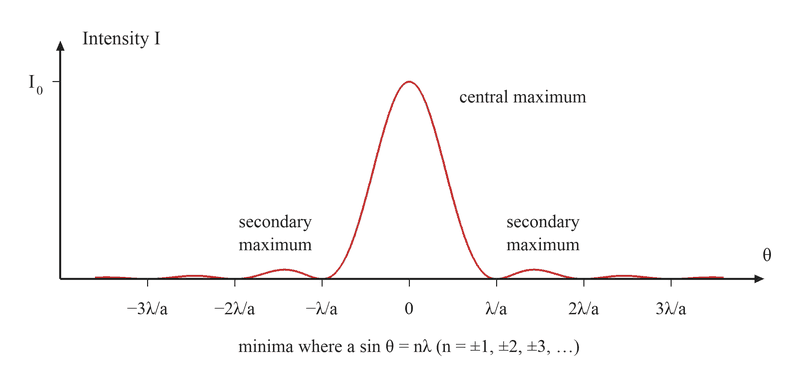
For small angles , so the ticks on the angle axis are marked .
Step 3 — Part (ii): state the law of Malus.
When completely plane polarised light of intensity falls on an analyser, the intensity of the light transmitted is proportional to the square of the cosine of the angle between the transmission axes of the polariser and the analyser.
Step 4 — Part (iii): set up the test.
We place a polaroid (or a Nicol prism) as an analyser in the path of the beam, look at the light coming through it, and slowly rotate the polaroid through one full turn about the direction of the beam.
Step 5 — Part (iii): read the result.
With ordinary (unpolarised) light, the transmitted intensity stays the same at every position of the polaroid (it is half the incident intensity), because the incident vibrations are spread equally in all directions. With plane polarised light, the transmitted intensity changes with the angle as : it is a maximum twice and falls to zero twice in one full rotation (zero when the polaroid's axis is perpendicular to the direction of vibration).
Therefore, (i) the graph has a tall central maximum at θ = 0, zeros at θ ≈ ±λ/a, ±2λ/a, ±3λ/a and weak secondary maxima; (ii) Malus' law: I = I₀ cos²θ, where θ is the angle between the transmission axes of the polariser and the analyser; (iii) view the light through a polaroid and rotate it: the intensity stays constant for ordinary light, but varies and drops to zero twice per rotation for plane polarised light.
Class 12 Physics Ch 22 questions students ask
How many questions are there in Class 12 Physics Ch 22?
62 questions. Every one is solved step by step on this page.
Are these Class 12 Physics solutions free?
Yes. Every question and its full working is free to read, with no account needed.
Can I download the Class 12 Physics Ch 22 solutions as a PDF?
There is no PDF to download. Every solution is on this page instead, which means it is searchable, always the current syllabus, and readable on a phone. Use your browser's print option if you want it on paper.