
Question 342 marksMedium
Explain how plane polarised light is produced using pile of plates.
Confirming your payment
Sign up now and get 250 free tokens.
Polarisation of Light · Question 34 of 62
Explain how plane polarised light is produced using pile of plates.
Solution:
Concept: At the polarising angle, a glass surface reflects part of the vibrations perpendicular to the plane of incidence and none of the vibrations in that plane.
Step 1 — Construction. A pile of plates is a number of thin glass plates (such as microscope cover slips) placed one on another in a tube, inclined so that the light falls on them at the polarising angle (about to for glass).
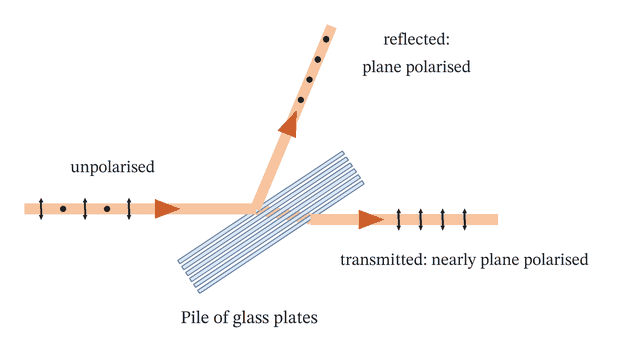
Step 2 — Action at each surface. At every surface the vibrations in the plane of incidence are fully transmitted, while a part of the vibrations perpendicular to the plane of incidence is reflected. The reflected light at each surface is completely plane polarised.
Step 3 — Effect of many plates. After passing many surfaces, almost all the perpendicular vibrations have been reflected away. The transmitted beam then carries almost only the vibrations in the plane of incidence, so it is (nearly) plane polarised, at right angles to the reflected light.
Therefore, a pile of plates at the polarising angle gives plane polarised reflected light and, with enough plates, nearly plane polarised transmitted light vibrating in the plane of incidence.