
Question 332 marksMedium
Using a diagram explain how polarised light is produced by scattering.
Confirming your payment
Sign up now and get 250 free tokens.
Polarisation of Light · Question 33 of 62
Using a diagram explain how polarised light is produced by scattering.
Solution:
Concept: When light falls on an air molecule, its electric field makes the electrons of the molecule vibrate along the field, and the vibrating charges send out (scatter) light. A vibrating charge sends no light along its own line of vibration.
Step 1 — The arrangement. Unpolarised sunlight travels horizontally and falls on an air molecule M. An observer looks at the scattered light at right angles to the sunlight, from below M.
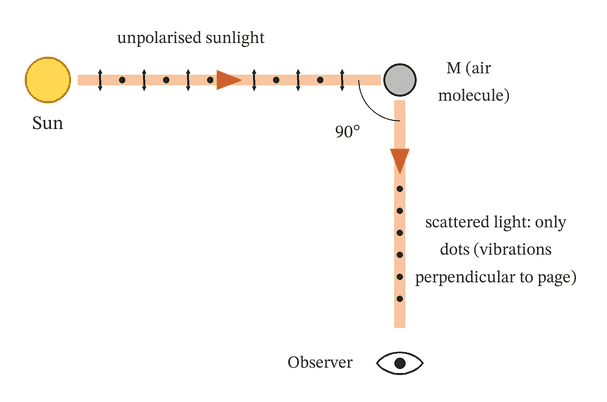
Step 2 — Vibrations in the plane of the page. The incident light has vibrations in the page (up and down, shown by arrows) and perpendicular to the page (dots). The up-and-down vibrations of M lie along the line to the observer, so they send no light towards the observer.
Step 3 — Vibrations perpendicular to the page. The vibrations of M perpendicular to the page are at right angles to the line of sight, so they do send light to the observer.
Step 4 — Conclusion. The light reaching the observer therefore vibrates only perpendicular to the page: it is plane polarised. This is why light from the blue sky, seen at to the sun, shows a change in brightness when viewed through a rotating polaroid.
Therefore, light scattered at to the incident beam is plane polarised, with its vibrations perpendicular to the plane containing the incident and scattered rays.