
Question 322 marksEasy
A light ray strikes the surface of transparent material such that the reflected light and refracted rays are mutually perpendicular. What is the nature of (i) the reflected light and
(ii) the refracted light?
Confirming your payment
Sign up now and get 250 free tokens.
Polarisation of Light · Question 32 of 62
A light ray strikes the surface of transparent material such that the reflected light and refracted rays are mutually perpendicular. What is the nature of (i) the reflected light and
(ii) the refracted light?
Solution:
Concept: Brewster's law says that light reflected from a transparent surface is completely plane polarised when the angle of incidence (the polarising angle) satisfies the relation below.
Here is the refractive index of the reflecting medium with respect to the medium the light comes from. At this angle the reflected and refracted rays are at right angles, so .
Step 1 — Recognise the angle. The reflected and refracted rays are at right angles only when the light falls at the polarising angle, so the angle of incidence here is .
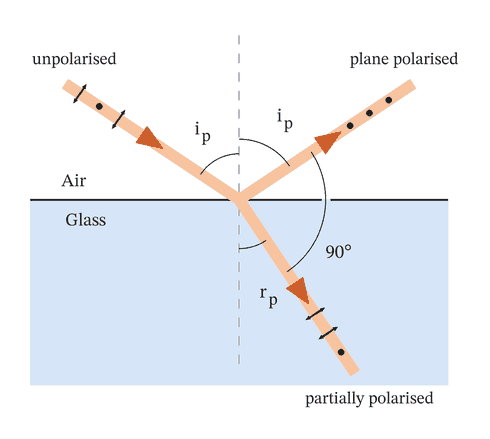
Step 2 — Part (i): the reflected light. At the polarising angle the reflected light is completely plane polarised, with its vibrations perpendicular to the plane of incidence (shown by dots in the figure).
Step 3 — Part (ii): the refracted light. The refracted light carries all the vibrations in the plane of incidence and most of the perpendicular ones (only a small part of these is reflected). So it is partially polarised, with more vibrations in the plane of incidence.
Note: The book's answer calls the refracted light unpolarised; it is in fact partially polarised, as the chapter itself says when it explains the pile of plates.
Therefore, (i) the reflected light is completely plane polarised and (ii) the refracted light is partially polarised.