
Question 412 marksMedium
When an unpolarised light is incident on a plane glass plate at polarising angle show that the reflected and refracted rays are perpendicular to each other.
Confirming your payment
Sign up now and get 250 free tokens.
Polarisation of Light · Question 41 of 62
When an unpolarised light is incident on a plane glass plate at polarising angle show that the reflected and refracted rays are perpendicular to each other.
Solution:
Concept: Snell's law, , holds for every ray; Brewster's law, , holds at the polarising angle.
Step 1 — Draw the rays. The ray meets the glass at the polarising angle ; it is reflected at and refracted at .
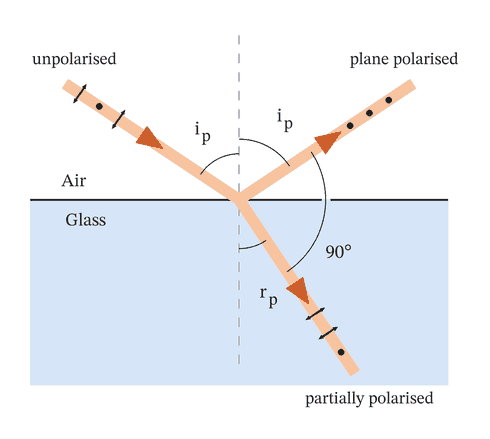
Step 2 — Combine the two laws. Let the ray fall on the surface at the polarising angle and be refracted at the angle . Snell's law gives:
Brewster's law gives:
Equating the two expressions for gives:
Cancelling (it is not zero) leaves:
Since , this means:
The angle of reflection equals . The reflected ray makes with the surface above it and the refracted ray makes with the surface below it, so the angle between them is:
Therefore, at the polarising angle , so the reflected and refracted rays are perpendicular to each other.