Solution:
Concept: Light falling at the polarising angle ip=tan−1μ is completely plane polarised on reflection. For completely plane polarised light, an analyser obeys Malus' law, I=I0cos2θ.
Step 1 — Read the question. The pass axis of an analyser always lies at right angles to the beam, so the angle meant is the angle θ between the pass axis and the direction of vibration of the reflected light. We take the light to fall at the polarising angle, so the reflected beam is completely plane polarised; let its intensity be I0.
Step 2 — Apply Malus' law. The transmitted intensity is:
I=I0cos2θ
Step 3 — Find the key points. The intensity is a maximum, I0, where cos2θ is 1, at θ=0∘, 180∘ and 360∘.
It is zero where cosθ is 0, at θ=90∘ and 270∘. Between these the intensity changes smoothly as cos2θ.
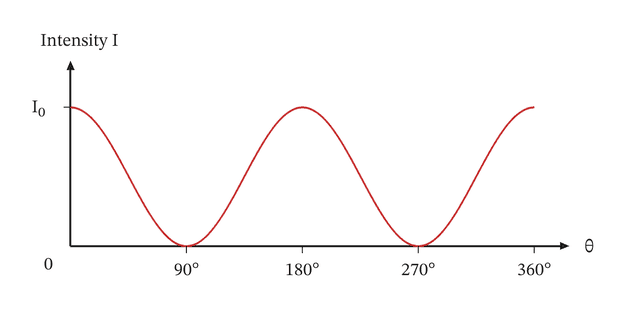
Note: At any other angle of incidence the reflected light is only partly polarised; the graph then has the same shape but its minima are not zero.
Therefore, the graph of I against θ is a cos2θ curve: maximum I0 at 0∘, 180∘ and 360∘, and zero at 90∘ and 270∘.
