Solution:
Key idea: In single-slit Fraunhofer diffraction, the intensity is greatest at the centre and falls to zero wherever asinθ=nλ (a is the slit width, λ the wavelength, n a non-zero whole number). Malus' law gives the intensity of polarised light passing through an analyser. Only plane polarised light changes in intensity when an analyser is turned.
Step 1 — Part (i): choose the axes.
The paper prints "Frannhofer"; it means Fraunhofer diffraction. We plot the intensity I of the diffracted light on the vertical axis against the angle of diffraction θ on the horizontal axis, with θ=0 at the centre.
Step 2 — Part (i): draw the graph.
The central maximum, at θ=0, is the brightest.
The intensity falls to zero at the first minima, where asinθ=±λ.
It then rises to weak secondary maxima, which lie between further zeros at asinθ=±2λ,±3λ,…
The central maximum is twice as wide as each secondary maximum, and the first secondary maxima have only about 4.7% of the central intensity (often rounded to about 4.5%, the value found by placing each secondary maximum midway between its two zeros).
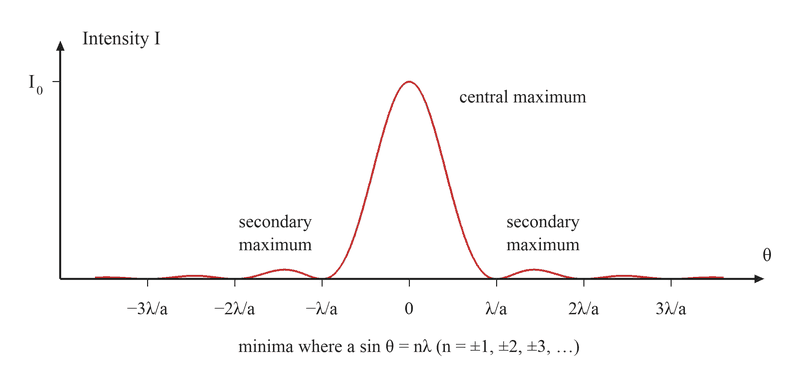
For small angles sinθ≈θ, so the ticks on the angle axis are marked aλ,a2λ,a3λ.
Step 3 — Part (ii): state the law of Malus.
When completely plane polarised light of intensity I0 falls on an analyser, the intensity I of the light transmitted is proportional to the square of the cosine of the angle θ between the transmission axes of the polariser and the analyser.
I=I0cos2θ
Step 4 — Part (iii): set up the test.
We place a polaroid (or a Nicol prism) as an analyser in the path of the beam, look at the light coming through it, and slowly rotate the polaroid through one full turn about the direction of the beam.
Step 5 — Part (iii): read the result.
With ordinary (unpolarised) light, the transmitted intensity stays the same at every position of the polaroid (it is half the incident intensity), because the incident vibrations are spread equally in all directions. With plane polarised light, the transmitted intensity changes with the angle as I0cos2θ: it is a maximum twice and falls to zero twice in one full rotation (zero when the polaroid's axis is perpendicular to the direction of vibration).
Therefore, (i) the graph has a tall central maximum at θ = 0, zeros at θ ≈ ±λ/a, ±2λ/a, ±3λ/a and weak secondary maxima; (ii) Malus' law: I = I₀ cos²θ, where θ is the angle between the transmission axes of the polariser and the analyser; (iii) view the light through a polaroid and rotate it: the intensity stays constant for ordinary light, but varies and drops to zero twice per rotation for plane polarised light.
