
Opening your dashboard
Class 12 Physics Chapter 22 Polarisation of Light: Previous Year Questions
6 questions on Chapter 22, each solved step by step. Class 12 Physics, ICSE 2026-27.
6 questions with solutions
1–5 marks · Mixed difficulty
- 11 mark
Question 1
State any two methods by which ordinary light can be polarised.
Solve with AIWritten solution
Solution:
Key idea: Ordinary light is unpolarised: its electric vector vibrates in all directions perpendicular to the direction of travel. A method of polarising it must remove (or separate out) all but one direction of vibration.
Step 1 — Give the first method.
Polarisation by reflection: when unpolarised light falls on a transparent surface such as glass at the polarising (Brewster) angle, given by , the reflected light is completely plane polarised.
Step 2 — Give the second method.
Polarisation by a polaroid (selective absorption): a polaroid sheet lets through only the vibrations parallel to its transmission axis, so the light coming out is plane polarised.
Other methods are polarisation by scattering (light scattered at by small particles or air molecules) and by double refraction in crystals such as calcite (Nicol prism).
Therefore, two methods are (1) reflection at the polarising (Brewster) angle and (2) passing the light through a polaroid; scattering and double refraction are other methods.
- 21 mark
Question 2
What is the difference between polarised light and unpolarised light?
Solve with AIWritten solution
Solution:
Key idea: Light is a transverse wave, and the direction in which its electric vector vibrates (always perpendicular to the direction of travel) decides whether it is polarised.
Step 1 — Describe unpolarised light.
In unpolarised (ordinary) light the electric vector vibrates in all possible directions in the plane perpendicular to the direction of propagation, changing at random.
Step 2 — Describe polarised light.
In plane polarised light the electric vector vibrates in only one fixed direction, perpendicular to the direction of propagation, so all its vibrations lie in a single plane.
Therefore, in unpolarised light the electric vector vibrates in all directions perpendicular to the direction of travel, whereas in plane polarised light it vibrates in one direction only.
- 31 mark
Question 3
A ray of ordinary light is travelling in air. It is incident on air glass pair at a polarising angle of . Find the angle of refraction in glass.
Solve with AIWritten solution
Solution:
Key idea: When light falls on a surface at the polarising (Brewster) angle , the reflected and refracted rays are perpendicular to each other, so , where is the angle of refraction.
Step 1 — State the condition at the polarising angle.
At the polarising angle the reflected ray and the refracted ray make with each other. This is equivalent to Brewster's law, , together with Snell's law.
Step 2 — Find the angle of refraction.
We subtract the polarising angle from .
As a check, , and Snell's law gives the same angle of .
Therefore, the angle of refraction in glass is 34°.
- 41 mark
Question 4
Ordinary (i.e. unpolarised) light is incident on the surface of a transparent material at the polarising angle. If it is partly reflected and partly refracted, what is the angle between the reflected and the refracted rays?
Solve with AIWritten solution
Solution:
Key idea: Brewster's law says that light incident at the polarising angle on a material of refractive index satisfies ; at this angle the reflected and refracted rays are perpendicular.
Step 1 — Combine Brewster's law with Snell's law.
Snell's law gives , and Brewster's law gives . Comparing the two, .
Step 2 — Find the angle between the rays.
The reflected ray makes an angle with the normal on one side and the refracted ray makes an angle with the normal on the other side, so the angle between them is .
Therefore, the reflected and refracted rays are at 90° to each other.
- 51 mark
Question 5
A beam of light is incident at the polarizing angle of on a certain glass plate. The refractive index of the glass plate is
Solve with AIAnswer
(A)
- Correct
(B)
(C)
(D)
Answer: (B)
Key idea: Brewster's law: when light is incident at the polarising angle , the refractive index of the reflecting material is .
Step 1 — Apply Brewster's law.
The polarising angle is given as , so we put into the law.
Step 2 — Note the value.
This is about , which is less than 1. A real glass plate in air (index about 1.5) has a polarising angle of about , so the numbers in the question are not realistic. The question simply tests the law , and option (B) is the answer it expects. If the were measured for light meeting the glass–air surface from inside the glass, the glass's index would be ; the question does not say this, so we keep the direct reading.
Why the others are wrong:
- (A) uses the sine of the incidence angle alone; Brewster's law involves the tangent of the polarising angle.
- (C) is the sine of the angle of refraction (at the polarising angle the refraction angle is , because the incidence and refraction angles add up to ); the index is , not alone.
- (D) equals ; it would give the index only if the light met the surface from inside the glass, which the question does not state.
Therefore, by Brewster's law the refractive index is tan 35°, option (B).
- 65 marks
Question 6
(i) Draw a labelled graph of intensity of diffracted light (I) versus angle () in the Frannhofer diffraction experiment for a single slit diffraction.
(ii) State the law of Malus.
(iii) How will you distinguish experimentally between ordinary light and plane polarized light?
Solve with AIWritten solution
Solution:
Key idea: In single-slit Fraunhofer diffraction, the intensity is greatest at the centre and falls to zero wherever ( is the slit width, the wavelength, a non-zero whole number). Malus' law gives the intensity of polarised light passing through an analyser. Only plane polarised light changes in intensity when an analyser is turned.
Step 1 — Part (i): choose the axes.
The paper prints "Frannhofer"; it means Fraunhofer diffraction. We plot the intensity of the diffracted light on the vertical axis against the angle of diffraction on the horizontal axis, with at the centre.
Step 2 — Part (i): draw the graph.
The central maximum, at , is the brightest.
The intensity falls to zero at the first minima, where .
It then rises to weak secondary maxima, which lie between further zeros at
The central maximum is twice as wide as each secondary maximum, and the first secondary maxima have only about of the central intensity (often rounded to about , the value found by placing each secondary maximum midway between its two zeros).
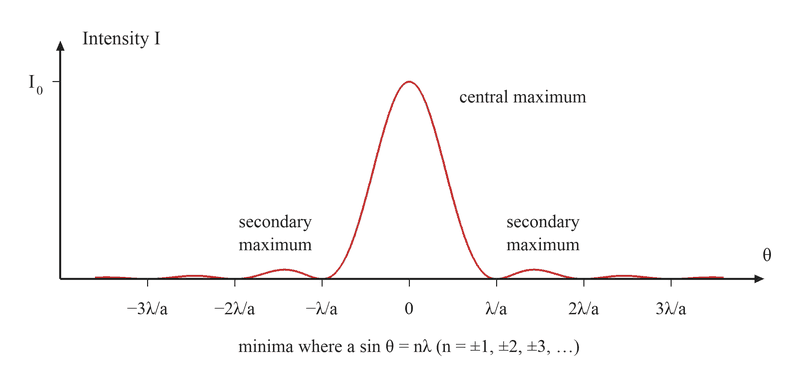
For small angles , so the ticks on the angle axis are marked .
Step 3 — Part (ii): state the law of Malus.
When completely plane polarised light of intensity falls on an analyser, the intensity of the light transmitted is proportional to the square of the cosine of the angle between the transmission axes of the polariser and the analyser.
Step 4 — Part (iii): set up the test.
We place a polaroid (or a Nicol prism) as an analyser in the path of the beam, look at the light coming through it, and slowly rotate the polaroid through one full turn about the direction of the beam.
Step 5 — Part (iii): read the result.
With ordinary (unpolarised) light, the transmitted intensity stays the same at every position of the polaroid (it is half the incident intensity), because the incident vibrations are spread equally in all directions. With plane polarised light, the transmitted intensity changes with the angle as : it is a maximum twice and falls to zero twice in one full rotation (zero when the polaroid's axis is perpendicular to the direction of vibration).
Therefore, (i) the graph has a tall central maximum at θ = 0, zeros at θ ≈ ±λ/a, ±2λ/a, ±3λ/a and weak secondary maxima; (ii) Malus' law: I = I₀ cos²θ, where θ is the angle between the transmission axes of the polariser and the analyser; (iii) view the light through a polaroid and rotate it: the intensity stays constant for ordinary light, but varies and drops to zero twice per rotation for plane polarised light.