
Question 473 marksMedium
How can a pile of glass plates be used to produce polarised light?
Confirming your payment
Sign up now and get 250 free tokens.
Polarisation of Light · Question 47 of 62
How can a pile of glass plates be used to produce polarised light?
Solution:
Concept: At the polarising angle a glass surface reflects only vibrations perpendicular to the plane of incidence (part of them) and transmits all the vibrations in that plane.
Step 1 — Construction. A pile of plates is a set of thin glass plates (such as microscope cover slips) stacked in a tube and inclined so that the beam falls on them at the polarising angle, about to for glass.
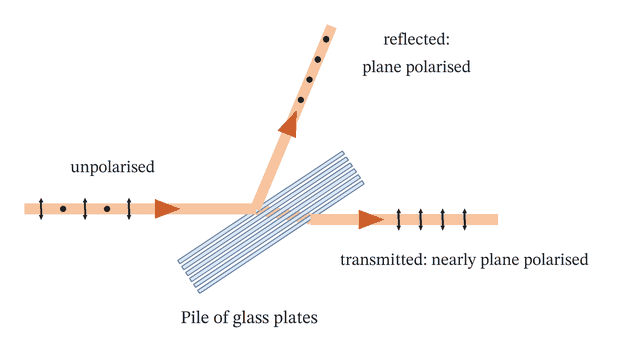
Step 2 — What happens at each surface. At every surface the vibrations in the plane of incidence pass through completely, while a fraction of the vibrations perpendicular to the plane of incidence is reflected. The reflected light is completely plane polarised (vibrations perpendicular to the plane of incidence).
Step 3 — Effect of many surfaces. As the beam crosses surface after surface, more and more of the perpendicular vibrations are removed by reflection. With a large number of plates the transmitted beam contains almost only vibrations in the plane of incidence, so it is (nearly) plane polarised.
Step 4 — Result. The pile thus gives two beams polarised at right angles to each other: the reflected beam (vibrations perpendicular to the plane of incidence) and the transmitted beam (vibrations in the plane of incidence).
Therefore, a pile of plates set at the polarising angle produces plane polarised light by reflection, and with many plates the transmitted light is also nearly plane polarised, in the perpendicular plane.