
Question 483 marksMedium
You are provided with a narrow and parallel beam of light. State how you will determine experimentally whether it is a beam of ordinary (unpolarised) light, partially polarised light or completely plane polarised light.
Confirming your payment
Sign up now and get 250 free tokens.
Polarisation of Light · Question 48 of 62
You are provided with a narrow and parallel beam of light. State how you will determine experimentally whether it is a beam of ordinary (unpolarised) light, partially polarised light or completely plane polarised light.
Solution:
Concept: A polaroid used as an analyser transmits only the component of vibration along its pass axis, so its rotation reveals how the vibrations in the beam are spread over directions.
Step 1 — The test. The beam is passed through a polaroid (analyser), and the polaroid is rotated about the beam as axis while the transmitted light is watched.
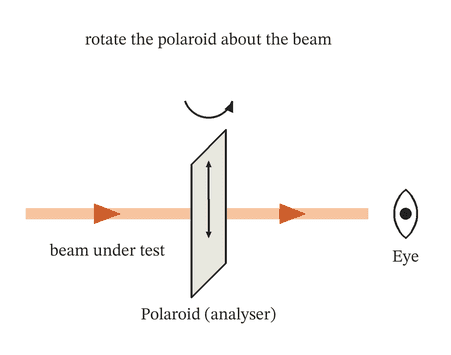
Step 2 — Unpolarised light. If the transmitted intensity does not change at all during the rotation, the vibrations are equal in all directions: the beam is ordinary (unpolarised) light.
Step 3 — Partially polarised light. If the intensity changes between a maximum and a minimum but never becomes zero, the beam is partially polarised.
Step 4 — Completely plane polarised light. If the intensity changes from a maximum to zero, twice in each full rotation, the beam is completely plane polarised.
Therefore, on rotating a polaroid in the beam: no change in intensity means unpolarised light, a change without a zero means partially polarised light, and a change down to zero means completely plane polarised light.