
Question 493 marksEasy
Describe briefly how a given beam of light can be analysed to determine whether it is linearly polarised or unpolarised?
Confirming your payment
Sign up now and get 250 free tokens.
Polarisation of Light · Question 49 of 62
Describe briefly how a given beam of light can be analysed to determine whether it is linearly polarised or unpolarised?
Solution:
Concept: By Malus' law, , an analyser passes all of linearly polarised light at and none at , while it passes half of unpolarised light in every position.
Step 1 — The test. The beam is viewed through a polaroid (analyser), which is rotated slowly about the beam.
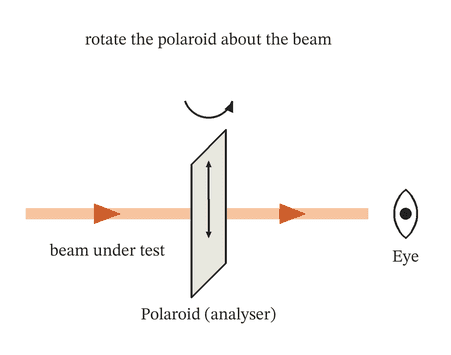
Step 2 — Linearly polarised light. The intensity of the transmitted light changes: it is a maximum when the pass axis is along the vibrations and zero when it is at right angles to them. In one full rotation it becomes zero twice.
Step 3 — Unpolarised light. The transmitted intensity stays the same (half of the incident intensity) for all positions of the analyser.
Therefore, if the intensity through a rotating analyser varies between a maximum and zero, the beam is linearly polarised; if it stays constant, the beam is unpolarised.