
Question 505 marksMedium
(a) Describe an experiment to show that light waves are electromagnetic waves.
(b) How will you produce plane polarised light by (i) reflection and (ii) by scattering?
(c) What are the uses of polarised light?
Confirming your payment
Sign up now and get 250 free tokens.
Polarisation of Light · Question 50 of 62
(a) Describe an experiment to show that light waves are electromagnetic waves.
(b) How will you produce plane polarised light by (i) reflection and (ii) by scattering?
(c) What are the uses of polarised light?
Solution:
Concept: In an electromagnetic wave the electric and magnetic vectors vibrate at right angles to the direction of travel, so the wave is transverse and can be polarised.
Step 1 — Part (a): the polariser–analyser experiment. Light from a lamp is passed through a polaroid P (polariser) and then through a second polaroid A (analyser).
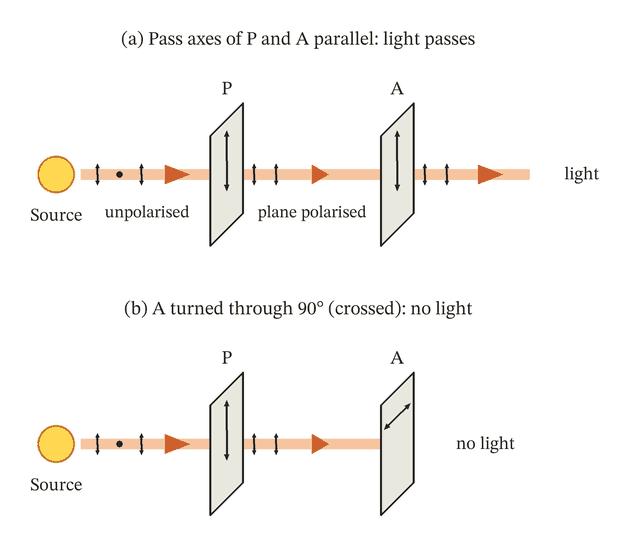
Step 2 — Part (a): observations. With A taken away, rotating P causes no change in the brightness of the light coming out of it. With A put back and P fixed, rotating A changes the brightness from a maximum (axes parallel) to zero (axes crossed) and back, twice in each full turn.
Step 3 — Part (a): conclusion. This shows that the light leaving P vibrates in one plane only, so light is a transverse wave, just as an electromagnetic wave must be. This agrees with Maxwell's result that electromagnetic waves travel with speed , which agrees with the measured speed of light.
Note: Polarisation by itself proves only that light is transverse; that light is electromagnetic follows from this together with the equality of its speed and .
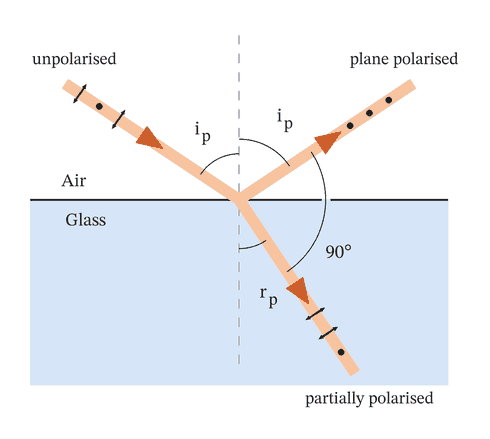
Step 4 — Part (b)(i): by reflection. Unpolarised light is made to fall on a glass plate at the polarising angle, (about to for glass). The reflected light is then completely plane polarised, with vibrations perpendicular to the plane of incidence, and the reflected and refracted rays are at right angles.
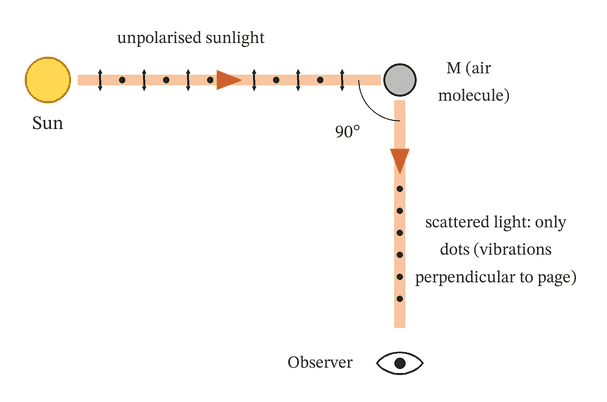
Step 5 — Part (b)(ii): by scattering. Unpolarised light (sunlight) falling on air molecules makes their electrons vibrate, and they scatter light. Light scattered at to the incident beam comes only from the vibrations perpendicular to the plane containing the incident and scattered rays, so it is plane polarised. Looking at the sky at right angles to the sun gives such light.
Step 6 — Part (c): uses of polarised light. Polarised light is used in:
(i) polaroid sunglasses and camera filters, to cut the glare reflected from water and roads (a camera filter also darkens the partly polarised blue sky);
(ii) liquid crystal displays of watches, calculators and screens;
(iii) stress analysis of models of engineering structures placed between crossed polaroids;
(iv) 3-D films, where each eye receives one of two differently polarised pictures;
(v) polarising microscopes, to study crystals, rocks and fibres.
Therefore, (a) the polariser–analyser experiment shows light is transverse, as electromagnetic waves are; (b) plane polarised light is produced (i) by reflection at the polarising angle and (ii) by scattering at ; (c) it is used in sunglasses, LCDs, stress analysis, 3-D films and microscopes.