
Question 515 marksMedium
(a) State and explain Malus law.
(b) What is dichroism? Explain the working of a polaroid. Mention the uses of polaroids.
Confirming your payment
Sign up now and get 250 free tokens.
Polarisation of Light · Question 51 of 62
(a) State and explain Malus law.
(b) What is dichroism? Explain the working of a polaroid. Mention the uses of polaroids.
Solution:
Concept: An analyser transmits only the component of the light's vibration along its pass axis; the intensity of light is proportional to the square of its amplitude.
Step 1 — Part (a): statement. Malus' law: when a completely plane polarised beam falls on an analyser, the intensity of the transmitted light varies as the square of the cosine of the angle between the plane of transmission of the analyser and the plane of the polariser.
Step 2 — Part (a): resolve the amplitude. Let OP be the direction of vibration of the polarised light, with amplitude , and OA the pass axis of the analyser, at an angle to OP. The amplitude splits into along OA and along OB, at right angles to OA.
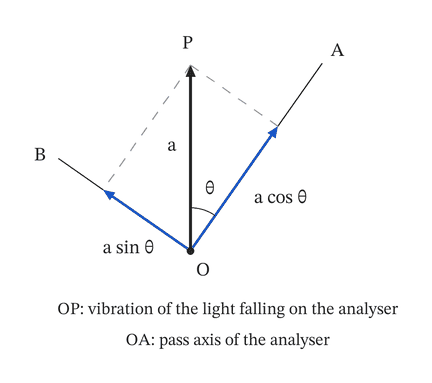
Step 3 — Part (a): transmitted intensity. The analyser passes the component along OA and stops the other. Since intensity is proportional to the square of the amplitude, we take the constant of proportionality as 1 and write the transmitted intensity as:
Here is the intensity of the light falling on the analyser.
Step 4 — Part (a): explanation. When the axes are parallel (), , a maximum. When they are crossed (), , so .
Step 5 — Part (b): dichroism. Some crystals, such as tourmaline, split light into two beams polarised at right angles and absorb one of them much more strongly than the other. This selective absorption of one of the two vibrations is called dichroism.
Step 6 — Part (b): working of a polaroid. A polaroid is a thin film in which a very large number of tiny dichroic crystals (or long, iodine-treated polymer molecules) are lined up in one direction, held between protective sheets. It absorbs the component of the electric vector in one direction and transmits the component along its pass axis, so unpolarised light coming out of it is plane polarised.
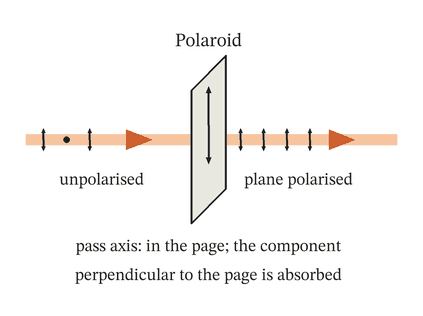
Step 7 — Part (b): uses of polaroids. Polaroids are used:
(i) Sunglasses: glare from water, wet roads and car bonnets is partly polarised with horizontal vibrations; polaroid sunglasses with a vertical pass axis cut most of it.
(ii) Liquid crystal displays (LCDs): watches, calculators and screens place the liquid crystal between two polarising sheets; each digit or pixel turns dark or bright as the crystal does or does not rotate the plane of polarisation.
(iii) Photographic filters: a polarising filter cuts glare reflected from water and roads, and darkens the blue sky, whose scattered light is partly polarised.
(iv) 3-D films: the two pictures are projected with different polarisations and the polaroid spectacles send one picture to each eye.
(v) Stress analysis: a model of a structure placed between crossed polaroids shows coloured fringes where it is strained.
(vi) Adjustable windows: two polaroids, one of them rotatable, can control the brightness of the light let in; such windows have been used in some trains and aircraft (many modern aircraft use electronically dimmed windows instead).
Therefore, (a) Malus' law is , because the analyser passes only the component of the amplitude; (b) dichroism is selective absorption of one of two perpendicular vibrations, a polaroid uses it to give plane polarised light, and polaroids are used in sunglasses, LCDs, camera filters, 3-D films, stress analysis and adjustable windows.