
Question 523 marksMedium
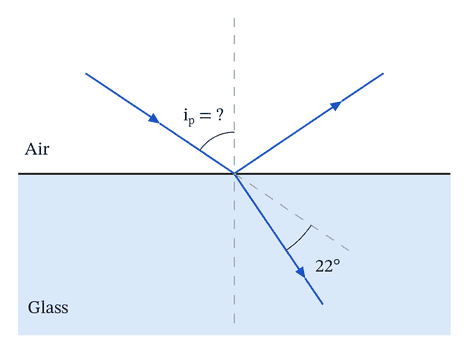
When a ray of light from air is incident on the surface of glass with angle of incidence equal to the angle of polarisation it suffers a deviation of on entering glass. Calculate the angle of polarisation.
Confirming your payment
Sign up now and get 250 free tokens.
Polarisation of Light · Question 52 of 62
When a ray of light from air is incident on the surface of glass with angle of incidence equal to the angle of polarisation it suffers a deviation of on entering glass. Calculate the angle of polarisation.
Solution:
Concept: Brewster's law: when unpolarised light falls on the surface of a transparent medium of refractive index at the polarising angle , the reflected light is completely plane polarised, and . At this angle the reflected and refracted rays are at right angles, so , where is the angle of refraction.
The deviation of the refracted ray from the original direction of the incident ray is .
Step 1 — Write the two equations. We call the angle of polarisation and the angle of refraction . The deviation gives:
At the polarising angle the reflected and refracted rays are perpendicular, so:
Step 2 — Add the two equations. Adding removes :
Step 3 — Find the angle of refraction as a check. We subtract from :
The deviation is then , as given.
Therefore, the angle of polarisation is .