
Question 563 marksMedium
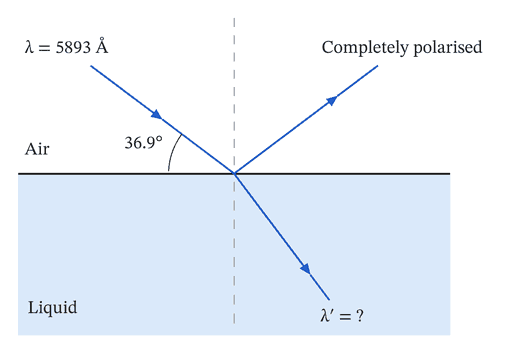
When a beam of light of wavelength 5893 Å is incident on the surface of a liquid at grazing angle , the reflected light is completely plane polarised. Calculate the wavelength of the refracted ray.
Confirming your payment
Sign up now and get 250 free tokens.
Polarisation of Light · Question 56 of 62
When a beam of light of wavelength 5893 Å is incident on the surface of a liquid at grazing angle , the reflected light is completely plane polarised. Calculate the wavelength of the refracted ray.
Solution:
Concept: Brewster's law: when unpolarised light falls on the surface of a transparent medium of refractive index at the polarising angle , the reflected light is completely plane polarised, and . At this angle the reflected and refracted rays are at right angles, so , where is the angle of refraction.
When light passes into a medium of refractive index , its frequency stays the same and its speed falls by the factor , so its wavelength becomes .
Step 1 — Find the angle of incidence. The grazing angle is measured from the surface, and the angle of incidence from the normal, so they add up to :
Step 2 — Find the refractive index. The reflected light is completely polarised, so Brewster's law applies. We keep five significant figures, so that rounding does not change the last digit of the answer:
Step 3 — Find the wavelength in the liquid. We divide the wavelength in air by :
Note: The printed answer m comes from rounding to 1.33 before dividing (). The two values differ in the third significant figure (4.42 and 4.43 × 10⁻⁷ m); with the angle given to three figures, both round to about 4.4 × 10³ Å.
Therefore, the wavelength of the refracted ray is about (4424.6 Å).