Opening your dashboard
Class 12 Physics Chapter 22 Polarisation of Light: Practice Questions
96 questions on Chapter 22, each worked through on its own page with the AI tutor. Class 12 Physics, ICSE 2026-27.
96 questions
1–4 marks · Mixed difficulty
- 11 mark
Question 1
A plane electromagnetic wave travels in vacuum. At a certain point and instant, its electric field points along the -direction and its magnetic field points along the -direction. The wave is travelling along the
- 23 marks
Question 2
(Hypothetical data.) The electric field of a light wave travelling in vacuum is given by
with .
(i) Find the wavelength and the frequency of the light, and check that it travels at .
(ii) Along which axis does the magnetic field of this wave vibrate?
(iii) Is this light polarised? If so, name its plane of vibration.
- 31 mark
Question 3
During an earthquake, two kinds of waves travel through the rock of the Earth. In P-waves the rock vibrates to and fro along the direction in which the wave travels; in S-waves it vibrates at right angles to that direction. Which of these waves can show polarisation?
- 42 marks
Question 4
A microwave transmitter sends out waves whose electric vector vibrates vertically. A grid of thin, parallel metal rods is placed in the beam between the transmitter and a receiver, with the rods vertical, as shown.
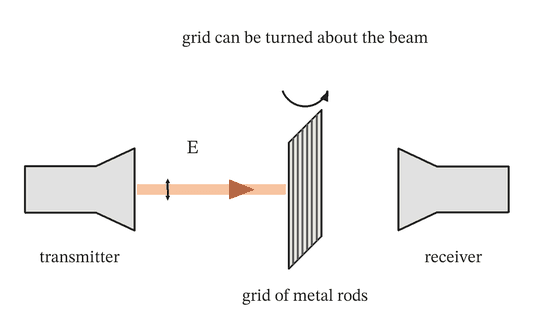
When the grid is turned slowly about the beam, the receiver's reading rises and falls twice in every full turn, from almost zero to a large value.
(i) What does this show about microwaves?
(ii) Is the reading largest or smallest when the rods are vertical? Give a reason.
- 51 mark
Question 5
(Hypothetical data.) At a point in the path of a plane electromagnetic wave in vacuum, the electric field reaches its greatest value, , at a certain instant. Take . At the same point and instant, the magnetic field is
- 61 mark
Question 6
Two friends talk over walkie-talkies on an open playground. Friend A holds set A with its straight rod antenna vertical, and the radio waves it sends out have their electric vector along the antenna. For the best reception, friend B should hold the rod antenna of set B
- 73 marks
Question 7
(Hypothetical data.) A plane electromagnetic wave travels in vacuum along the -direction. At a certain point and instant, its electric field is . Take .
(i) Find the magnitudes of and at that point and instant.
(ii) Using the fact that points along the direction of travel, find the direction of as a unit vector.
(iii) Show that and are at right angles.
- 83 marks
Question 8
(Hypothetical data.) A laser pointer gives a beam of power , spread evenly over a cross-section of . For a plane electromagnetic wave, the intensity (power per unit area) is , where is the amplitude of the electric field. Take and .
(i) Find the intensity of the beam.
(ii) Find and the amplitude of the magnetic field.
(iii) In which direction does the beam carry energy, compared with the directions of and ?
- 91 mark
Question 9
In the figure, a beam of light travelling in the plane of the page is drawn with dots only.
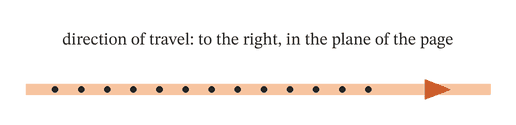
This beam represents
- 102 marks
Question 10
A beam of plane polarised light travels horizontally towards the east. Its electric vector vibrates vertically.
(i) Describe the plane of vibration of this beam.
(ii) Describe its plane of polarisation.
- 113 marks
Question 11
(Hypothetical data.) Two light waves of the same frequency travel together along the -direction. In one, the electric vector vibrates along the -axis with amplitude ; in the other, it vibrates along the -axis with amplitude .
(i) The two vibrations are always in phase. Show that the resultant light is plane polarised, and find the amplitude of its electric vector and the angle its vibration makes with the -axis.
(ii) What changes if the -vibration is always exactly half a period behind the -vibration?
- 123 marks
Question 12
(Hypothetical data.) In the simple model of unpolarised light used in this chapter, the electric vector keeps one direction for only about and then changes at random to another direction at right angles to the beam, every direction being equally likely. To simplify, suppose the electric vector (amplitude ) points in turn along directions making , , and with the -axis, spending equal times in each. The beam travels along the -axis.
(i) Find the average value of and of over these four directions.
(ii) Hence show that the two perpendicular components carry equal shares of the intensity. If the beam has an intensity of , what intensity is carried by the -component?
(iii) Why is this light not plane polarised at , even though its two components are equally strong?
- 131 mark
Question 13
A beam of plane polarised light, with its electric vector vertical, falls normally on a thin plate of ordinary, unstressed glass and passes through it. The light that comes out of the plate is
- 142 marks
Question 14
(Hypothetical data.) In the simple model of unpolarised light used in this chapter, the electric vector keeps one direction for only about . A lamp gives light of wavelength (in vacuum). Take .
(i) How many oscillations does the electric vector make while its direction stays fixed?
(ii) Over what length of the beam does the electric vector keep one direction?
- 151 mark
Question 15
Which of these gives out light that is already plane polarised as it leaves the source?
- 163 marks
Question 16
(Hypothetical data.) A lamp L is fixed at the top of a pole that stands at the edge O of a pond, above the still water surface. The pond is deep with a flat bottom, and the refractive index of water is 1.33. Light from the lamp is reflected at a point P on the water surface.

(i) How far from O must P be for the reflected light to be completely plane polarised?
(ii) Find the angle of refraction of the light that enters the water at P.
(iii) How far beyond P, measured horizontally, does this refracted light reach the bottom of the pond?
- 171 mark
Question 17
(Hypothetical data.) Unpolarised light falls on a flat glass plate (, polarising angle about ) at an angle of incidence of . At every angle of incidence between and , glass reflects the vibration perpendicular to the plane of incidence more strongly than the vibration in that plane. The reflected light is
- 183 marks
Question 18
In a gas laser the light travels to and fro along a tube whose ends are closed by thin, flat windows of fused silica (refractive index 1.46). Each window is tilted so that the light travelling along the tube meets it at the polarising angle, as shown.
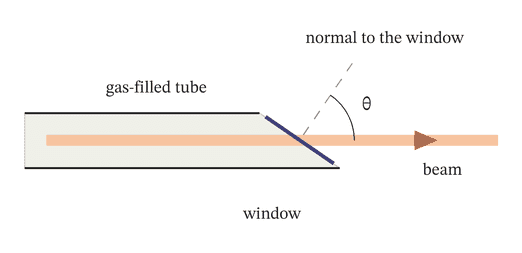
(i) Find the angle between the normal to the window and the axis of the tube.
(ii) Light vibrating in which direction passes through the window without any loss by reflection?
(iii) Explain why the light that comes out of such a laser is plane polarised.
- 193 marks
Question 19
(Hypothetical data.) A beam of unpolarised light falls on the upper face of a glass slab with parallel faces, at the polarising angle. The refractive index of the glass is 1.52.
(i) Find the angle of incidence and the angle of refraction at the upper face.
(ii) Show that the refracted light meets the lower face of the slab at the polarising angle for light going from glass into air.
(iii) What can you say about the light reflected at the lower face?
- 201 mark
Question 20
(Hypothetical data.) Inside a glass block (), a narrow beam of unpolarised light travels towards a flat glass–air surface. The angle of incidence inside the glass is slowly increased from towards . Which statement describes what happens?
- 213 marks
Question 21
(Hypothetical data.) For a sample of crown glass, the refractive index is 1.512 for red light and 1.530 for violet light.
(i) Find the polarising angle of this glass, for light falling on it from air, for red light and for violet light.
(ii) A narrow beam of white light falls on the glass at the polarising angle for red light. Is the reflected light completely plane polarised for every colour? Explain.
- 223 marks
Question 22
Light falling on glass sets the electrons in the glass vibrating along the electric vector of the light inside the glass, and these vibrating electrons send out the reflected light. A vibrating electron sends out no light along the line in which it vibrates. Unpolarised light falls on glass at the polarising angle, where the reflected and refracted rays are at right angles. Use these facts to explain why the reflected light has no vibrations in the plane of incidence.
- 231 mark
Question 23
The refractive index of water is 1.33 and that of diamond is 2.42. Going from water to diamond, the polarising angle (for light falling on the surface from air)
- 244 marks
Question 24
(Hypothetical data.) In some lasers a glass prism of refractive index 1.50 is placed in the beam so that light vibrating in the plane of incidence passes through it without any loss by reflection. For this, the light must meet both faces of the prism at the polarising angle. A ray enters the first face at the polarising angle, as shown.
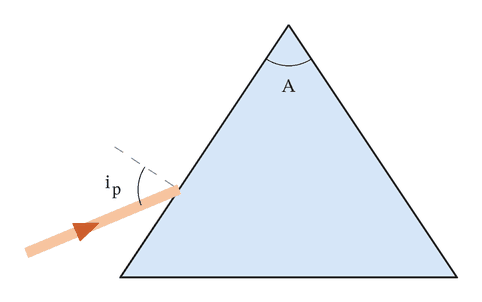
(i) Find the angle of incidence and the angle of refraction at the first face.
(ii) Find the refracting angle of the prism for which the ray meets the second face at the polarising angle for light going from glass into air.
(iii) Find the angle of emergence and the total deviation of the ray.
- 253 marks
Question 25
(Hypothetical data.) A laser gives plane polarised light. Its beam falls on the still surface of water (refractive index 1.33) in a tank, with the electric vector vibrating in the plane of incidence, and the reflected beam makes a spot on a wall. As the angle of incidence is slowly increased from , the spot fades, disappears at one angle, and then appears again.
(i) Find the angle of incidence at which the spot disappears.
(ii) Keeping this angle of incidence, the laser is turned through about its own beam. What happens to the spot? Give a reason.
(iii) Why does the reflected spot never disappear when the laser is replaced by an ordinary torch?
- 261 mark
Question 26
In a classroom demonstration, a narrow beam of white light passes through a tank of water in which extremely small particles (much smaller than the wavelength of light) slowly form. A student looks at the beam from the side, at to it, through a polaroid, which the student slowly turns. The student also looks at the spot where the transmitted beam falls on a white screen beyond the tank. Which description is correct?
- 271 mark
Question 27
On a clear morning the Sun is above the eastern horizon. An observer O studies the sky in the vertical plane that contains the Sun, as shown, looking through a polaroid that is slowly turned.
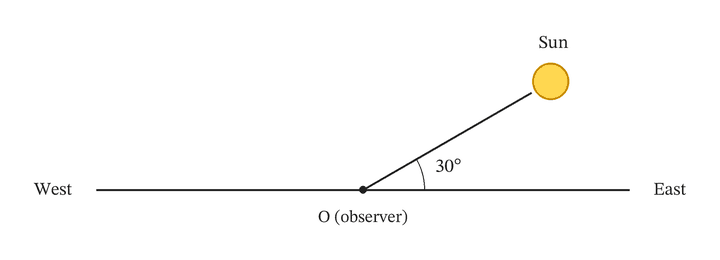
For light scattered once by air molecules, the sky light is most strongly polarised where the line of sight makes with the sunlight. In this vertical plane, that part of the sky is
- 281 mark
Question 28
Honeybees can sense the direction of vibration of polarised sky light and use it to find their way. At sunset the Sun is on the horizon, due west. A bee looks straight up at the point of the sky directly overhead (the zenith). Treating the light as scattered once by air molecules, the light reaching the bee from the zenith is
- 292 marks
Question 29
A laser beam whose vibrations are vertical passes horizontally through a glass tank of water. A pinch of very fine particles (much smaller than the wavelength of light) has been stirred into the water, so the beam is seen by the light that the particles scatter. Observer A looks down at the beam from directly above; observer B looks at it horizontally from the side, at right angles to the beam.
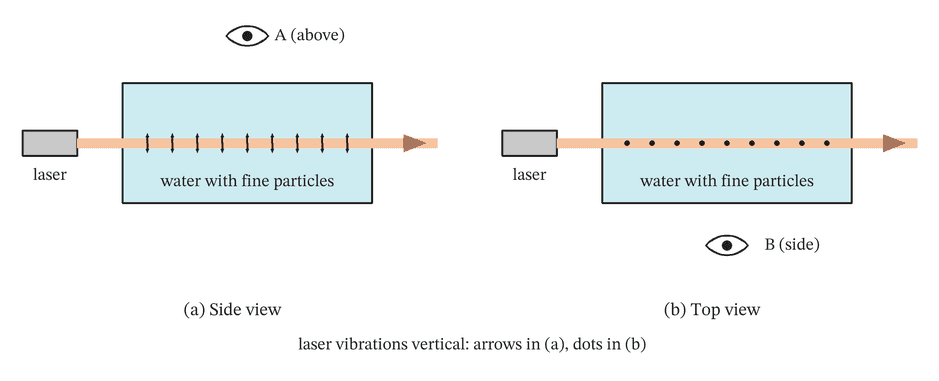
(a) Which observer sees the beam brightly, and which hardly sees it at all? Explain.
(b) The laser is now turned about the beam so that its vibrations become horizontal. What change do the observers notice?
- 303 marks
Question 30
For sunlight scattered once by air molecules, the degree of polarisation of the light scattered through an angle (the angle between the sunlight and the line of sight) is given by
where means completely plane polarised and means unpolarised.
(a) Find for and for .
(b) At what scattering angles is the scattered light exactly half polarised ()?
(c) On a clear day, the light from the part of the sky at from the Sun is typically only about 70–80% polarised. Give one reason why.
- 313 marks
Question 31
A student points a light meter at a patch of clear blue sky from the Sun and slowly turns an ideal polaroid in front of it. The reading rises and falls twice in each turn, between a greatest value of 34 units and a least value of 6 units; it never falls to zero. (Hypothetical data.) Treat the sky light as a mixture of unpolarised light of intensity and plane polarised light of intensity , measured in the same units before the polaroid.
(a) Explain why the reading never falls to zero.
(b) Find and .
(c) The degree of polarisation of the sky light is . Find .
- 322 marks
Question 32
Seen through a polaroid that is slowly turned, the blue sky at from the Sun brightens and dims strongly, but a white cloud in the same part of the sky looks almost equally bright at every setting. Explain the difference.
- 331 mark
Question 33
In the arrangement shown, seen from above, a horizontal beam of unpolarised light is scattered by a very small particle . Light scattered through , also horizontally, falls on a second very small particle . Detector is level with , in the direction shown, at to the light arriving at ; detector is directly above .
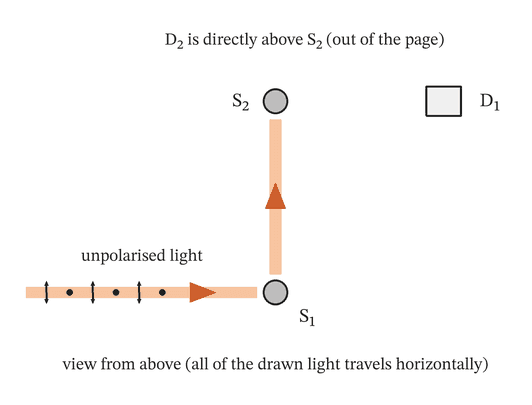
Which detector receives light scattered by ?
- 341 mark
Question 34
Plane polarised light falls on an analyser. With the pass axis of the analyser at to the vibrations of the light, a light meter behind it reads 88 units. (Hypothetical data.) The analyser is turned further in the same direction. At which of these angles between the pass axis and the vibrations will the meter again read 88 units?
- 351 mark
Question 35
A student tests Malus' law with a laser, whose light is plane polarised, a polaroid on a rotating mount, and a photodiode whose current is proportional to the intensity of the light falling on it. With the pass axis at to the laser's vibrations, the current is . (Hypothetical data.) When the polaroid is turned so that this angle becomes , the current is
- 361 mark
Question 36
In a demonstration, a polaroid spins at a steady 15 revolutions per second in a beam of plane polarised laser light, and a photodiode behind it shows the transmitted intensity on an oscilloscope. (Hypothetical data.) The frequency at which the transmitted intensity rises and falls is
- 372 marks
Question 37
A laser beam, plane polarised, falls on an ideal polaroid whose pass axis is at to the vibrations of the light. (Hypothetical data.)
(a) Find the power of the light that passes through.
(b) What happens to the rest of the beam's power in the polaroid, and why does this matter if the same kind of sheet is used with a very powerful laser?
- 383 marks
Question 38
Plane polarised light of intensity falls on an analyser. Let be the angle between the pass axis and the vibrations.
(a) Find the change in the transmitted intensity, as a fraction of , when the analyser is turned from to , from to , and from to .
(b) An experimenter wants to detect a very small turn of the plane of vibration of the light from the change in the meter reading. Near which setting should the analyser be kept to get the biggest change in reading? Explain using (a).
- 394 marks
Question 39
In a laboratory test of Malus' law, plane polarised light falls on an analyser, and the reading of a light meter behind it is recorded for several angles between the pass axis and the vibrations. (Hypothetical data.)
(units) 39.8 35.5 26.6 16.7 7.0 1.3 (a) Explain why a graph of against should be a straight line through the origin.
(b) Work out for each reading, plot the graph, draw the best straight line through the origin and find its gradient.
(c) What does the gradient represent?
(d) Use your line to predict the reading at .
- 403 marks
Question 40
Light from two different lamps is combined into one beam, so the two parts do not interfere. Part 1 has intensity and is plane polarised with vertical vibrations; part 2 has intensity and is plane polarised with horizontal vibrations. The combined beam falls on an ideal analyser whose pass axis makes an angle with the vertical.
(a) Find the transmitted intensity as a function of .
(b) Find the greatest and least transmitted intensities, and the settings at which they occur.
(c) For which angle between and is the transmitted intensity ?
- 412 marks
Question 41
Use Malus' law to show that an ideal polaroid lets through exactly half of the intensity of unpolarised light falling on it, whatever the direction of its pass axis.
- 421 mark
Question 42
Wearing polarised sunglasses, a student looks at the LCD screen of a laptop. As the student slowly tilts their head sideways, the screen looks almost black at one particular angle of tilt, though the surroundings change only slightly in brightness. The best explanation is that
- 432 marks
Question 43
A clear plastic ruler is placed between two crossed polaroids in front of a lamp. Without the ruler the view through the polaroids is dark. With the ruler in place, bright coloured bands appear in it, and the bands crowd together and shift when the ruler is bent.
(a) Why is the view dark without the ruler?
(b) What does the plastic do to the light, and how do engineers use this effect?
- 441 mark
Question 44
In a 3-D cinema that uses linear polarisers, the picture for the right eye is projected with its vibrations at to the vertical, and the picture for the left eye with its vibrations at right angles to those of the right-eye picture. Each lens of the viewer's glasses is an ideal polaroid whose pass axis matches the picture meant for that eye.
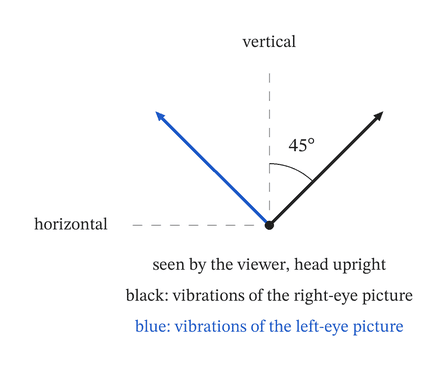
If the viewer tilts their head sideways through , the fraction of the left-eye picture's intensity that now leaks through the right-eye lens is
- 453 marks
Question 45
On a slightly hazy day, a photographer fits an ideal polarising filter to a camera to darken the blue sky. The sky being photographed, at from the Sun, sends light of intensity , of which a fraction 0.60 is plane polarised and the remaining 0.40 is unpolarised. White clouds in the same view send unpolarised light of intensity . (Hypothetical data.)
(a) What fraction of the sky light passes when the filter is turned to make the sky as dark as possible?
(b) What fraction of the cloud light passes at the same setting?
(c) Find the ratio of the brightness of the clouds to that of the sky without the filter and with it, and say what this does to the photograph.
- 461 mark
Question 46
A technician has an unmarked polaroid sheet and wants to find its pass axis. The technician looks through it at sunlight glinting off a polished glass table top across the room, seen at a shallow angle, and turns the sheet until the glare looks darkest. At that position the pass axis of the sheet is
- 473 marks
Question 47
A real polaroid sheet is not ideal. For light vibrating along its pass axis it transmits 80% of the intensity; for light vibrating at right angles to its pass axis it transmits 0.10%. (Hypothetical data.) Unpolarised light of intensity passes through two such sheets.
(a) Find the intensity after the first sheet.
(b) Find the intensity after the second sheet when the two pass axes are parallel, and when they are crossed.
(c) Find the ratio of these two intensities, and say what it tells us about crossed real polaroids.
- 481 mark
Question 48
Cinemas that show 3-D films with polarised light use a special "silver" screen coated with fine metal particles, instead of an ordinary matt white screen. The main reason is that
- 492 marks
Question 49
Can sound waves be polarised? Give reasons.
- 502 marks
Question 50
How will you show that light waves are transverse in nature?
- 511 mark
Question 51
Which vector, electric or magnetic, is used to represent the polarisation of e.m. waves?
- 522 marks
Question 52
Sunglasses are made of polaroids and not of coloured glasses, why?
- 531 mark
Question 53
Give examples for two commonly used devices which make use of polarised light.
- 541 mark
Question 54
Is it possible to view the polarised light using the unaided eye?
- 551 mark
Question 55
Does the value of polarising angle depend upon the colour?
- 561 mark
Question 56
What is Brewster angle?
- 573 marks
Question 57
The polarising angle for a ray travelling from air to ice is . What is the polarising angle if the light ray travels from ice to air?
- 583 marks
Question 58
Find the degree of polarisation of a beam of light passing through a pile of glass plates consisting of 15 plates, if at a particular angle the coefficient of reflection of glass plate is 5% for vibration in the plane of incidence and 10% for vibrations perpendicular to the plane of incidence. (Assume that no light is absorbed.)
- 593 marks
Question 59
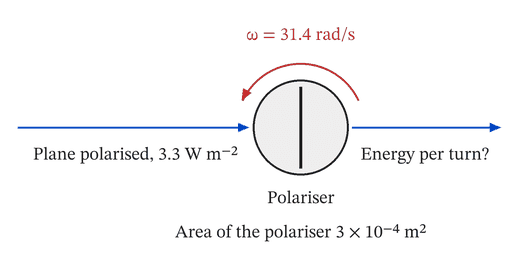
A beam of plane polarised light falls normally on a polariser (cross-sectional area ) which rotates about the axis of the ray with an angular velocity of . Find the energy of light passing through the polariser per revolution and the intensity of the emergent beam if the flux of energy of the incident ray is .
- 603 marks
Question 60
The degree of polarisation of a partially polarised light is 0.3. What is the ratio of the intensities of the polarised component of this light and the natural component?
- 611 mark
Question 61
What is meant by plane polarised light?
- 621 mark
Question 62
What types of waves show the property of polarisation?
- 632 marks
Question 63
Briefly describe how a given beam of light be analysed and determined if it is linearly polarised or unpolarised.
- 642 marks
Question 64
A ray of light incident in air for a certain air-glass surface of separation has a polarising angle of . What will be the angle of refraction in glass?

- 651 mark
Question 65
Which plane is defined as the plane of polarisation in a plane polarised electromagnetic wave?
- 662 marks
Question 66
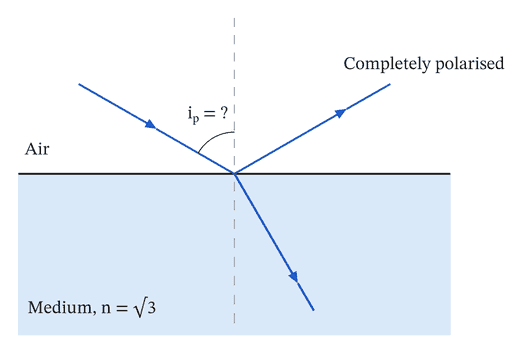
Light intensity can be partially reflected and partially transmitted by a medium whose refractive index is . Find out the angle of polarisation for this medium.
- 672 marks
Question 67
Explain why light waves can be polarised but sound waves cannot.
- 681 mark
Question 68
Give any two methods by which light can be polarised.
- 692 marks
Question 69
What is the difference between the electric field vector at any point in the path of a linearly polarised light and an unpolarised light?
- 702 marks
Question 70
(i) In case of polarised light, what is meant by the 'plane of polarisation'?
(ii) Find refractive index of glass if its polarising angle is .
- 711 mark
Question 71
State one use of polaroid.
- 722 marks
Question 72
The critical angle for a given transparent medium and air is . A ray of light travelling in air incident on this transparent medium at an angle of incidence equal to the polarising angle . What is the relation between the two angles and ?
- 732 marks
Question 73
What is the difference between the electric field vector at any point in the path of linearly polarised light and that of an unpolarised light?
- 741 mark
Question 74
A ray of light is incident on a medium at the polarising angle. What is the angle between the reflected and the refracted rays?
- 751 mark
Question 75
State the law of Malus.
- 762 marks
Question 76
How will you identify experimentally whether a given beam of light is plane polarised or unpolarised?
- 771 mark
Question 77
Light waves can be polarised as they are
- 781 mark
Question 78
A light wave has amplitude and angle between analyser and polariser is . Light is reflected by analyser has amplitude
- 791 mark
Question 79
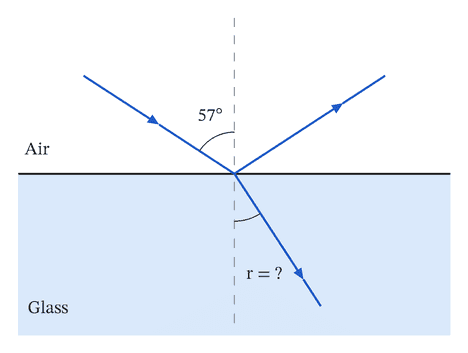
The polarising angle of glass is . A ray of light which is incident at this angle will have an angle of refraction as
- 801 mark
Question 80
The angle of incidence at which reflected light is totally polarised for reflection from air to glass (refractive index ) is
- 811 mark
Question 81
Which of the following cannot be polarised?
- 821 mark
Question 82
A polaroid is placed at to an incoming light of intensity . Now the intensity of light passing through polaroid after polarisation would be
- 831 mark
Question 83
Which of the following is incorrect?
- 841 mark
Question 84
When unpolarised light beam is incident from air onto glass () at the polarising angle
- 851 mark
Question 85
Light is incident on a glass surface at polarising angle of . Then the angle between the incident ray and the refracted ray is
- 861 mark
Question 86
The Brewster angle for glass-air interface is . If a ray of light going from air to glass strikes at an angle of incidence , then the angle of refraction is
[Hint. ]

- 871 mark
Question 87
The transverse nature of light is shown by
- 881 mark
Question 88
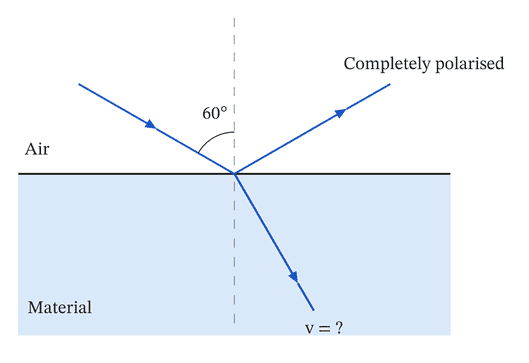
When the angle of incidence on a material is , the reflected light is completely polarised. The velocity of the refracted ray inside the material is (in m s)
- 891 mark
Question 89
In case of linearly polarised light, the magnitude of the electric field vector
- 901 mark
Question 90
Refractive index of a material is equal to tangent of polarising angle. It is called
- 911 mark
Question 91
When an unpolarised light of intensity is incident on a polarising sheet, the intensity of light which does not get transmitted is
- 921 mark
Question 92
Unpolarised light is incident from air on a plane surface of material of refractive index . At a particular angle of incidence , it is found that the reflected and refracted rays are perpendicular to each other. Which of the following options is correct for this situation?
- 931 mark
Question 93
A system of three polarisers , , is set up such that the pass axis is crossed with respect to that of . The pass axis of is inclined at to the pass axis of . When a beam of unpolarised light of intensity is incident on , the intensity of light transmitted by the three polarisers is . The ratio equals nearly

- 941 mark
Question 94
The Brewster angle for an interface should be
- 951 mark
Question 95
A polariser-analyser set is adjusted such that the intensity of light coming out of analyser is just 10% of the original intensity. Assuming that the polariser-analyser set does not absorb any light, the angle by which the analyser need to be rotated further to reduce the output intensity to zero is
- 961 mark
Question 96
A beam of plane polarised light of large cross-sectional area and uniform intensity of falls normally on a polariser (cross-sectional area ) which rotates about its axis with an angular speed of rad/s. The energy of light passing through the polariser per revolution is close to