
Question 41 markMCQEasy
A ray of light strikes a glass plate at an angle of incidence equal to . If the reflected and refracted rays are perpendicular to each other then the refractive index of glass is
Confirming your payment
Sign up now and get 250 free tokens.
Polarisation of Light · Question 4 of 62
A ray of light strikes a glass plate at an angle of incidence equal to . If the reflected and refracted rays are perpendicular to each other then the refractive index of glass is
(A)
(B)
(C)
(D)
Answer: (A)
Concept: Brewster's law says that light reflected from a transparent surface is completely plane polarised when the angle of incidence is the polarising angle , given by the relation below.
Here is the refractive index of the reflecting medium with respect to the medium the light comes from. At this angle the reflected and refracted rays are at right angles, so .
Step 1 — Recognise the polarising angle. The reflected and refracted rays are perpendicular, so the angle of incidence, , is the polarising angle.
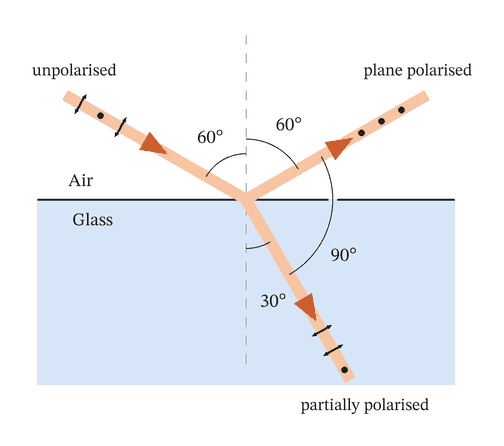
Step 2 — Apply Brewster's law. The refractive index is the tangent of this angle:
Step 3 — Check the other options. Each other option comes from a different function of or is impossible:
Therefore, the answer is (A): the refractive index of the glass is .