
Question 282 marksEasy
Describe an experiment to show polarisation of light.
Confirming your payment
Sign up now and get 250 free tokens.
Polarisation of Light · Question 28 of 62
Describe an experiment to show polarisation of light.
Solution:
Concept: A polaroid passes only the vibrations along its pass axis, so two polaroids in line can show whether light vibrates in one plane.
Step 1 — Apparatus. Light from a lamp falls on a polaroid P (the polariser). The light from P falls on a second polaroid A (the analyser), and the transmitted light is viewed on a screen or by eye.
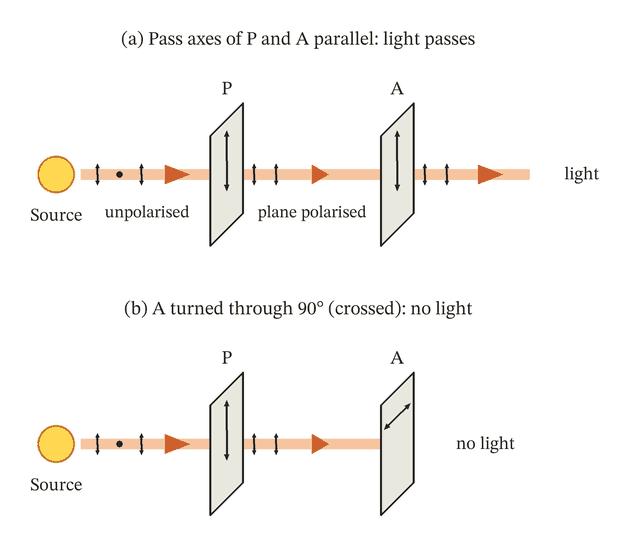
Step 2 — Rotate P with A taken out of the beam. First remove A, so that only P is in the beam, and look at the light coming straight out of P. When P is rotated about the beam, the brightness of this light does not change. So the light from the lamp vibrates equally in all directions: it is unpolarised.
Step 3 — Rotate A with P fixed. The light coming through A is brightest when the axes of P and A are parallel. It fades as A is turned and becomes zero when the axes are at (crossed). It becomes brightest again after a further .
Step 4 — Conclusion. The light leaving P therefore vibrates in one plane only: it is plane polarised. The experiment also shows that light is a transverse wave.
Therefore, a polariser and a rotating analyser show polarisation: the brightness through the analyser changes from maximum to zero as it is turned through .