
Opening your dashboard
Class 12 Physics Chapter 22 Polarisation of Light: Competency-Based Questions (CBQ)
40 questions on Chapter 22, each worked through on its own page with the AI tutor. Class 12 Physics, ICSE 2026-27.
40 questions
1–4 marks · Mixed difficulty
- 13 marks
Question 1
Competency: Application
Many television satellites send two sets of channels on the same band of frequencies. In channel set H the electric vector of the radio waves vibrates horizontally; in channel set V it vibrates vertically. At the focus of a home dish, a small straight metal probe picks up only the component of the electric vector that lies along it, and the power it picks up is proportional to the square of that component. The figure shows these directions as seen along the beam.

(a) With the probe exactly horizontal, it receives channel set H strongly but almost nothing of channel set V. What does this tell you about the radio waves from the satellite?
(b) An engineer suggests a third set of channels on the same band, with the electric vector vibrating along the direction in which the waves travel. Explain why this cannot work.
(c) An installer leaves the probe turned from the horizontal, as shown. (Hypothetical data.) Find the fraction of channel set H's power that the probe now picks up, the fraction of channel set V's power that leaks in, and the ratio of the two when both sets arrive equally strong.
- 21 mark
Question 2
Competency: Analysis & Evaluation
In the early 1800s, Thomas Young's interference experiments gave strong evidence that light is a wave.
Assertion (A): Young's interference fringes, on their own, could not show whether light waves are transverse or longitudinal.
Reason (R): Interference is shown by longitudinal waves, such as the sound from two loudspeakers playing the same note, as well as by transverse waves.
- 31 mark
Question 3
Competency: Analysis & Evaluation
A student looks through a polaroid at the reflection of a bright window in a glazed floor tile. At one particular viewing angle, the student finds that turning the polaroid about the line of sight can make the reflection almost vanish. Which conclusion about light follows directly from this observation?
- 44 marks
Question 4
Competency: Application
A food laboratory checks the sugar content of a clear sugar solution with a polarimeter, shown below. Light from a sodium lamp passes through a polariser P, a tube long holding the solution, and an analyser A, to the observer's eye. With the tube empty, A is turned until it is crossed with P, and the field of view is dark.
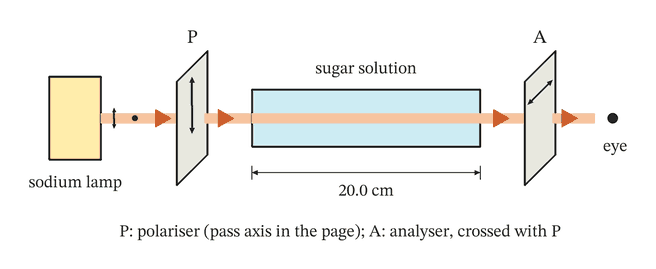
Dissolved sugar (sucrose) is optically active: it turns the plane of vibration of plane polarised light passing through it by an angle . Here is the length of solution in decimetres, is the concentration in and, for sucrose with sodium light at , . The sign means clockwise, as seen by the observer looking towards the lamp. When the tube is filled with the solution the field becomes bright, and it becomes dark again when A is turned clockwise. (Hypothetical data.)
(a) Explain why the field becomes bright when the solution is put in, and why turning A brings the darkness back.
(b) Find the concentration of sugar in the solution, in grams per .
(c) Turning A through anticlockwise from the crossed position would also give darkness. Explain why, and how a second measurement with a tube long tells the two possibilities apart.
- 51 mark
Question 5
Competency: Analysis & Evaluation
A teacher has two sources that each give light of almost a single wavelength: a small laser whose light is plane polarised, and a sodium-vapour lamp.
Assertion (A): A single polaroid placed in front of the laser can be turned so that it stops the laser's light completely, but no setting of a single polaroid can stop the light of the sodium lamp.
Reason (R): The light of the laser and the light of the sodium lamp both have very nearly a single wavelength.
- 61 mark
Question 6
Competency: Application
A student shines an ordinary LED torch through two polaroids P and Q, whose pass axes are parallel, onto a light meter, as shown. The meter reads units. (Hypothetical data.)

Keeping P and Q fixed, the student turns the torch about its own beam through . The meter now reads
- 74 marks
Question 7
Competency: Analysis & Evaluation
In a helium–neon laser, light bounces to and fro between two mirrors and , passing each time through a tube of gas that amplifies it. The tube is closed by two thin fused-silica windows (refractive index ), tilted so that the light travelling along the tube meets them at the polarising angle, as shown.
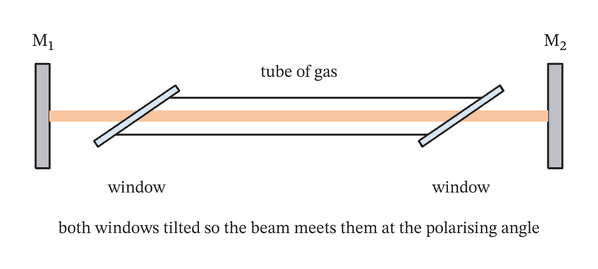
At this angle, each surface of a window reflects none of the light vibrating in the plane of incidence, but about of the light vibrating perpendicular to it; whatever is reflected is lost from the beam. Treat the mirrors as perfect. On each round trip ( to and back) the gas increases the intensity of the light by . (Hypothetical data.)
(a) What fraction of light vibrating perpendicular to the plane of incidence passes through one window (both of its surfaces)?
(b) Find the fraction of each of the two vibrations that the windows let through in one complete round trip. Then find the factor by which the intensity of each vibration changes per round trip, including the gain.
(c) A designer suggests windows set at right angles to the tube instead. At normal incidence each surface reflects a fraction of light of every vibration. Show that the laser would then not work at all.
- 83 marks
Question 8
Competency: Application
A photographer wants to photograph goods in a shop window on a sunny day, but the window glass (refractive index ) reflects a bright, sunlit building across the street. The photographer holds the camera at the same height as the part of the window being photographed and stands to one side of it, so that the plane of incidence is horizontal, as in this view from above. The photographer fits an ideal polarising filter to the lens. (Hypothetical data.)
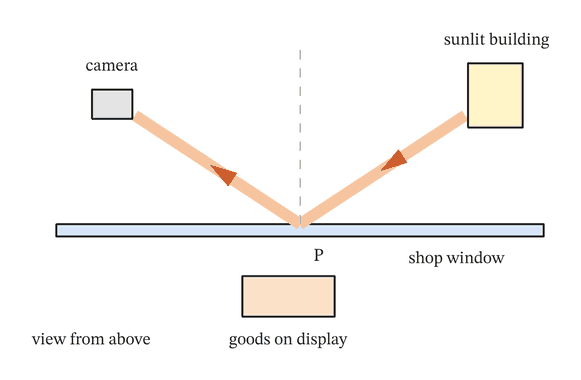
(a) At what angle to the glass surface should the photographer's line of sight be, for the filter to be able to remove the reflection completely?
(b) Should the pass axis of the filter then be vertical or horizontal? Explain.
(c) A friend photographs the same window from straight in front. Explain why the filter cannot remove the reflection for the friend.
- 93 marks
Question 9
Competency: Analysis & Evaluation
A gemmologist must identify a colourless stone whose refractive index is too high for an ordinary refractometer, which cannot read above about . The gemmologist shines a narrow beam onto a flat, polished facet and looks at the reflected light through a polaroid whose pass axis lies in the plane of incidence, as shown. The gemmologist changes the angle of incidence until the reflected light vanishes, which happens at , and the reading is believed to be correct to within . (Hypothetical data.) Refractive indices: diamond , cubic zirconia , moissanite about .

(a) Find the refractive index of the stone and identify it.
(b) Show that an error of in this reading could not change the identification.
(c) Explain why the reflected light must be viewed through a polaroid with its pass axis in the plane of incidence.
- 101 mark
Question 10
Competency: Analysis & Evaluation
While photographing a bright rainbow, a photographer slowly turns the polarising filter on the camera lens. At one setting the rainbow almost disappears, although the sky around it changes much less. In each raindrop, the light that forms the rainbow is refracted in, reflected once at the back of the drop at an angle of incidence of about , and refracted out. For light going from water into air, the polarising angle is about and the critical angle about . The best explanation is that
- 111 mark
Question 11
Competency: Analysis & Evaluation
In a Brewster angle microscope, a laser beam whose vibrations lie in the plane of incidence strikes a water surface at an angle of incidence of , and a camera looks along the direction in which reflected light would travel, as shown. Where the water is clean, the camera sees almost no light. Part of the surface is covered by a film of an oily substance only one molecule thick (a few nanometres), and that part looks bright.
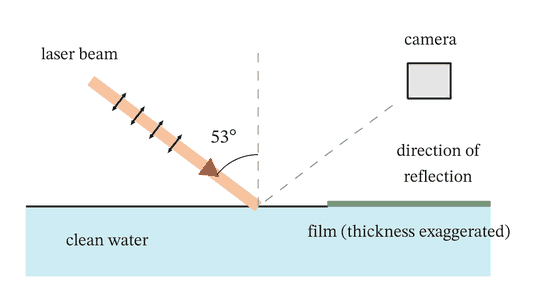
The best explanation is that
- 121 mark
Question 12
Competency: Analysis & Evaluation
On a clear morning, sunlight falls on a calm lake at the polarising angle for water.
Assertion (A): The sunlight reflected from the lake is completely plane polarised, with its vibrations horizontal.
Reason (R): Most of the sunlight falling on the lake is not reflected but enters the water.
- 133 marks
Question 13
Competency: Application
A small delivery robot works in a city street where tall buildings hide the Sun. It finds its way with a "sky compass": a camera with a turning polaroid that looks straight up at the zenith Z, the point of the sky directly overhead, and finds the direction of vibration of the sky light there. In this chapter's model, light scattered once by air molecules vibrates at right angles to the plane that contains the sunlight and the line of sight. At 9 a.m. on a clear day, the robot finds that light from the zenith vibrates horizontally along a line east of north, as shown. (Hypothetical data.)
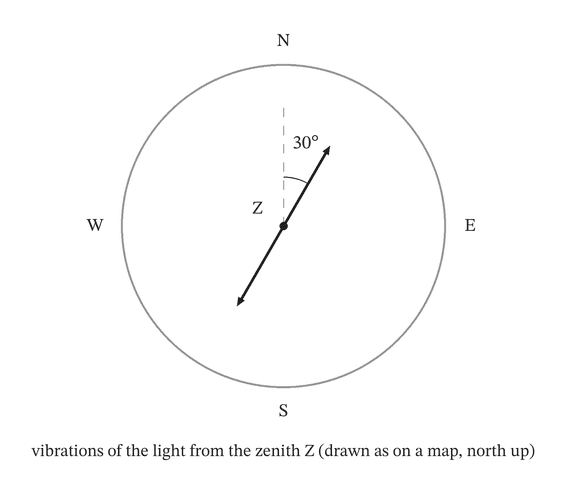
(a) Which two compass directions could the Sun be in? Give each as an angle measured clockwise from north.
(b) Which of the two is correct at 9 a.m.? Explain.
(c) Near noon in the tropics, the Sun can be almost directly overhead. Explain why the sky compass then fails when it looks at the zenith, and where in the sky it should look instead.
- 141 mark
Question 14
Competency: Analysis & Evaluation
A honeybee flying back to its hive can see a patch of clear blue sky, but the Sun itself is hidden behind a hill.
Assertion (A): The bee can still work out the direction of the Sun from the light of that patch of sky.
Reason (R): Light from every part of a clear blue sky is completely plane polarised.
- 151 mark
Question 15
Competency: Analysis & Evaluation
On a clear afternoon, a tourist looks at the sky through polarised sunglasses.
Assertion (A): Polarised sunglasses darken every part of a clear blue sky by the same fraction, whatever the direction the tourist looks in.
Reason (R): Light from the clear sky is partially polarised, most strongly in directions at to the sunlight.
- 163 marks
Question 16
Competency: Application
A "variable ND filter" for a camera lens is made of two polarising sheets in one mount, and the front sheet can be turned to dim the scene by different amounts. Treat both sheets as ideal and the light from the scene as unpolarised. Photographers measure dimming in "stops": each stop halves the light. (Hypothetical data.)
(a) What fraction of the light from the scene passes when the two pass axes are parallel?
(b) Through what angle must the front sheet be turned from the parallel setting to dim the light by 3 stops compared with the parallel setting?
(c) Find the angle for 6 stops. Compare the turn needed to go from 3 stops to 6 stops with the turn from 0 to 3 stops, and say what this means for a photographer.
- 174 marks
Question 17
Competency: Analysis & Evaluation
An angle sensor on a robot arm uses a polaroid disc fixed to the turning shaft. Beam 1, from a laser whose light is plane polarised with vertical vibrations, passes through the disc to photodiode 1. Beam 2, from a second laser whose vibrations are at clockwise from the vertical, passes through another part of the same disc to photodiode 2. Each photodiode reads units when the disc's pass axis is parallel to the vibrations of its own beam, and its reading is proportional to the intensity of the light it receives. All angles are measured clockwise from the vertical, as seen from the photodiodes. (Hypothetical data.)
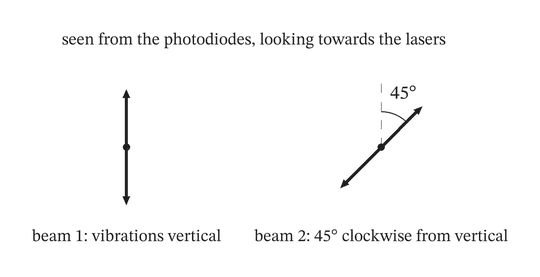
(a) At one moment photodiode 1 reads units. Find every possible angle of the disc's pass axis from to .
(b) At the same moment photodiode 2 reads units. Which of your angles in (a) are still possible?
(c) Explain why no arrangement of polaroids could decide between the angles that remain.
- 181 mark
Question 18
Competency: Analysis & Evaluation
A student turns an analyser in a beam of plane polarised light, starting with its pass axis parallel to the vibrations.
Assertion (A): When the analyser has turned through , the intensity of the light it lets through has fallen by , but the amplitude of that light has fallen by only about .
Reason (R): The analyser lets through only the component of the amplitude , and the intensity of light is proportional to the square of its amplitude.
- 191 mark
Question 19
Competency: Application
To show a customer that a pair of sunglasses really is polarised, a shopkeeper holds one lens in front of the other and looks through both at a white LED panel that gives unpolarised light. The shopkeeper turns one lens until the pass axes of the two lenses are at to each other. Treating each lens as an ideal polaroid, the fraction of the panel's light that passes through both lenses is
- 203 marks
Question 20
Competency: Analysis & Evaluation
An angler wears polarised sunglasses, whose lenses are ideal polaroids with vertical pass axes, to spot fish in a calm lake, as shown. Two kinds of light reach the angler's eyes from the same part of the lake: glare (sunlight reflected by the water surface) of intensity , and light from a fish that has been refracted out through the surface, of intensity . Treat each as two parts, one vibrating horizontally and one vibrating in the vertical plane through the ray (called "vertical" here). The glare is horizontal and vertical; the light from the fish is vertical and horizontal. Without sunglasses the glare is 4 times as bright as the light from the fish, . (Hypothetical data.)
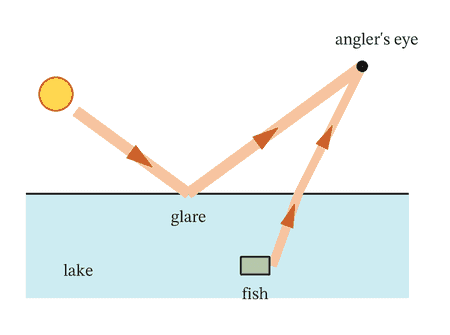
(a) Use what happens to the fish's light at the water surface to explain why, after leaving the water, it has more vertical than horizontal vibration.
(b) Find the intensities of the glare and of the fish's light that pass the sunglasses, in terms of .
(c) By what factor do the sunglasses improve the ratio of the fish's light to the glare?
- 213 marks
Question 21
Competency: Analysis & Evaluation
In the middle of the twentieth century, inventors proposed a way to stop the glare of oncoming headlamps at night, though it was never adopted. Every car's headlamps would carry a polarising sheet with its pass axis at to the vertical, tilted up to the right as seen by that car's own driver looking ahead. Every car would also have a polarising visor in front of the driver, made by the same rule. Cars A and B approach each other, as shown. Treat all the sheets as ideal polaroids. (Hypothetical data.)
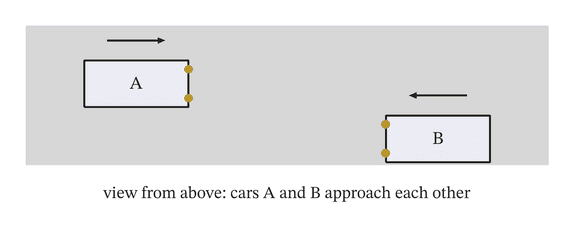
(a) Show that light from B's headlamps cannot pass through A's visor.
(b) Light from A's own headlamps comes back to A after being scattered by the road and objects ahead, which largely destroys its polarisation. Treating this returned light as unpolarised, what fraction of it passes A's visor?
(c) Each headlamp's sheet also absorbs half of the lamp's unpolarised light. By what factor must the lamps be made brighter, so that A's driver sees the road ahead as brightly as with ordinary lamps and an ordinary windscreen?
- 221 mark
Question 22
Competency: Analysis & Evaluation
On a sunny day, a driver wearing polarised sunglasses looks at the car in front, whose rear window is made of toughened glass.
Assertion (A): Through the sunglasses, the driver may see a pattern of darker and lighter patches in the toughened glass, which looks evenly clear without them.
Reason (R): Toughened glass has stresses locked into it, and stressed glass changes the polarisation of light passing through it by different amounts at different places.
- 231 mark
Question 23
Competency: Analysis & Evaluation
A student writes notes on how the polaroid lenses of a pair of sunglasses work.
Assertion (A): A polaroid sheet turns the vibrations of unpolarised light round into the direction of its pass axis, so almost all of the light gets through.
Reason (R): In a polaroid sheet, long-chain molecules lined up in one direction absorb the component of the electric vector parallel to the chains.
- 241 mark
Question 24
Competency: Application
The LCD screen of a car's navigation unit gives out light that is plane polarised, vibrating at to the vertical. The driver wears polarised sunglasses whose lenses are ideal polaroids with vertical pass axes. The unit can be fixed with its screen in landscape position, or turned through into portrait position. Compared with the screen seen without sunglasses, the fraction of its light that reaches the driver's eyes is
- 251 mark
Question 25
Competency: Analysis & Evaluation
In many cars a head-up display shows the speed by reflecting light from a projector in the dashboard off the inside of the windscreen into the driver's eyes, as shown. The light meets the windscreen at an angle of incidence of about , close to the polarising angle for glass. A driver wearing polarised sunglasses with vertical pass axes finds the display very faint, though the road ahead stays clearly visible.
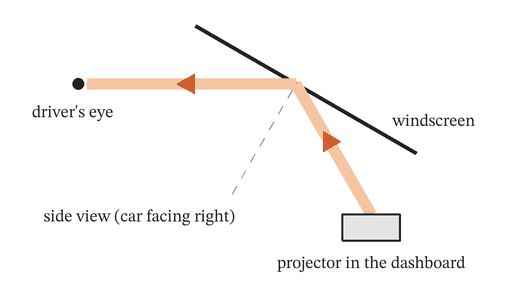
The most likely reason is that
- 264 marks
Question 26
A beam of plane polarised light vibrates in an unknown direction. An analyser with a reference mark is placed in the beam, and all turns are made clockwise as seen by the observer. With the pass axis on the mark, a light meter reads 30 units; with the pass axis turned from the mark, it reads 10 units. (Hypothetical data.)
(a) Find the intensity of the beam falling on the analyser.
(b) Find the angle between the vibrations and the mark.
(c) With the pass axis turned from the mark, the meter reads 37.3 units. On which side of the mark do the vibrations lie?
- 274 marks
Question 27
A simple model of one pixel of a liquid-crystal display (LCD) has a polariser with a vertical pass axis and an analyser with a horizontal pass axis, so the two are crossed. Between them is a liquid-crystal layer that turns the direction of vibration of the light passing through it by an angle , which depends on the voltage across the layer: with no voltage, and smaller at higher voltages. The backlight gives unpolarised light of intensity . Treat and as ideal and ignore all other losses.
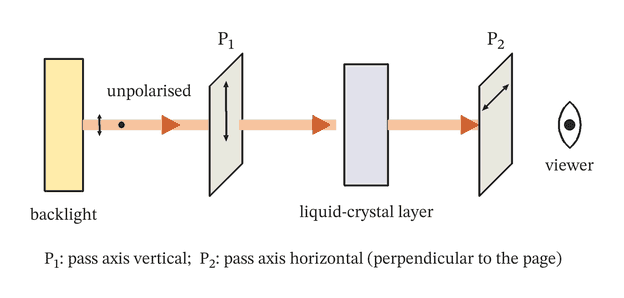
(a) Find the intensity leaving the pixel when there is no voltage.
(b) Find the intensity when the voltage makes .
(c) What value of makes the pixel give one-quarter of its brightest output (a grey level)?
(d) How does the pixel look at a high voltage that makes ?
- 283 marks
Question 28
A ray of light is incident on the surface of a glass plate of refractive index 1.732 at the polarising angle. Calculate the angle of refraction of the ray.
- 293 marks
Question 29
The polarising angle for a ray travelling from air to ice is . What is the polarising angle of the light ray when travels from ice to air?
- 303 marks
Question 30
When a beam of light of wavelength 5893 Å is incident on the surface of a liquid at grazing angle , the reflected light is completely plane polarised. Calculate the wavelength of the refracted ray.
- 313 marks
Question 31
For a given medium, the polarising angle is . What will be the critical angle for the medium?
- 323 marks
Question 32
A ray of light strikes a glass plate at an angle of incidence . If the reflected and refracted rays are perpendicular to each other, find the index of refraction of glass.
- 333 marks
Question 33
When a ray of light from air is incident on the surface of glass with angle of incidence equal to the angle of polarisation, it suffers a deviation of on entering glass. Calculate the angle of polarisation.
- 343 marks
Question 34
Find the polarising angle for a light incident from (i) water to glass and
(ii) glass to water. Refractive indices of glass and water are 1.54 and 1.33, respectively.
- 353 marks
Question 35
Two polarising crystals have their polarising directions parallel so that the intensity of transmitted light is maximum. Through what angle must either sheet be rotated so that the intensity of light transmitted becomes one half the initial value?
- 363 marks
Question 36
Unpolarised light of intensity passes through three polarisers such that the transmission axis of the last polariser is crossed with the first. If the intensity of the emergent light is , what is the angle between the transmission axes of the first two polarisers? At what angle will the transmitted intensity be maximum?
- 373 marks
Question 37
What is a polaroid? Explain (i) plane polarised light and (ii) polarising angle. Will ultrasonic waves show any polarisation? Give reason for your answer.
- 383 marks
Question 38
(i) State Brewster's law.
(ii) Show that when a ray of light is incident on a refracting surface at the polarising angle, the reflected and the refracted rays are at right angle to each other.
- 391 mark
Question 39
Competency: Analysis & Evaluation
A college laboratory compares three clear liquids, P, Q and R. A laser beam, whose vibrations lie in the plane of incidence, falls on the still, flat surface of each liquid from air. The angle of incidence is slowly increased, and the angle at which the reflected beam fades to almost nothing is recorded to the nearest .
Liquid P Q R Angle of incidence at which the reflection vanishes (Hypothetical data.)
Which conclusion about these liquids is correct?
- 403 marks
Question 40
Competency: Analysis & Evaluation
A student builds a polariscope from two flat plates of black glass, plate 1 and plate 2, each of refractive index . Black glass reflects light only from its front surface. A narrow beam of unpolarised light from a lamp falls on plate 1 at its polarising angle, and the reflected beam travels to plate 2, which it also meets at the polarising angle. A light meter is placed in the beam reflected by plate 2.
Plate 2 can be turned about the beam coming from plate 1, keeping the same angle of incidence, and the light meter is moved so that it stays in the beam reflected by plate 2. Let be the angle between the plane of incidence at plate 2 and the plane of incidence at plate 1. With , the meter reads units. (Hypothetical data.)
(a) Find the angle of incidence at each plate. State the direction of vibration of the light travelling from plate 1 to plate 2.
(b) Find the meter reading when and when .
(c) At any angle of incidence between and other than the polarising angle, glass also reflects part of the light vibrating in the plane of incidence. A classmate sets plate 2 at an angle of incidence of instead. Explain what the classmate will find at , and decide which of the two set-ups is the better analyser.