
Competency: Application
A food laboratory checks the sugar content of a clear sugar solution with a polarimeter, shown below. Light from a sodium lamp passes through a polariser P, a tube long holding the solution, and an analyser A, to the observer's eye. With the tube empty, A is turned until it is crossed with P, and the field of view is dark.
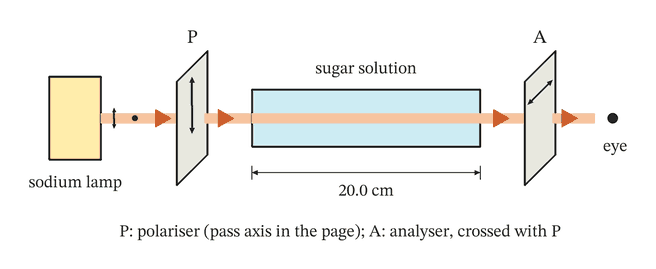
Dissolved sugar (sucrose) is optically active: it turns the plane of vibration of plane polarised light passing through it by an angle . Here is the length of solution in decimetres, is the concentration in and, for sucrose with sodium light at , . The sign means clockwise, as seen by the observer looking towards the lamp. When the tube is filled with the solution the field becomes bright, and it becomes dark again when A is turned clockwise. (Hypothetical data.)
(a) Explain why the field becomes bright when the solution is put in, and why turning A brings the darkness back.
(b) Find the concentration of sugar in the solution, in grams per .
(c) Turning A through anticlockwise from the crossed position would also give darkness. Explain why, and how a second measurement with a tube long tells the two possibilities apart.