
A simple model of one pixel of a liquid-crystal display (LCD) has a polariser with a vertical pass axis and an analyser with a horizontal pass axis, so the two are crossed. Between them is a liquid-crystal layer that turns the direction of vibration of the light passing through it by an angle , which depends on the voltage across the layer: with no voltage, and smaller at higher voltages. The backlight gives unpolarised light of intensity . Treat and as ideal and ignore all other losses.
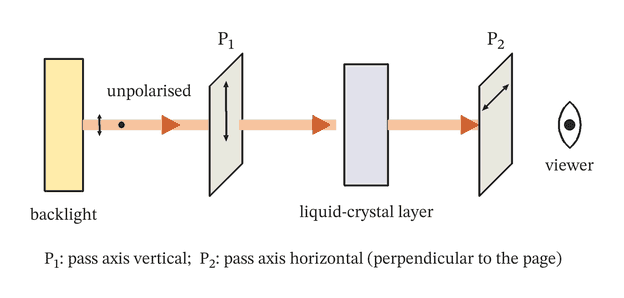
(a) Find the intensity leaving the pixel when there is no voltage.
(b) Find the intensity when the voltage makes .
(c) What value of makes the pixel give one-quarter of its brightest output (a grey level)?
(d) How does the pixel look at a high voltage that makes ?