
Competency: Analysis & Evaluation
An angler wears polarised sunglasses, whose lenses are ideal polaroids with vertical pass axes, to spot fish in a calm lake, as shown. Two kinds of light reach the angler's eyes from the same part of the lake: glare (sunlight reflected by the water surface) of intensity , and light from a fish that has been refracted out through the surface, of intensity . Treat each as two parts, one vibrating horizontally and one vibrating in the vertical plane through the ray (called "vertical" here). The glare is horizontal and vertical; the light from the fish is vertical and horizontal. Without sunglasses the glare is 4 times as bright as the light from the fish, . (Hypothetical data.)
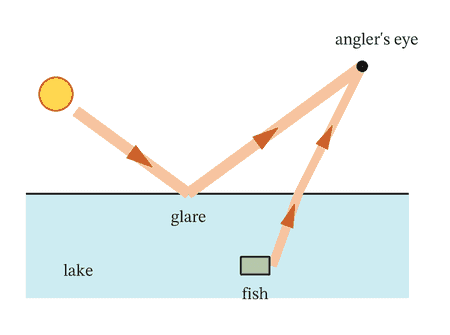
(a) Use what happens to the fish's light at the water surface to explain why, after leaving the water, it has more vertical than horizontal vibration.
(b) Find the intensities of the glare and of the fish's light that pass the sunglasses, in terms of .
(c) By what factor do the sunglasses improve the ratio of the fish's light to the glare?