
Competency: Analysis & Evaluation
In the middle of the twentieth century, inventors proposed a way to stop the glare of oncoming headlamps at night, though it was never adopted. Every car's headlamps would carry a polarising sheet with its pass axis at to the vertical, tilted up to the right as seen by that car's own driver looking ahead. Every car would also have a polarising visor in front of the driver, made by the same rule. Cars A and B approach each other, as shown. Treat all the sheets as ideal polaroids. (Hypothetical data.)
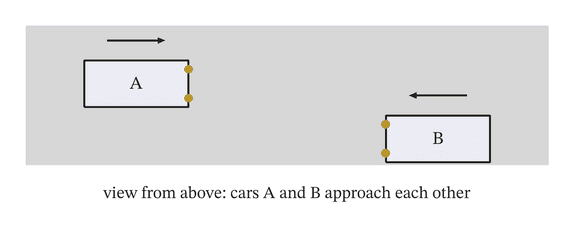
(a) Show that light from B's headlamps cannot pass through A's visor.
(b) Light from A's own headlamps comes back to A after being scattered by the road and objects ahead, which largely destroys its polarisation. Treating this returned light as unpolarised, what fraction of it passes A's visor?
(c) Each headlamp's sheet also absorbs half of the lamp's unpolarised light. By what factor must the lamps be made brighter, so that A's driver sees the road ahead as brightly as with ordinary lamps and an ordinary windscreen?