
Competency: Analysis & Evaluation
In a helium–neon laser, light bounces to and fro between two mirrors and , passing each time through a tube of gas that amplifies it. The tube is closed by two thin fused-silica windows (refractive index ), tilted so that the light travelling along the tube meets them at the polarising angle, as shown.
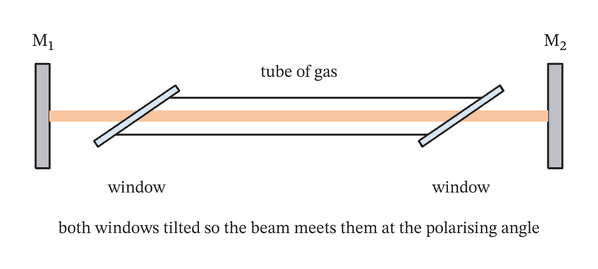
At this angle, each surface of a window reflects none of the light vibrating in the plane of incidence, but about of the light vibrating perpendicular to it; whatever is reflected is lost from the beam. Treat the mirrors as perfect. On each round trip ( to and back) the gas increases the intensity of the light by . (Hypothetical data.)
(a) What fraction of light vibrating perpendicular to the plane of incidence passes through one window (both of its surfaces)?
(b) Find the fraction of each of the two vibrations that the windows let through in one complete round trip. Then find the factor by which the intensity of each vibration changes per round trip, including the gain.
(c) A designer suggests windows set at right angles to the tube instead. At normal incidence each surface reflects a fraction of light of every vibration. Show that the laser would then not work at all.