
Competency: Application
A small delivery robot works in a city street where tall buildings hide the Sun. It finds its way with a "sky compass": a camera with a turning polaroid that looks straight up at the zenith Z, the point of the sky directly overhead, and finds the direction of vibration of the sky light there. In this chapter's model, light scattered once by air molecules vibrates at right angles to the plane that contains the sunlight and the line of sight. At 9 a.m. on a clear day, the robot finds that light from the zenith vibrates horizontally along a line east of north, as shown. (Hypothetical data.)
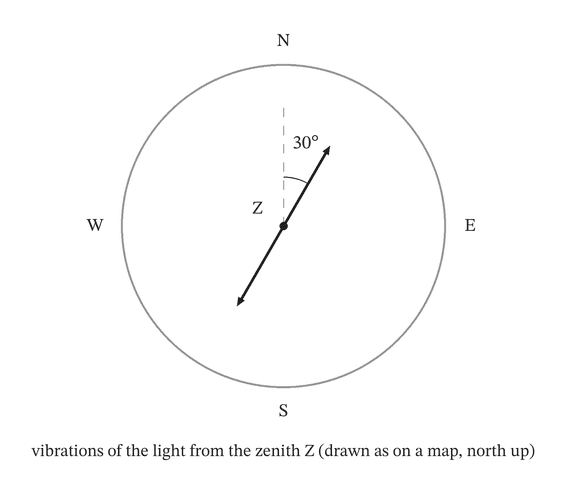
(a) Which two compass directions could the Sun be in? Give each as an angle measured clockwise from north.
(b) Which of the two is correct at 9 a.m.? Explain.
(c) Near noon in the tropics, the Sun can be almost directly overhead. Explain why the sky compass then fails when it looks at the zenith, and where in the sky it should look instead.