
Opening your dashboard
Class 12 Biology Chapter 2: Sexual Reproduction in Flowering Plants Solutions
143 textbook questions with step-by-step answers, free to read, for ISC 2026-27.
Get talked through Ch 2, not just shown the answer
Reading a finished solution is not the same as being able to do it. The AI tutor takes one question at a time and works it with you, in your own words, until you can.
- Ask it out loud, in your own words
- It gives you the next step, not the answer
- Stuck on part (ii)? Start there
143 questions with solutions
1–5 marks · Mixed difficulty
- 11 mark
Question 1
Which part of flower is called microsporophyll?
Solve with AIWritten solution
Solution:
Concept: In flowering plants the spore-bearing leaves (sporophylls) are parts of the flower. A microsporophyll bears microsporangia, in which the microspores (pollen grains) form, and a megasporophyll bears ovules.
Step 1 — Find the part that bears microsporangia.
A stamen has a stalk, the filament, and a head, the anther. A typical anther has two lobes with two microsporangia (pollen sacs) in each, and the pollen grains form inside these microsporangia.
Step 2 — Name the microsporophyll.
The stamen bears the microsporangia, so it is the microsporophyll. In the same way, the carpel, which bears the ovules, is the megasporophyll.
Therefore, the stamen is the part of the flower called the microsporophyll.
- 21 mark
Question 2
What is a dioecious plant?
Solve with AIWritten solution
Solution:
Concept: Plants with unisexual flowers carry their male and female flowers either on the same plant (monoecious, as in maize and castor) or on separate plants (dioecious).
Step 1 — Define a dioecious plant.
In a dioecious species the male and female flowers are borne on separate plants. Each plant therefore bears either only male flowers or only female flowers.
Step 2 — Give examples.
Date palm and papaya are common examples; most papaya varieties have separate male and female plants.
Step 3 — See what this does to pollination.
A flower can then receive pollen only from another plant, so dioecy prevents both autogamy and geitonogamy and ensures cross-pollination.
Therefore, a dioecious plant is one that bears only male or only female flowers, so that male and female flowers are on separate plants, e.g. date palm and papaya.
- 31 mark
Question 3
In which type of flower is the ovary half inferior?
Solve with AIWritten solution
Solution:
Concept: Flowers are grouped by the position of the ovary in relation to the other floral parts on the thalamus: hypogynous (superior ovary), perigynous (half-inferior ovary) and epigynous (inferior ovary).
Step 1 — Describe a perigynous flower.
In a perigynous flower the thalamus grows up as a cup or rim around the ovary. The sepals, petals and stamens arise from this rim at about the level of the ovary, so the ovary is half inferior.
Step 2 — Give examples.
Plum, rose and peach have perigynous flowers.
Step 3 — Compare it with the other two types.
In a hypogynous flower, such as mustard and China rose, the other parts arise below the ovary, which is superior. In an epigynous flower, such as guava and cucumber, the thalamus encloses and fuses with the ovary, which is inferior.
Therefore, the ovary is half inferior in a perigynous flower, as in plum, rose and peach.
- 41 mark
Question 4
What are the stamens of China rose called?
Solve with AIWritten solution
Solution:
Concept: When the filaments of stamens are joined but the anthers stay free, the stamens are named by the number of bundles: one bundle is monadelphous, two bundles are diadelphous and more than two are polyadelphous.
Step 1 — Look at the stamens of China rose.
In China rose (Hibiscus rosa-sinensis), the filaments of all the stamens are joined into a single tube, the staminal tube, around the style, while the anthers are free.
Step 2 — Name the condition.
One bundle of stamens makes the condition monadelphous, as in other members of the mallow family such as cotton.
Therefore, the stamens of China rose are monadelphous.
- 51 mark
Question 5
What is the condition called when anthers are united and filaments are free?
Solve with AIWritten solution
Solution:
Concept: The stamens of a flower may be joined by their filaments, by their anthers, or by both.
Step 1 — Read the condition.
Here the anthers are joined to form a tube around the style, while the filaments stay free.
Step 2 — Name the condition.
Stamens united by their anthers only are called syngenesious, as in sunflower and marigold of the family Asteraceae. When both the anthers and the filaments are joined, as in Cucurbita, the stamens are called synandrous.
Therefore, the condition is called syngenesious.
- 61 mark
Question 6
Which plant shows tetradynamous conditions of stamens.
Solve with AIWritten solution
Solution:
Concept: In the tetradynamous condition a flower has six stamens in two whorls: two short stamens in the outer whorl and four long stamens in the inner whorl.
Step 1 — Find the family with this condition.
This arrangement is typical of the mustard family, Brassicaceae.
Step 2 — Name the plant.
Mustard shows tetradynamous stamens, as do radish and cabbage of the same family.
Therefore, mustard shows the tetradynamous condition of stamens.
- 71 mark
Question 7
What is the meaning of apocarpous condition? Give one example.
Solve with AIWritten solution
Solution:
Concept: A gynoecium with more than one carpel is multicarpellary. Its carpels may be free from one another or fused together.
Step 1 — State the meaning.
In the apocarpous condition the carpels of a multicarpellary gynoecium are free, so each carpel forms its own separate pistil.
Step 2 — Give an example.
Lotus and rose have apocarpous gynoecia. When the carpels are fused, as in mustard and tomato, the condition is called syncarpous.
Therefore, the apocarpous condition is a multicarpellary gynoecium with free carpels, e.g. rose (or lotus).
- 81 mark
Question 8
What kind of inflorescence does banana have?
Solve with AIWritten solution
Solution:
Concept: A spadix is a spike with a thick, fleshy axis, usually bearing unisexual flowers, and covered by one or more large bracts called spathes.
Step 1 — Describe the banana inflorescence.
The banana has a long, hanging, fleshy axis. Its flowers are borne in clusters (hands), and each cluster lies in the axil of a large, purplish-red bract, a spathe. Female flowers are in the lower clusters, and male flowers are near the tip.
Step 2 — Name the inflorescence.
A fleshy axis with many spathes covering groups of flowers is a spadix; because it bears several spathes, the banana spadix is called a compound spadix.
Therefore, banana has a spadix inflorescence (a compound spadix).
- 91 mark
Question 9
What is nucellus?
Solve with AIWritten solution
Solution:
Concept: An ovule has a stalk (funicle), one or two protective layers (integuments), a small opening (micropyle), a base (chalaza) and, inside the integuments, a mass of cells called the nucellus.
Step 1 — Define the nucellus.
The nucellus is the mass of parenchyma cells that forms the main body of the ovule, enclosed by the integuments. Its cells hold plenty of reserve food.
Step 2 — State its role.
The megaspore mother cell arises in the micropylar region of the nucellus, and the embryo sac later develops inside it, using its food. In a few seeds, such as black pepper and beet, part of the nucellus remains as a food-storing tissue called the perisperm.
Therefore, the nucellus is the food-rich mass of cells inside the integuments of the ovule, which encloses the embryo sac.
- 101 mark
Question 10
How many cells does embryosac contain? Name them.
Solve with AIWritten solution
Solution:
Concept: In most flowering plants the mature embryo sac (female gametophyte) is 8-nucleate but 7-celled.
Step 1 — Count the nuclei.
The nucleus of the functional megaspore divides by mitosis three times in a row, giving 2, then 4, then 8 nuclei. Four nuclei lie at the micropylar end and four at the chalazal end.
Step 2 — See how the nuclei form cells.
At the micropylar end three nuclei become cells: two synergids and one egg cell, which together form the egg apparatus. At the chalazal end three nuclei become the three antipodal cells. One nucleus from each end moves to the middle; these two polar nuclei stay together in one large central cell.
Step 3 — Count the cells.
We add the cells at the two ends and the central cell.
Note: The textbook's answer gives 8 cells, counting the two polar nuclei as two cells. They share one central cell, so the embryo sac has 8 nuclei but only 7 cells.
Therefore, the embryo sac contains 7 cells: 3 antipodal cells, 2 synergids, 1 egg cell and 1 central cell with 2 polar nuclei (8 nuclei in all).
- 111 mark
Question 11
What is another term of embryo sac?
Solve with AIWritten solution
Solution:
Concept: The plant body of a flowering plant is the diploid sporophyte. The haploid structures that grow from its spores and form gametes are the gametophytes.
Step 1 — Trace where the embryo sac comes from.
The embryo sac develops from the haploid functional megaspore by mitosis, and it produces the female gamete, the egg.
Step 2 — Name it.
A haploid structure that grows from a megaspore and bears the female gamete is the female gametophyte, also called the megagametophyte.
Therefore, another term for the embryo sac is the female gametophyte (megagametophyte).
- 121 mark
Question 12
Which cell undergoes meiotic division in ovule?
Solve with AIWritten solution
Solution:
Concept: The formation of megaspores from the megaspore mother cell is called megasporogenesis.
Step 1 — Find the cell.
In the micropylar region of the nucellus, one cell becomes large, with dense cytoplasm and a prominent nucleus. This diploid cell is the megaspore mother cell (MMC).
Step 2 — State what it does.
The MMC divides by meiosis to form four haploid megaspores.
Therefore, the megaspore mother cell (MMC) undergoes meiotic division in the ovule.
- 131 mark
Question 13
Which cell undergoes mitotic division and forms the eight haploid nuclei?
Solve with AIWritten solution
Solution:
Concept: Of the four megaspores formed by meiosis, three degenerate in most flowering plants, and one, the functional megaspore, develops into the embryo sac.
Step 1 — Find the dividing cell.
The functional megaspore is the only one of the four that survives, and its nucleus starts to divide.
Step 2 — Follow the divisions.
The nucleus divides by mitosis three times in a row without forming cell walls (free-nuclear divisions), giving 2, then 4, then 8 nuclei. All eight are haploid, because mitosis keeps the chromosome number of the megaspore.
Therefore, the functional megaspore undergoes mitotic division and forms the eight haploid nuclei.
- 141 mark
Question 14
Which cells are present at the chalazal end?
Solve with AIWritten solution
Solution:
Concept: The embryo sac has two ends: the micropylar end, towards the micropyle of the ovule, and the chalazal end, towards the chalaza at the opposite side.
Step 1 — Recall the cells at the micropylar end.
The micropylar end holds the egg apparatus, made of two synergids and one egg cell.
Step 2 — Recall the cells at the chalazal end.
The chalazal end holds three cells called the antipodal cells.
Therefore, the three antipodal cells are present at the chalazal end of the embryo sac.
- 151 mark
Question 15
Name the pollination when pollen from one flower are deposited on stigma of another flower on the same plant.
Solve with AIWritten solution
Solution:
Concept: In self-pollination pollen reaches the stigma of the same flower (autogamy) or of another flower on the same plant (geitonogamy).
Step 1 — Read the transfer.
Here pollen moves from one flower to the stigma of a different flower of the same plant.
Step 2 — Name the pollination.
Transfer between two flowers of one plant is geitonogamy. It needs a pollinating agent, like cross-pollination, but genetically it is like autogamy, because the pollen comes from the same plant.
Therefore, the pollination is called geitonogamy.
- 161 mark
Question 16
What kind of flowers are called cleistogamous flowers?
Solve with AIWritten solution
Solution:
Key idea: Many flowers open so that their anthers and stigma are exposed to pollinators; these are called chasmogamous flowers. Some plants also produce flowers that stay closed all the time, and in these pollination takes place inside the closed flower.
Step 1 — Describe a cleistogamous flower.
The name comes from the Greek kleistos, closed, and gamos, marriage. Cleistogamous flowers do not open at all, and inside each closed flower the anthers and the stigma lie close to each other.
Step 2 — Explain how pollination takes place in it.
When the anthers burst inside the closed flower bud, the pollen grains come into contact with the stigma of the same flower. No pollen can enter from outside, so these flowers are always autogamous (self-pollinated). They set seed even when no pollinator is present.
Step 3 — Give examples.
Viola (common pansy), Oxalis and Commelina produce both chasmogamous flowers and cleistogamous flowers.
Therefore, cleistogamous flowers are flowers that never open, so they are always self-pollinated (autogamous) inside the closed flower.
- 171 mark
Question 17
The term given for wind pollination.
Solve with AIWritten solution
Solution:
Key idea: Pollination is the transfer of pollen grains from an anther to a stigma. Each kind of pollination is named from a Greek word for its agent joined to -phily, which means love of.
Step 1 — Identify the agent.
Here the agent that carries the pollen is wind, and the Greek word for wind is anemos.
Step 2 — Name the type of pollination.
So pollination by wind is called anemophily, and wind-pollinated flowers are called anemophilous. It is the most common kind of abiotic pollination and is seen, for example, in grasses such as maize.
Therefore, pollination by wind is called anemophily.
- 181 mark
Question 18
Name the nuclei present in the pollen tube.
Solve with AIWritten solution
Solution:
Key idea: A mature pollen grain has two cells: a large vegetative (tube) cell and a small generative cell that floats in its cytoplasm. In over 60 per cent of flowering plants the pollen is shed at this 2-celled stage; in the rest the generative cell divides first, and the pollen is shed at the 3-celled stage.
Step 1 — Follow the pollen grain as it germinates.
When a pollen grain lands on a suitable stigma, it puts out a pollen tube through one of its germ pores. The contents of the pollen grain then move into the growing tube.
Step 2 — Name the nuclei that enter the tube.
The tube (vegetative) nucleus moves into the pollen tube, and the generative nucleus, inside the generative cell, follows it.
Step 3 — Note what the generative nucleus becomes.
In 2-celled pollen the generative cell divides by mitosis inside the pollen tube to form the two male gametes. In 3-celled pollen this division has already taken place, so the tube carries the tube nucleus and the two male gametes.
Therefore, the pollen tube contains the tube (vegetative) nucleus and the generative nucleus, which divides to form the two male nuclei (male gametes).
- 191 mark
Question 19
Which nucleus produces two male nuclei?
Solve with AIWritten solution
Solution:
Key idea: A mature pollen grain has a large vegetative (tube) cell and a small generative cell. The two cells have different jobs: the vegetative cell forms the pollen tube, and the generative cell produces the male gametes.
Step 1 — Follow the generative nucleus.
The generative cell divides once by mitosis. Mitosis keeps the chromosome number, so both products are haploid, like the pollen grain itself. These two products are the male gametes (male nuclei).
Step 2 — State when this division happens.
In plants whose pollen is shed at the 2-celled stage, the division takes place in the pollen tube. In plants whose pollen is shed at the 3-celled stage, it takes place inside the pollen grain before shedding.
Step 3 — Compare it with the tube nucleus.
The tube (vegetative) nucleus does not divide. It stays in the vegetative cell, which grows out as the pollen tube.
Therefore, the generative nucleus divides by mitosis to produce the two male nuclei (male gametes).
- 201 mark
Question 20
How is endosperm formed?
Solve with AIWritten solution
Solution:
Key idea: Flowering plants show double fertilisation: the two male gametes released into the embryo sac fuse with two different targets. One fuses with the egg (syngamy), and the other fuses with the two polar nuclei of the central cell (triple fusion).
Step 1 — Find the nuclei that take part.
The central cell of the embryo sac contains two haploid polar nuclei. In many plants these fuse first to form a diploid secondary nucleus.
Step 2 — Describe triple fusion.
The second male gamete (haploid) fuses with the two polar nuclei, or with the diploid secondary nucleus that they formed. Three haploid nuclei take part, so the product is the triploid primary endosperm nucleus (PEN), and the central cell becomes the primary endosperm cell (PEC).
Step 3 — Describe how the endosperm develops.
The primary endosperm cell divides repeatedly to form the triploid endosperm, a tissue that stores food. Usually the nucleus first divides many times without cell walls forming (free-nuclear endosperm, like the water of a tender coconut); walls form later and the tissue becomes cellular (like the white kernel of the coconut). Endosperm development begins before embryo development, so food is ready for the young embryo.
Therefore, endosperm forms when the second male gamete fuses with the two polar nuclei (the secondary nucleus) in triple fusion, giving the triploid primary endosperm nucleus, which divides repeatedly to form the endosperm.
- 211 mark
Question 21
Name the nuclei that fuse to form the zygote?
Solve with AIWritten solution
Solution:
Key idea: In flowering plants the pollen tube releases two male gametes into the embryo sac. One of them fuses with the egg cell; this fusion is called syngamy (fertilisation).
Step 1 — Find the nuclei that fuse.
One male gamete moves into the egg cell, and its nucleus fuses with the nucleus of the egg. Both nuclei are haploid.
Step 2 — State the product.
The fusion of two haploid nuclei gives a diploid zygote, which later develops into the embryo.
Step 3 — Separate it from the other fusion.
The second male gamete fuses with the two polar nuclei (triple fusion) and forms the primary endosperm nucleus, not the zygote.
Therefore, the zygote is formed by the fusion of the nucleus of one male gamete with the nucleus of the egg cell.
- 221 mark
Question 22
What is the function of endosperm?
Solve with AIWritten solution
Solution:
Key idea: The endosperm is the triploid tissue formed after triple fusion. Its cells are packed with reserve food.
Step 1 — State the main function.
The endosperm stores food, such as starch, proteins and oils, and supplies it to the developing embryo.
Step 2 — Note what happens in different seeds.
In some seeds, such as pea and groundnut, the embryo uses up all the endosperm before the seed matures, and the food is stored in the cotyledons instead. In others, such as wheat, maize and castor, part of the endosperm remains in the mature seed and feeds the seedling during germination.
Therefore, the endosperm stores food and nourishes the developing embryo (and, in endospermic seeds, the young seedling).
- 231 mark
Question 23
What is coleoptile?
Solve with AIWritten solution
Solution:
Key idea: In the embryo of a grass, such as maize, wheat or rice, the single cotyledon is a shield-shaped scutellum. The shoot tip (plumule) and the root tip (radicle) of this monocot embryo each have their own protective sheath.
Step 1 — Locate the coleoptile.
Above the point where the scutellum is attached, the embryo axis (the epicotyl) carries the shoot apex and a few leaf primordia. These are enclosed in a hollow, leaf-like (foliar) sheath called the coleoptile.
Step 2 — State its function.
During germination the coleoptile pushes up through the soil and protects the delicate plumule inside it. Once it is above the ground, the first leaf grows out through its tip.
Step 3 — Compare it with the coleorhiza.
At the other end of the axis, the radicle and root cap are enclosed in a similar sheath called the coleorhiza.
Watch out: The coleoptile is not the cotyledon. In grasses the cotyledon is the scutellum, and the coleoptile is a separate sheath around the plumule.
Therefore, the coleoptile is the hollow foliar sheath that encloses and protects the plumule (shoot apex) in the embryo of a monocot of the grass family.
- 241 mark
Question 24
What are non-endospermic seeds?
Solve with AIWritten solution
Solution:
Key idea: After double fertilisation the triploid endosperm forms first and feeds the developing embryo. Whether any endosperm is left in the mature seed decides whether the seed is endospermic (albuminous) or non-endospermic (exalbuminous).
Step 1 — Describe what happens to the endosperm.
In non-endospermic seeds the developing embryo uses up all the endosperm before the seed matures.
Step 2 — Say where the food is stored.
The food is then stored in the thick, fleshy cotyledons of the embryo. Pea, gram, bean and groundnut are examples.
Step 3 — Compare them with endospermic seeds.
In endospermic seeds, such as wheat, maize and castor, part of the endosperm remains in the mature seed and is used during germination.
Therefore, non-endospermic (exalbuminous) seeds are seeds in which no endosperm is left at maturity, because the embryo has used it up, and the food is stored in the cotyledons.
- 251 mark
Question 25
Name two endospermic and two non-endospermic seeds.
Solve with AIWritten solution
Solution:
Key idea: Endospermic (albuminous) seeds keep part of the endosperm in the mature seed as a food store. Non-endospermic (exalbuminous) seeds have none left, because the embryo used it up and stored the food in its cotyledons.
Step 1 — Name two endospermic seeds.
In cereals such as rice and maize, most of the grain is endosperm, which is the food store; the single cotyledon (scutellum) absorbs this food during germination. So rice and maize are endospermic. Castor is a dicot example.
Step 2 — Name two non-endospermic seeds.
In gram and pea, the two thick cotyledons hold the stored food and no endosperm remains, so they are non-endospermic.
Note: Strictly, a grain of rice or maize is a one-seeded fruit (a caryopsis) whose wall is fused with the seed coat. It is still the standard example of an endospermic seed.
Therefore, rice and maize are endospermic seeds, and gram and pea are non-endospermic seeds.
- 261 mark
Question 26
Name various parts of pericarp.
Solve with AIWritten solution
Solution:
Key idea: After fertilisation the ovary develops into the fruit, and the wall of the ovary develops into the fruit wall, called the pericarp.
Step 1 — Name the three layers.
In a fleshy fruit the pericarp is usually divided into three layers: the outer epicarp, the middle mesocarp and the inner endocarp.
Step 2 — See the layers in a mango.
In a mango the epicarp is the thin skin, the mesocarp is the fleshy part we eat, and the endocarp is the hard, stony layer around the seed.
Step 3 — Note what happens in dry fruits.
In dry fruits, such as groundnut and mustard, the pericarp becomes dry, and its layers are often not clearly separate.
Therefore, the pericarp has three parts: the epicarp, the mesocarp and the endocarp.
- 271 mark
Question 27
Name a false fruit and why is it so?
Solve with AIWritten solution
Solution:
Key idea: A true fruit develops from the ovary alone. A false fruit (pseudocarp) is one in which another part of the flower, most often the thalamus (receptacle), also grows and forms part of the fruit.
Step 1 — Name a false fruit.
The apple is a false fruit. Strawberry and cashew are other examples.
Step 2 — Explain why the apple is a false fruit.
In an apple the thalamus grows round the ovary and becomes the thick, fleshy part that we eat. The ovary itself forms only the central core, which holds the seeds.
Therefore, the apple is a false fruit, because its edible fleshy part develops from the thalamus and not from the ovary.
- 281 mark
Question 28
Is coconut a true or false fruit?
Solve with AIWritten solution
Solution:
Key idea: A fruit that develops from the ovary alone, with no other floral part joining it, is a true fruit.
Step 1 — Trace the parts of the coconut.
The whole coconut develops from the ovary of the female flower. Its wall (the pericarp) forms the smooth outer skin (epicarp), the thick fibrous husk used as coir (mesocarp) and the hard shell (endocarp).
Step 2 — Note the seed inside.
Inside the shell lies the seed. Its endosperm is free-nuclear at first (the coconut water) and later becomes cellular (the white kernel).
Step 3 — Decide the type of fruit.
No part other than the ovary forms the fruit, so the coconut is a true fruit. Since it has a hard, stony endocarp, it is a kind of drupe, called a fibrous drupe.
Therefore, the coconut is a true fruit (a fibrous drupe).
- 291 mark
Question 29
What type of fruit is as raspberry?
Solve with AIWritten solution
Solution:
Key idea: An aggregate fruit develops from a single flower whose pistil has many free carpels (an apocarpous ovary). Each carpel ripens into a small fruitlet, and the fruitlets stay together as one fruit.
Step 1 — Look at the raspberry flower.
A raspberry flower has many free carpels on a cone-shaped receptacle.
Step 2 — See what each carpel forms.
Each carpel ripens into a tiny drupe (a drupelet). The drupelets hold together as a cluster, which comes off the receptacle when the fruit is picked.
Step 3 — Name the type of fruit.
One flower with many free carpels gives a cluster of fruitlets, so the raspberry is an aggregate fruit, an etaerio of drupelets.
Therefore, the raspberry is an aggregate fruit (an etaerio of drupelets).
- 301 mark
Question 30
Why is pineapple called multiple fruit?
Solve with AIWritten solution
Solution:
Key idea: A multiple (composite) fruit develops from a whole inflorescence, not from a single flower.
Step 1 — See where the pineapple comes from.
The pineapple develops from a whole spike of many flowers arranged on one fleshy axis.
Step 2 — Describe how the fruit forms.
As the fruit develops, the ovaries of all these flowers, together with their bracts and the fleshy central axis, fuse into a single fleshy mass. Each "eye" on the surface marks one flower.
Step 3 — Name the type of fruit.
A fruit formed from a whole inflorescence is a multiple fruit; the pineapple type is called a sorosis. Jackfruit and mulberry are formed in the same way.
Therefore, the pineapple is called a multiple fruit because it develops from a whole inflorescence, not from a single flower.
- 311 mark
Question 31
What is apomixis?
Solve with AIWritten solution
Solution:
Key idea: Normally a seed forms after fertilisation, so its embryo carries genes from two parents. Some plants, such as some members of the sunflower family (Asteraceae) and some grasses, can form seeds without fertilisation. This is a kind of asexual reproduction that mimics sexual reproduction.
Step 1 — Define apomixis.
Apomixis is the formation of seeds without fertilisation, that is, without the fusion of gametes.
Step 2 — Describe how the embryo forms.
There are two common ways. In some species the egg cell is formed without reduction division (meiosis), so it is diploid, and it develops into the embryo without fertilisation. More often, as in many Citrus and mango varieties, some diploid cells of the nucellus around the embryo sac start dividing, push into the embryo sac and develop into embryos.
Step 3 — Note the result.
The embryo comes only from diploid cells of the mother plant, so the seedlings are genetically identical to the parent (clones). This is why plant breeders want to bring apomixis into hybrid crops: farmers could then sow seed saved from a hybrid year after year without the hybrid's features breaking up.
Watch out: A normal megaspore is haploid, because it is formed by meiosis. The diploid cells that form an apomictic embryo are an egg formed without meiosis or cells of the nucellus (or integument).
Therefore, apomixis is the formation of seeds without fertilisation, the embryo arising from a diploid egg formed without meiosis or from diploid cells of the nucellus.
- 321 mark
Question 32
What is sporophytic budding?
Solve with AIWritten solution
Solution:
Key idea: The cells of the nucellus and the integuments of an ovule belong to the parent sporophyte, so they are diploid. In some plants these cells grow directly into embryos, without forming an embryo sac or gametes.
Step 1 — Define sporophytic budding.
Sporophytic budding, also called adventive embryony, is the development of an embryo directly from a diploid sporophytic cell of the ovule, usually a cell of the nucellus or of an integument.
Step 2 — Describe how it happens.
Such a cell divides, pushes into the embryo sac and develops into an embryo, often alongside the embryo formed by fertilisation. It is one kind of apomixis.
Step 3 — Give examples and the result.
It occurs in many Citrus and mango varieties. Several embryos can form in one seed, so these seeds show polyembryony, and the extra embryos are genetically identical to the parent plant.
Therefore, sporophytic budding (adventive embryony) is the development of an embryo directly from a diploid sporophytic cell of the ovule, such as a cell of the nucellus or an integument.
- 331 mark
Question 33
Name the parts that develop from a mature ovule and a mature ovary.
Solve with AIWritten solution
Solution:
Key idea: After fertilisation the parts of the flower change: the ovule becomes the seed, and the ovary around it becomes the fruit.
Step 1 — Follow the ovule.
After fertilisation the zygote forms the embryo, the primary endosperm cell forms the endosperm, and the integuments harden into the seed coat; the micropyle remains as a small pore in the seed coat. So the mature ovule becomes the seed.
Step 2 — Follow the ovary.
The ovary grows and ripens into the fruit, and its wall becomes the fruit wall (pericarp). The seeds stay inside the fruit.
Therefore, a mature ovule develops into the seed, and a mature ovary develops into the fruit.
- 341 mark
Question 34
Arrange the following terms in the correct developmental sequence: Pollen grain, sporogenous tissue, microspore tetrad, pollen mother cell, male gametes.
Solve with AIWritten solution
Solution:
Key idea: Pollen grains develop inside the microsporangia (pollen sacs) of the anther. The process, called microsporogenesis, includes one meiosis, and later mitosis in the pollen grain gives the male gametes.
Step 1 — Start with the sporogenous tissue.
In a young anther, the centre of each microsporangium is filled with compactly arranged cells called the sporogenous tissue.
Step 2 — Find the pollen mother cells.
As the anther develops, each cell of the sporogenous tissue can act as a diploid pollen mother cell (microspore mother cell).
Step 3 — Follow meiosis.
Each pollen mother cell divides by meiosis to form a cluster of four haploid cells, the microspore tetrad.
Step 4 — Follow the microspores.
As the anther matures, the microspores separate from one another and develop into pollen grains.
Step 5 — Reach the male gametes.
The generative cell of each pollen grain divides by mitosis to form two male gametes.
Therefore, the developmental sequence is: sporogenous tissue, pollen mother cell, microspore tetrad, pollen grain and then male gametes.
- 351 mark
Question 35
Explain the role of tapetum in the formation of pollen grain wall.
Solve with AIWritten solution
Solution:
Key idea: The wall of a microsporangium has four layers: the epidermis, the endothecium, the middle layers and, innermost, the tapetum. Tapetal cells have dense cytoplasm and generally more than one nucleus, and they serve the developing pollen grains. The pollen grain wall has a tough outer exine, made of sporopollenin, and a thin inner intine, made of cellulose and pectin.
Step 1 — Note the position of the tapetum.
The tapetum lies right next to the sporogenous tissue, so whatever it makes or releases reaches the developing microspores directly.
Step 2 — Free the microspores.
The tapetum secretes the enzyme callase, which dissolves the callose wall that holds the four microspores of a tetrad together, so that each microspore can build its own wall.
Step 3 — Supply the material for the exine.
The tapetum makes and releases the precursors of sporopollenin. These are carried to the surface of each microspore and laid down there, building up the tough, patterned exine.
Step 4 — Add the pollen coat.
In many insect-pollinated plants, the tapetum breaks down at the end and deposits an oily, sticky layer called pollenkitt on the exine. This helps the pollen grains stick to insects and to the stigma.
Step 5 — Nourish the pollen.
Throughout their development, the tapetum also nourishes the developing pollen grains. The intine, in contrast, is made by the microspore itself.
Therefore, the tapetum helps form the pollen grain wall by releasing callase to free the microspores, supplying the sporopollenin that builds the exine and depositing the pollenkitt coat, and it also nourishes the developing pollen grains.
- 361 mark
Question 36
What is the technique employed to preserve pollen grains for germplasm collection?
Solve with AIWritten solution
Solution:
Key idea: Pollen grains stay alive (viable) only for a limited time after they are shed: about 30 minutes in rice and wheat, and some months in some members of the rose, pea and potato families (Rosaceae, Leguminosae and Solanaceae). To keep pollen for years, it must be stored at a very low temperature.
Step 1 — Name the technique.
Pollen grains are preserved by cryopreservation: they are stored in liquid nitrogen at −196 °C.
Step 2 — Explain why it works.
At this temperature the metabolism of the pollen almost stops, so the pollen stays viable for years.
Step 3 — Note its use.
Such stores of pollen are called pollen banks, much like seed banks. Plant breeders use the stored pollen in crop-breeding programmes, for example to cross plants that flower at different times or in different places.
Therefore, pollen grains are preserved for germplasm collection by cryopreservation (storage in liquid nitrogen at −196 °C) in pollen banks.
- 371 mark
Question 37
In a culture there is a mixture of haploid and diploid cells. It must be because of
(a) generative cells
(b) vegetative cells
(c) anther wall
(d) pollen cells.
Solve with AIWritten solution
Solution:
Key idea: In anther culture, whole anthers are grown on a nutrient medium to raise plants from pollen. The pollen grains, and both of their cells, are haploid, because they come from meiosis. The wall of the anther, however, is part of the parent sporophyte, so its cells are diploid.
Step 1 — Work out the ploidy of each kind of cell.
The generative cell and the vegetative cell are the two cells of a pollen grain. A pollen grain develops from a haploid microspore by mitosis, so both of its cells are haploid. The anther wall (epidermis, endothecium, middle layers and tapetum) is diploid sporophytic tissue.
Step 2 — Find the source of the diploid cells.
A culture that has both haploid and diploid cells must contain some tissue other than pollen. The haploid cells come from the pollen grains, so the diploid cells can only come from the anther wall cultured along with them.
Step 3 — Rule out the other options.
Each of the other options names a haploid cell, so none of them can give the diploid cells.
- (a) is wrong: the generative cell is formed by mitosis in a haploid pollen grain, so it is haploid.
- (b) is wrong: the vegetative (tube) cell is the other cell of the same haploid pollen grain, so it is haploid too.
- (d) is wrong: the pollen cells are haploid; they explain the haploid cells in the culture, but not the diploid ones.
Note: The printed answer is "pollen cells", on the view that the generative cell is diploid. Both cells of a pollen grain are haploid, so the diploid cells can only come from the anther wall.
Therefore, the answer is (c) anther wall: the diploid cells come from the anther wall, which is cultured along with the haploid pollen.
- 381 mark
Question 38
What kind of flowers are called cleistogamous flowers?
Solve with AIWritten solution
Solution:
Key idea: Many flowers open so that their anthers and stigma are exposed to pollinators; these are called chasmogamous flowers. Some plants also produce flowers that stay closed all the time, and in these pollination takes place inside the closed flower.
Step 1 — Describe a cleistogamous flower.
The name comes from the Greek kleistos, closed, and gamos, marriage. Cleistogamous flowers do not open at all, and inside each closed flower the anthers and the stigma lie close to each other.
Step 2 — Explain how pollination takes place in it.
When the anthers burst inside the closed flower bud, the pollen grains come into contact with the stigma of the same flower. No pollen can enter from outside, so these flowers are always autogamous (self-pollinated). They set seed even when no pollinator is present.
Step 3 — Give examples.
Viola (common pansy), Oxalis and Commelina produce both chasmogamous flowers and cleistogamous flowers.
Therefore, cleistogamous flowers are flowers that never open, so they are always self-pollinated (autogamous) inside the closed flower.
- 391 mark
Question 39
Name the nuclei present in the pollen tube.
Solve with AIWritten solution
Solution:
Key idea: A mature pollen grain has two cells: a large vegetative (tube) cell and a small generative cell that floats in its cytoplasm. In over 60 per cent of flowering plants the pollen is shed at this 2-celled stage; in the rest the generative cell divides first, and the pollen is shed at the 3-celled stage.
Step 1 — Follow the pollen grain as it germinates.
When a pollen grain lands on a suitable stigma, it puts out a pollen tube through one of its germ pores. The contents of the pollen grain then move into the growing tube.
Step 2 — Name the nuclei that enter the tube.
The tube (vegetative) nucleus moves into the pollen tube, and the generative nucleus, inside the generative cell, follows it.
Step 3 — Note what the generative nucleus becomes.
In 2-celled pollen the generative cell divides by mitosis inside the pollen tube to form the two male gametes. In 3-celled pollen this division has already taken place, so the tube carries the tube nucleus and the two male gametes.
Therefore, the pollen tube contains the tube (vegetative) nucleus and the generative nucleus, which divides to form the two male nuclei (male gametes).
- 401 mark
Question 40
Which nucleus produces two male nuclei?
Solve with AIWritten solution
Solution:
Key idea: A mature pollen grain has a large vegetative (tube) cell and a small generative cell. The two cells have different jobs: the vegetative cell forms the pollen tube, and the generative cell produces the male gametes.
Step 1 — Follow the generative nucleus.
The generative cell divides once by mitosis. Mitosis keeps the chromosome number, so both products are haploid, like the pollen grain itself. These two products are the male gametes (male nuclei).
Step 2 — State when this division happens.
In plants whose pollen is shed at the 2-celled stage, the division takes place in the pollen tube. In plants whose pollen is shed at the 3-celled stage, it takes place inside the pollen grain before shedding.
Step 3 — Compare it with the tube nucleus.
The tube (vegetative) nucleus does not divide. It stays in the vegetative cell, which grows out as the pollen tube.
Therefore, the generative nucleus divides by mitosis to produce the two male nuclei (male gametes).
- 411 mark
Question 41
How is endosperm formed?
Solve with AIWritten solution
Solution:
Key idea: Flowering plants show double fertilisation: the two male gametes released into the embryo sac fuse with two different targets. One fuses with the egg (syngamy), and the other fuses with the two polar nuclei of the central cell (triple fusion).
Step 1 — Find the nuclei that take part.
The central cell of the embryo sac contains two haploid polar nuclei. In many plants these fuse first to form a diploid secondary nucleus.
Step 2 — Describe triple fusion.
The second male gamete (haploid) fuses with the two polar nuclei, or with the diploid secondary nucleus that they formed. Three haploid nuclei take part, so the product is the triploid primary endosperm nucleus (PEN), and the central cell becomes the primary endosperm cell (PEC).
Step 3 — Describe how the endosperm develops.
The primary endosperm cell divides repeatedly to form the triploid endosperm, a tissue that stores food. Usually the nucleus first divides many times without cell walls forming (free-nuclear endosperm, like the water of a tender coconut); walls form later and the tissue becomes cellular (like the white kernel of the coconut). Endosperm development begins before embryo development, so food is ready for the young embryo.
Therefore, endosperm forms when the second male gamete fuses with the two polar nuclei (the secondary nucleus) in triple fusion, giving the triploid primary endosperm nucleus, which divides repeatedly to form the endosperm.
- 421 mark
Question 42
What is the function of endosperm?
Solve with AIWritten solution
Solution:
Key idea: The endosperm is the triploid tissue formed after triple fusion. Its cells are packed with reserve food.
Step 1 — State the main function.
The endosperm stores food, such as starch, proteins and oils, and supplies it to the developing embryo.
Step 2 — Note what happens in different seeds.
In some seeds, such as pea and groundnut, the embryo uses up all the endosperm before the seed matures, and the food is stored in the cotyledons instead. In others, such as wheat, maize and castor, part of the endosperm remains in the mature seed and feeds the seedling during germination.
Therefore, the endosperm stores food and nourishes the developing embryo (and, in endospermic seeds, the young seedling).
- 431 mark
Question 43
What are non-endospermic seeds?
Solve with AIWritten solution
Solution:
Key idea: After double fertilisation the triploid endosperm forms first and feeds the developing embryo. Whether any endosperm is left in the mature seed decides whether the seed is endospermic (albuminous) or non-endospermic (exalbuminous).
Step 1 — Describe what happens to the endosperm.
In non-endospermic seeds the developing embryo uses up all the endosperm before the seed matures.
Step 2 — Say where the food is stored.
The food is then stored in the thick, fleshy cotyledons of the embryo. Pea, gram, bean and groundnut are examples.
Step 3 — Compare them with endospermic seeds.
In endospermic seeds, such as wheat, maize and castor, part of the endosperm remains in the mature seed and is used during germination.
Therefore, non-endospermic (exalbuminous) seeds are seeds in which no endosperm is left at maturity, because the embryo has used it up, and the food is stored in the cotyledons.
- 441 mark
Question 44
Name various parts of pericarp.
Solve with AIWritten solution
Solution:
Key idea: After fertilisation the ovary develops into the fruit, and the wall of the ovary develops into the fruit wall, called the pericarp.
Step 1 — Name the three layers.
In a fleshy fruit the pericarp is usually divided into three layers: the outer epicarp, the middle mesocarp and the inner endocarp.
Step 2 — See the layers in a mango.
In a mango the epicarp is the thin skin, the mesocarp is the fleshy part we eat, and the endocarp is the hard, stony layer around the seed.
Step 3 — Note what happens in dry fruits.
In dry fruits, such as groundnut and mustard, the pericarp becomes dry, and its layers are often not clearly separate.
Therefore, the pericarp has three parts: the epicarp, the mesocarp and the endocarp.
- 451 mark
Question 45
Name a false fruit and why is it called so.
Solve with AIWritten solution
Solution:
Key idea: A true fruit develops from the ovary alone. A false fruit (pseudocarp) is one in which another part of the flower, most often the thalamus (receptacle), also grows and forms part of the fruit.
Step 1 — Name a false fruit.
The apple is a false fruit. Strawberry and cashew are other examples.
Step 2 — Explain why the apple is a false fruit.
In an apple the thalamus grows round the ovary and becomes the thick, fleshy part that we eat. The ovary itself forms only the central core, which holds the seeds.
Therefore, the apple is a false fruit, because its edible fleshy part develops from the thalamus and not from the ovary.
- 461 mark
Question 46
What is apomixis?
Solve with AIWritten solution
Solution:
Key idea: Normally a seed forms after fertilisation, so its embryo carries genes from two parents. Some plants, such as some members of the sunflower family (Asteraceae) and some grasses, can form seeds without fertilisation. This is a kind of asexual reproduction that mimics sexual reproduction.
Step 1 — Define apomixis.
Apomixis is the formation of seeds without fertilisation, that is, without the fusion of gametes.
Step 2 — Describe how the embryo forms.
There are two common ways. In some species the egg cell is formed without reduction division (meiosis), so it is diploid, and it develops into the embryo without fertilisation. More often, as in many Citrus and mango varieties, some diploid cells of the nucellus around the embryo sac start dividing, push into the embryo sac and develop into embryos.
Step 3 — Note the result.
The embryo comes only from diploid cells of the mother plant, so the seedlings are genetically identical to the parent (clones). This is why plant breeders want to bring apomixis into hybrid crops: farmers could then sow seed saved from a hybrid year after year without the hybrid's features breaking up.
Watch out: A normal megaspore is haploid, because it is formed by meiosis. The diploid cells that form an apomictic embryo are an egg formed without meiosis or cells of the nucellus (or integument).
Therefore, apomixis is the formation of seeds without fertilisation, the embryo arising from a diploid egg formed without meiosis or from diploid cells of the nucellus.
- 471 mark
Question 47
What is sporophytic budding?
Solve with AIWritten solution
Solution:
Key idea: The cells of the nucellus and the integuments of an ovule belong to the parent sporophyte, so they are diploid. In some plants these cells grow directly into embryos, without forming an embryo sac or gametes.
Step 1 — Define sporophytic budding.
Sporophytic budding, also called adventive embryony, is the development of an embryo directly from a diploid sporophytic cell of the ovule, usually a cell of the nucellus or of an integument.
Step 2 — Describe how it happens.
Such a cell divides, pushes into the embryo sac and develops into an embryo, often alongside the embryo formed by fertilisation. It is one kind of apomixis.
Step 3 — Give examples and the result.
It occurs in many Citrus and mango varieties. Several embryos can form in one seed, so these seeds show polyembryony, and the extra embryos are genetically identical to the parent plant.
Therefore, sporophytic budding (adventive embryony) is the development of an embryo directly from a diploid sporophytic cell of the ovule, such as a cell of the nucellus or an integument.
- 481 mark
Question 48
Arrange the following terms in the correct developmental sequence: Pollen grain, sporogenous tissue, microspore tetrad, pollen mother cell, male gametes.
Solve with AIWritten solution
Solution:
Key idea: Pollen grains develop inside the microsporangia (pollen sacs) of the anther. The process, called microsporogenesis, includes one meiosis, and later mitosis in the pollen grain gives the male gametes.
Step 1 — Start with the sporogenous tissue.
In a young anther, the centre of each microsporangium is filled with compactly arranged cells called the sporogenous tissue.
Step 2 — Find the pollen mother cells.
As the anther develops, each cell of the sporogenous tissue can act as a diploid pollen mother cell (microspore mother cell).
Step 3 — Follow meiosis.
Each pollen mother cell divides by meiosis to form a cluster of four haploid cells, the microspore tetrad.
Step 4 — Follow the microspores.
As the anther matures, the microspores separate from one another and develop into pollen grains.
Step 5 — Reach the male gametes.
The generative cell of each pollen grain divides by mitosis to form two male gametes.
Therefore, the developmental sequence is: sporogenous tissue, pollen mother cell, microspore tetrad, pollen grain and then male gametes.
- 491 mark
Question 49
Explain the role of tapetum in the formation of pollen grain wall.
Solve with AIWritten solution
Solution:
Key idea: The wall of a microsporangium has four layers: the epidermis, the endothecium, the middle layers and, innermost, the tapetum. Tapetal cells have dense cytoplasm and generally more than one nucleus, and they serve the developing pollen grains. The pollen grain wall has a tough outer exine, made of sporopollenin, and a thin inner intine, made of cellulose and pectin.
Step 1 — Note the position of the tapetum.
The tapetum lies right next to the sporogenous tissue, so whatever it makes or releases reaches the developing microspores directly.
Step 2 — Free the microspores.
The tapetum secretes the enzyme callase, which dissolves the callose wall that holds the four microspores of a tetrad together, so that each microspore can build its own wall.
Step 3 — Supply the material for the exine.
The tapetum makes and releases the precursors of sporopollenin. These are carried to the surface of each microspore and laid down there, building up the tough, patterned exine.
Step 4 — Add the pollen coat.
In many insect-pollinated plants, the tapetum breaks down at the end and deposits an oily, sticky layer called pollenkitt on the exine. This helps the pollen grains stick to insects and to the stigma.
Step 5 — Nourish the pollen.
Throughout their development, the tapetum also nourishes the developing pollen grains. The intine, in contrast, is made by the microspore itself.
Therefore, the tapetum helps form the pollen grain wall by releasing callase to free the microspores, supplying the sporopollenin that builds the exine and depositing the pollenkitt coat, and it also nourishes the developing pollen grains.
- 502 marks
Question 50
Which part of a plant is termed as a male gametophyte?
Solve with AIWritten solution
Solution:
Key idea: The life cycle of a flowering plant alternates between a diploid sporophyte, which is the plant we see, and a tiny haploid gametophyte, which makes the gametes. The male gametophyte starts as a microspore formed by meiosis in the anther.
Step 1 — Trace where the pollen grain comes from.
In the pollen sacs of the anther, each diploid pollen mother cell divides by meiosis to give four haploid microspores. Each microspore develops into a pollen grain, so the pollen grain is haploid.
Step 2 — See what the pollen grain does.
The nucleus of the microspore divides by mitosis to form a large vegetative cell and a small generative cell. The generative cell then divides to form two male gametes, either inside the pollen grain or in the pollen tube.
Step 3 — Decide its status.
A haploid structure that develops from a spore and produces the male gametes is the male gametophyte. So the pollen grain is the male gametophyte; after it germinates on the stigma, the pollen grain with its pollen tube forms the mature male gametophyte.
Therefore, the pollen grain is the male gametophyte of a flowering plant; it is haploid and produces the two male gametes.
- 512 marks
Question 51
What is sporopollenin?
Solve with AIWritten solution
Solution:
Key idea: The wall of a pollen grain has two layers: a hard outer exine and a thin inner intine. The exine is made of a special substance called sporopollenin.
Step 1 — State what sporopollenin is.
Sporopollenin is the tough organic substance that makes up the exine of the pollen grain.
Step 2 — Describe its properties.
Sporopollenin is one of the most resistant organic materials known. It can withstand high temperatures and strong acids and alkalis, and no enzyme that breaks it down is known so far.
Step 3 — Note where it is absent.
The exine has prominent apertures called germ pores, where sporopollenin is absent. During germination the pollen tube grows out through a germ pore.
Step 4 — Give its importance.
Because sporopollenin protects the pollen so well, pollen grains are well preserved as fossils, and their shapes help scientists study the plants of the past.
Therefore, sporopollenin is the highly resistant organic substance that forms the exine of the pollen grain; it withstands high temperatures and strong acids and alkalis, so pollen grains are well preserved as fossils.
- 522 marks
Question 52
Name two important layers enclosing a pollen grain.
Solve with AIWritten solution
Solution:
Key idea: A pollen grain is usually spherical, about 25–50 micrometres across, and has a two-layered wall.
Step 1 — Describe the outer layer.
The outer layer is the exine. It is hard and thick, is made of sporopollenin, and often bears a pattern of ridges or spines. It has germ pores, where sporopollenin is absent.
Step 2 — Describe the inner layer.
The inner layer is the intine. It is a thin, continuous layer made of cellulose and pectin. When the pollen grain germinates, the pollen tube grows out through a germ pore, and its wall is continuous with the intine.
Therefore, the two layers enclosing a pollen grain are the outer exine (made of sporopollenin) and the inner intine (made of cellulose and pectin).
- 532 marks
Question 53
Which parts of a plant are termed as
(i) microsporangia,
(ii) megasporangia and
(iii) female gametophyte.
Solve with AIWritten solution
Solution:
Key idea: A sporangium is a structure that produces spores. In flowering plants the anther produces microspores, which become pollen grains, and the ovule produces megaspores, one of which forms the female gametophyte.
Step 1 — Name the microsporangia (part i).
A typical anther is bilobed, and each lobe has two chambers, so it has four pollen sacs, one at each corner. These pollen sacs are the microsporangia; they produce the microspores that develop into pollen grains.
Step 2 — Name the megasporangia (part ii).
The ovule is the megasporangium. A cell in its nucellus becomes the megaspore mother cell, which gives rise to the megaspores. Because the nucellus is covered by integuments, the ovule is described as an integumented megasporangium.
Step 3 — Name the female gametophyte (part iii).
The functional megaspore develops into the embryo sac, which contains the egg and the other cells. So the embryo sac is the female gametophyte.
Therefore, (i) the pollen sacs of the anther are the microsporangia, (ii) the ovules are the megasporangia, and (iii) the embryo sac is the female gametophyte.
- 542 marks
Question 54
How are the eight cells placed in an embryo-sac? Name them.
Solve with AIWritten solution
Solution:
Key idea: The embryo sac develops from the functional megaspore. Its nucleus divides three times by mitosis, giving 8 nuclei. Six of these nuclei get cell walls of their own, while the remaining two (the polar nuclei) stay in one large central cell. So a typical embryo sac is 8-nucleate but 7-celled.
Step 1 — Describe the micropylar end.
Three cells at the micropylar end form the egg apparatus: one egg cell and two synergids, one on either side of it. Each synergid has thickenings at its micropylar tip called the filiform apparatus, which guides the pollen tube into the synergid.
Step 2 — Describe the chalazal end.
Three cells at the chalazal end are the antipodal cells.
Step 3 — Describe the centre.
The large central cell fills the rest of the embryo sac and contains the two polar nuclei, which lie just below the egg apparatus.
Step 4 — Count the cells and nuclei.
The egg apparatus has 3 cells, the antipodals 3 and the central cell 1, so there are 7 cells. The central cell holds 2 nuclei, so there are 8 nuclei in all.
Note: The question says "eight cells". The embryo sac has eight nuclei but only seven cells, because the two polar nuclei share one central cell.
Therefore, the embryo sac has 7 cells with 8 nuclei: the egg cell and two synergids (the egg apparatus) at the micropylar end, three antipodal cells at the chalazal end, and the central cell with two polar nuclei in the middle.
- 552 marks
Question 55
What is a megaspore?
Solve with AIWritten solution
Solution:
Key idea: In the ovule, a single cell in the micropylar region of the nucellus enlarges into the megaspore mother cell (MMC). It is diploid, large, has dense cytoplasm and a prominent nucleus. The formation of megaspores from it is called megasporogenesis.
Step 1 — Follow the meiosis.
The diploid megaspore mother cell divides by meiosis to form four haploid megaspores, usually arranged in a row.
Step 2 — Find the functional megaspore.
In most flowering plants only one megaspore, usually the one towards the chalazal end, remains functional, and the other three degenerate.
Step 3 — Follow its development.
The functional megaspore develops into the female gametophyte, the embryo sac. Because the embryo sac forms from a single megaspore, this is called monosporic development.
Therefore, a megaspore is one of the four haploid cells formed by meiosis of the diploid megaspore mother cell; usually only one is functional, and it develops into the embryo sac.
- 562 marks
Question 56
What is autogamy and geitonogamy?
Solve with AIWritten solution
Solution:
Key idea: Pollination is the transfer of pollen grains from an anther to a stigma. Its kinds are named by where the pollen comes from: the same flower, another flower of the same plant, or a flower on a different plant.
Step 1 — Define autogamy (part i).
Autogamy is the transfer of pollen grains from the anther to the stigma of the same flower. It needs a bisexual flower in which pollen release and stigma receptivity happen at the same time, with the anthers and stigma close together. Pea, wheat and rice are largely autogamous, and cleistogamous flowers are always autogamous.
Step 2 — Define geitonogamy (part ii).
Geitonogamy is the transfer of pollen grains from the anther of one flower to the stigma of another flower on the same plant. It occurs, for example, in monoecious plants such as maize and many cucurbits.
Step 3 — Compare the two.
Geitonogamy works like cross-pollination, because a pollinating agent must carry the pollen from one flower to another. Genetically, however, it is like autogamy, because the pollen comes from the same plant.
Therefore, autogamy is the pollination of a flower by its own pollen, and geitonogamy is the transfer of pollen to the stigma of another flower on the same plant.
- 572 marks
Question 57
List two important advantages of geitonogamy.
Solve with AIWritten solution
Solution:
Key idea: In geitonogamy the pollen of one flower reaches the stigma of another flower on the same plant. The flowers are different, but the pollen and the ovules come from one plant, so genetically it is a kind of self-pollination.
Step 1 — State the first advantage: seed set with the plant's own pollen.
Geitonogamy lets flowers that cannot pollinate themselves set seed with pollen from the same plant. This includes the unisexual flowers of a monoecious plant, such as the male and female flowers of maize or a cucurbit. So a single plant can set seed even when no other plant of its kind grows nearby.
Step 2 — State the second advantage: the parental characters are kept.
Because the pollen comes from the same plant, the offspring receive genes from that one parent only, so the parental characters are preserved. Repeated over several generations, this makes the plants more and more homozygous, and pure lines can be obtained, which plant breeders use.
Watch out: Continued self-pollination can lower vigour (inbreeding depression). This is why many plants have devices, such as self-incompatibility, that favour cross-pollination.
Therefore, two advantages of geitonogamy are that a plant can set seed with its own pollen, even in unisexual flowers, and that the parental characters are preserved, so pure lines can be raised.
- 582 marks
Question 58
Give two important adaptations found in anemophilic flowers.
Solve with AIWritten solution
Solution:
Key idea: Wind cannot choose where it carries pollen, so most of the pollen is lost. Wind-pollinated (anemophilous) flowers make up for this by producing huge amounts of light pollen and by exposing their anthers and stigmas to the air.
Step 1 — State the first adaptation: the stamens and pollen.
The stamens are long and well exposed, often hanging out of the flower, so that the wind easily shakes out the pollen. The pollen grains are small, light, dry and non-sticky, so that air currents carry them far, and they are produced in huge numbers.
Step 2 — State the second adaptation: the stigma.
The stigmas are large, often feathery and well exposed, so that they trap pollen grains from the air. In maize, for example, the long threads hanging from the cob (the "silk", which some books call tassels) are the styles and stigmas.
Step 3 — Note other common features.
The flowers are usually small, dull in colour and without scent or nectar, because they need not attract animals. They often have a single ovule in each ovary and are packed into an inflorescence.
Therefore, two adaptations of anemophilous flowers are long, exposed stamens that release huge amounts of small, light, dry pollen, and large, feathery, exposed stigmas that trap the pollen from the air.
- 592 marks
Question 59
What is entomophily?
Solve with AIWritten solution
Solution:
Key idea: Entomophily (from the Greek entomon, insect) is a kind of biotic pollination. Most flowering plants are pollinated by animals, and among these, insects, particularly bees, are the main pollinators.
Step 1 — Define entomophily.
Entomophily is pollination by insects, such as bees, butterflies, moths, flies, wasps and beetles.
Step 2 — Describe how the insect carries pollen.
The insect visits a flower for food, that is, nectar and pollen. While it moves on the flower, pollen grains stick to its body; when it visits the next flower of the same kind, some of this pollen is brushed onto the stigma.
Step 3 — Describe the features of such flowers.
Insect-pollinated flowers are usually large, brightly coloured, scented and rich in nectar; small flowers are grouped into an inflorescence so that they are easily seen. Their pollen is usually sticky, with a coat of pollenkitt, and the stigma is sticky too.
Therefore, entomophily is pollination by insects, which carry pollen from flower to flower while they visit the flowers for nectar and pollen.
- 602 marks
Question 60
What is syngamy?
Solve with AIWritten solution
Solution:
Key idea: In flowering plants the pollen tube carries two male gametes into the embryo sac, and each of them fuses with a different part of it. Only the fusion with the egg is fertilisation in the strict sense.
Step 1 — Recall where the male gametes are released.
The pollen tube grows through the style, enters the ovule through the micropyle and then enters one of the two synergids of the embryo sac. There its tip bursts and releases the two non-motile male gametes.
Step 2 — Describe the fusion called syngamy.
One of the two male gametes moves to the egg cell, and its nucleus fuses with the egg nucleus. Each of these nuclei is haploid (), so their fusion gives a single diploid () nucleus.
Step 3 — Name the product and say what it becomes.
The fertilised egg is the zygote. It divides by mitosis and develops into the embryo of the seed. The second male gamete is not used in syngamy; it takes part in triple fusion instead.
Therefore, syngamy is the fusion of one male gamete with the egg cell in the embryo sac, forming the diploid zygote, which develops into the embryo.
- 612 marks
Question 61
Name the cells involved in triple fusion.
Solve with AIWritten solution
Solution:
Key idea: Triple fusion is the second of the two fusions of double fertilisation. It is called triple because three haploid nuclei fuse together.
Step 1 — Recall what the central cell contains.
The central cell is the large cell in the middle of the embryo sac. It contains two polar nuclei, one that came from each end of the embryo sac. In many plants these two nuclei fuse before fertilisation to form a single diploid secondary (definitive) nucleus.
Step 2 — Bring in the second male gamete.
The pollen tube releases two male gametes. One fuses with the egg (syngamy). The second male gamete moves into the central cell and fuses with the two polar nuclei, or with the secondary nucleus formed from them.
Step 3 — Count the nuclei that fuse.
Each of the three nuclei is haploid, so the product has three sets of chromosomes.
The product is the triploid primary endosperm nucleus (PEN), and the central cell is now the primary endosperm cell, which develops into the endosperm.
Therefore, the cells involved in triple fusion are the second male gamete and the central cell with its two polar nuclei, which together form the triploid primary endosperm nucleus.
- 622 marks
Question 62
What is the significance of double fertilisation?
Solve with AIWritten solution
Solution:
Key idea: Double fertilisation is the occurrence of two fusions in the same embryo sac: syngamy (male gamete + egg) and triple fusion (male gamete + two polar nuclei).
Step 1 — State the result of the first fusion, syngamy.
One male gamete fuses with the egg to form the diploid zygote, which develops into the embryo and later the new plant. Syngamy restores the diploid chromosome number and brings together the genes of two parents, which gives variation.
Step 2 — State the result of the second fusion, triple fusion.
The other male gamete fuses with the two polar nuclei to form the triploid primary endosperm nucleus. This develops into the endosperm, the tissue that stores food for the growing embryo, and in cereals such as wheat and rice for the young seedling as well.
Step 3 — Explain why linking the two fusions is useful.
Because the endosperm normally forms only after triple fusion has taken place, the plant does not spend food on ovules that have no embryo. Food is laid down only in ovules that will become seeds. The endosperm also carries genes from both parents.
Note: Double fertilisation that produces an endosperm is found only in flowering plants. The gymnosperms Ephedra and Gnetum show a second fusion too, but it forms an extra embryo, not an endosperm.
Therefore, double fertilisation is significant because it forms both the embryo (from the diploid zygote) and the embryo's food store, the endosperm (from the triploid primary endosperm nucleus), and it ensures that endosperm develops only in fertilised ovules.
- 632 marks
Question 63
How is cellular endosperm development different from helobial?
Solve with AIWritten solution
Solution:
Key idea: The endosperm develops from the primary endosperm nucleus (PEN). Its three types, free-nuclear (nuclear), cellular and helobial, differ in when cell walls form after the PEN divides.
Step 1 — Describe cellular endosperm development.
In the cellular type, every division of the PEN, including the very first one, is followed at once by cell-wall formation (cytokinesis). The endosperm is therefore made of cells from the beginning and never passes through a free-nuclear stage. It is seen in Petunia and Datura.
Step 2 — Describe helobial endosperm development.
In the helobial type, only the first division of the PEN is followed by a wall. This wall divides the embryo sac into two unequal chambers, a larger micropylar chamber and a smaller chalazal chamber. The later divisions in each chamber are free-nuclear, mostly in the micropylar chamber, and walls form only afterwards, so the endosperm becomes cellular late. The type is common in monocots and is named after the old order Helobiales.
Step 3 — Compare the two types.
Both types end up cellular. The difference lies in what follows the first division: cellular endosperm forms walls after every division, while helobial endosperm forms one wall and then goes through a free-nuclear phase.
Therefore, cellular endosperm forms a wall after every nuclear division from the start, whereas helobial endosperm forms a wall only after the first division (giving two unequal chambers) and then passes through a free-nuclear stage before becoming cellular.
- 642 marks
Question 64
What is a suspensor? What is its function?
Solve with AIWritten solution
Solution:
Key idea: In a dicot such as Capsella, the zygote first divides transversely into a basal (suspensor) cell towards the micropyle and a terminal (embryonal) cell towards the chalaza. The basal cell gives the suspensor; the terminal cell gives most of the embryo.
Step 1 — Describe how the suspensor forms.
The basal cell, at the micropylar end, divides transversely several times to form a short filament of about 6 to 10 cells. This filament is the suspensor, and the developing embryo hangs from its chalazal end.
Step 2 — Describe the parts of the suspensor.
The cell at the micropylar end of the suspensor often swells and acts as a haustorium that absorbs food. The cell next to the embryo, called the hypophysis, later forms the tip of the radicle and the root cap. The suspensor is temporary and is crushed or used up as the seed matures.
Step 3 — State the functions of the suspensor.
As its cells elongate, the suspensor pushes the young embryo deep into the endosperm, so that the embryo is surrounded by food. It also absorbs nutrients from the endosperm and nearby tissues and passes them to the embryo, and in some plants, such as beans, it makes growth regulators like gibberellins for the young embryo.
Therefore, the suspensor is the short chain of cells formed from the basal (micropylar) cell of the dividing zygote; it pushes the embryo into the endosperm and passes food to it.
- 652 marks
Question 65
What do you understand by the term callus?
Solve with AIWritten solution
Solution:
Key idea: Plant cells are totipotent: a single cell or a small piece of tissue can, under the right conditions, grow into a whole plant. Tissue culture uses this property.
Step 1 — Describe how a callus is formed.
A small piece of plant tissue, called an explant, is sterilised and placed on a sterile nutrient medium. The medium contains sugar, mineral salts, vitamins and the plant growth regulators auxin and cytokinin, so the cells of the explant divide again and again.
Step 2 — Describe what a callus is.
The repeated divisions give a lump of unorganised, undifferentiated cells, mostly thin-walled and parenchyma-like. This lump is the callus. A similar mass of cells also forms naturally over a wound on a plant.
Step 3 — Explain why a callus is useful.
When the ratio of growth regulators in the medium is changed, the callus forms shoots and roots, or somatic embryos. A higher cytokinin-to-auxin ratio favours shoots and a higher auxin-to-cytokinin ratio favours roots, so many new plantlets can be raised from one callus.
Therefore, a callus is an unorganised, undifferentiated mass of dividing plant cells, formed when an explant is grown on a nutrient medium in tissue culture (and also over wounds), which can be made to form new plantlets.
- 662 marks
Question 66
Why is the process of fertilisation in a flowering plant referred to as double fertilisation? Explain.
Solve with AIWritten solution
Solution:
Key idea: In most organisms fertilisation is a single fusion of one male and one female gamete. In flowering plants two fusions take place in each embryo sac, using the two male gametes of one pollen tube.
Step 1 — Follow the pollen tube into the embryo sac.
The pollen tube enters the ovule through the micropyle and enters one of the synergids, guided by its filiform apparatus. There it releases two male gametes.
Step 2 — Describe the first fusion, syngamy.
One male gamete fuses with the egg to form the diploid zygote, which develops into the embryo.
Step 3 — Describe the second fusion, triple fusion.
The other male gamete fuses with the two polar nuclei of the central cell to form the triploid primary endosperm nucleus, which develops into the endosperm.
Step 4 — Explain the name.
Both male gametes of the same pollen tube take part, each in a separate fusion, in the same embryo sac and at about the same time. Since fertilisation happens twice, the event is called double fertilisation. It was first described by S. G. Nawaschin in 1898.
Therefore, fertilisation in flowering plants is called double fertilisation because two fusions, syngamy (forming the zygote) and triple fusion (forming the primary endosperm nucleus), take place in the same embryo sac, one for each of the two male gametes.
- 672 marks
Question 67
What is pericarp?
Solve with AIWritten solution
Solution:
Key idea: After fertilisation the ovary develops into the fruit and the ovules develop into seeds. Each part of the ovary has a matching part in the fruit.
Step 1 — State where the pericarp comes from.
The wall of the ovary grows and matures after fertilisation. It becomes the wall of the fruit, called the pericarp.
Step 2 — Name the layers of the pericarp.
In many fleshy fruits the pericarp has three layers. The epicarp is the outer skin, the mesocarp is the middle layer (fleshy and edible in mango, fibrous in coconut), and the endocarp is the innermost layer around the seed (hard and stony in mango and coconut).
Step 3 — State what the pericarp does.
The pericarp protects the developing seeds. It also helps in dispersal: a fleshy pericarp attracts animals that eat the fruit and scatter the seeds, while a dry pericarp may split open to release them.
Therefore, the pericarp is the wall of the fruit; it develops from the ovary wall and usually has three layers, the epicarp, mesocarp and endocarp.
- 682 marks
Question 68
What is the site of microsporogenesis?
Solve with AIWritten solution
Solution:
Key idea: Microsporogenesis is the formation of microspores from microspore (pollen) mother cells by meiosis.
Step 1 — Locate the microsporangia.
A typical anther has two lobes, and each lobe has two microsporangia (pollen sacs), so the anther has four in all. Each microsporangium is surrounded by wall layers, the innermost of which, the tapetum, nourishes the developing pollen.
Step 2 — Describe what happens inside a microsporangium.
The centre of each microsporangium is filled with sporogenous tissue. Its diploid cells act as microspore (pollen) mother cells, and each divides by meiosis to form a tetrad of four haploid microspores.
Step 3 — State what the microspores become.
As the anther matures, the microspores separate from the tetrads and develop into pollen grains.
Therefore, microsporogenesis takes place in the microsporangia (pollen sacs) of the anther, where pollen mother cells divide by meiosis to form tetrads of microspores.
- 692 marks
Question 69
Give the term for pollination by bats.
Solve with AIWritten solution
Solution:
Key idea: Pollination by animals is zoophily, and each type is named after the group of animals: entomophily (insects), ornithophily (birds) and so on. Bats belong to the order Chiroptera.
Step 1 — Name the type of pollination.
Pollination by bats is called chiropterophily, from Chiroptera, the order of bats.
Step 2 — Describe the flowers that bats pollinate.
Bat-pollinated flowers open at night, are large and sturdy, are usually pale or dull in colour and have a strong musty or fruity smell. They produce plenty of nectar and pollen and often hang on long stalks or grow on the trunk, where a flying bat can reach them easily.
Step 3 — Give examples.
Examples are the baobab (Adansonia), the sausage tree (Kigelia), wild bananas and many species of Agave.
Therefore, pollination by bats is called chiropterophily, as in the baobab (Adansonia) and the sausage tree (Kigelia).
- 702 marks
Question 70
Define parthenocarpy. Give one example in which it occurs naturally.
Solve with AIWritten solution
Solution:
Key idea: The word comes from the Greek parthenos, virgin, and karpos, fruit: a fruit formed without fertilisation.
Step 1 — Define parthenocarpy.
Normally a fruit develops from the ovary only after fertilisation, and the fertilised ovules become seeds. In parthenocarpy the ovary develops into a fruit without fertilisation. As no ovule is fertilised, no seeds form, so the fruit is seedless.
Step 2 — Give a natural example.
Parthenocarpy occurs naturally in banana. Cultivated bananas form their fruits without fertilisation; the tiny black specks in the pulp are undeveloped ovules, not seeds. Some varieties of pineapple are also naturally parthenocarpic.
Step 3 — Mention how it can be induced.
Parthenocarpy can also be induced by spraying unpollinated flowers with growth regulators such as auxins (in tomato) or gibberellins (in grapes).
Therefore, parthenocarpy is the formation of a seedless fruit from an ovary without fertilisation; it occurs naturally in banana.
- 712 marks
Question 71
Name the types of cross-pollination found in silk cotton tree and Vallisneria respectively.
Solve with AIWritten solution
Solution:
Key idea: Cross-pollination is named after its agent: anemophily (wind), hydrophily (water), entomophily (insects), ornithophily (birds) and chiropterophily (bats).
Step 1 — Identify the agent for the silk cotton tree.
The silk cotton tree (Bombax ceiba) bears large, bright red, cup-shaped flowers full of nectar on bare branches in the dry season. Nectar-feeding birds such as mynas and bulbuls visit them and carry pollen from tree to tree, so the tree shows ornithophily.
Step 2 — Identify the agent for Vallisneria.
Vallisneria is a submerged freshwater plant. Its male flowers break free and float to the water surface, and the female flowers reach the surface on long coiled stalks. Water currents carry the floating male flowers to the female flowers, so the plant shows hydrophily. After pollination the stalk coils up and pulls the female flower under water.
Therefore, the silk cotton tree shows ornithophily (pollination by birds) and Vallisneria shows hydrophily (pollination by water).
- 722 marks
Question 72
Coconut palm is monoecious while date palm is dioecious. Why are they called so?
Solve with AIWritten solution
Solution:
Key idea: The terms come from Greek: mono (one) or di (two) and oikos (house). A monoecious plant is one 'house' for both sexes; in a dioecious plant the two sexes live in two different 'houses'.
Step 1 — Explain why coconut palm is monoecious.
A coconut palm bears unisexual flowers, but every plant bears both kinds: each inflorescence has many male flowers and fewer, larger female flowers. Since male and female flowers are on the same plant, coconut palm is monoecious. Maize and castor are other examples.
Step 2 — Explain why date palm is dioecious.
In date palm each tree bears flowers of only one sex: male trees bear only male flowers and female trees bear only female flowers. Since the sexes are on different plants, date palm is dioecious. Growers keep a few male trees or carry pollen to the female trees by hand. Papaya is another example.
Therefore, coconut palm is called monoecious because one plant bears both male and female flowers, and date palm is called dioecious because its male and female flowers are borne on separate plants.
- 732 marks
Question 73
Explain any two devices by which autogamy is prevented in flowering plants.
Solve with AIWritten solution
Solution:
Key idea: Autogamy is the transfer of pollen to the stigma of the same flower. Flowering plants have several outbreeding devices that stop it: dichogamy, herkogamy (including heterostyly), self-incompatibility and unisexual flowers.
Step 1 — Explain dichogamy.
In many bisexual flowers the anthers and the stigma of the same flower mature at different times, so the flower's own pollen is not shed while its stigma is receptive. In protandry the anthers mature first, as in sunflower and Salvia; in protogyny the stigma matures first, as in the banyan and other figs.
Step 2 — Explain self-incompatibility.
Self-incompatibility is a genetic mechanism controlled by a gene with many alleles (the S alleles). When pollen lands on a stigma of the same flower or plant and carries a matching allele, the pistil rejects it: the pollen either fails to germinate on the stigma or its tube stops growing in the style. The male gametes never reach the egg, so self-fertilisation is prevented. It is seen in ornamental tobacco (Nicotiana alata), cabbage and many fruit trees.
Therefore, two devices that prevent autogamy are dichogamy (anthers and stigma of a flower maturing at different times) and self-incompatibility (genetic rejection of a plant's own pollen by its pistil).
- 742 marks
Question 74
Name the type of flower which favours cross-pollination.
Solve with AIWritten solution
Solution:
Key idea: Cross-pollination (xenogamy) is the transfer of pollen to the stigma of a flower on a different plant of the same species. Any arrangement that keeps a flower's own pollen away from its own stigma favours it.
Step 1 — Explain why bisexual flowers self-pollinate easily.
In a bisexual flower the anthers and the stigma are close together, so pollen of the same flower can easily reach its own stigma.
Step 2 — Explain why unisexual flowers favour cross-pollination.
A unisexual flower has only stamens (a male flower) or only a pistil (a female flower). A female flower has no pollen of its own, so autogamy is impossible and the stigma must receive pollen from another flower.
Step 3 — Compare monoecious and dioecious plants.
If both kinds of flower are on the same plant (monoecious, as in maize and castor), pollen can still pass between flowers of that plant, which is geitonogamy. If they are on different plants (dioecious, as in date palm and papaya), autogamy and geitonogamy are both prevented, so cross-pollination (xenogamy) is the only kind possible.
Therefore, unisexual flowers favour cross-pollination, and on dioecious plants such as date palm and papaya cross-pollination is the only kind possible.
- 752 marks
Question 75
Mention the pollinating agent of an inflorescence of small, dull coloured flowers with well exposed stamens and large feathery stigma. Give any one characteristic of pollen grains produced by such flowers.
Solve with AIWritten solution
Solution:
Key idea: Flowers show features suited to their pollinating agent. Flowers pollinated by wind need no colour, scent or nectar, because they do not have to attract animals.
Step 1 — Identify the agent from the clues.
Small, dull flowers have nothing to attract animals. Well-exposed stamens let the wind blow pollen away, and a large feathery stigma acts like a net that traps pollen from the air. These are the features of wind-pollinated (anemophilous) flowers, as in grasses and maize.
Step 2 — Give a characteristic of their pollen.
The pollen grains of such flowers are light, small, dry and non-sticky, so the wind can carry them easily. They are also produced in very large numbers, because most of the pollen is lost on the way.
Therefore, the pollinating agent is wind (anemophily), and the pollen grains of such flowers are light, dry and non-sticky and are produced in very large numbers.
- 762 marks
Question 76
What is the function of meiocytes?
Solve with AIWritten solution
Solution:
Key idea: A meiocyte is a diploid () cell that divides by meiosis. In a flowering plant the plant body is the diploid sporophyte; its meiocytes form haploid () spores, which grow into the gametophytes that make the gametes.
Step 1 — Name the meiocytes of a flowering plant.
The meiocytes are the microspore (pollen) mother cells in the microsporangia of the anther and the megaspore mother cell in the nucellus of the ovule.
Step 2 — State what the male meiocyte forms.
Each pollen mother cell divides by meiosis into a tetrad of four haploid microspores, and each microspore develops into a pollen grain, the male gametophyte.
Step 3 — State what the female meiocyte forms.
The megaspore mother cell divides by meiosis into four haploid megaspores. Usually three of them degenerate, and the one functional megaspore develops into the embryo sac, the female gametophyte.
Step 4 — Explain why meiosis here matters.
Meiosis halves the chromosome number, so the gametes made by the gametophytes are haploid and fertilisation restores the diploid number. Crossing over during meiosis also produces new combinations of genes, which gives variation.
Therefore, meiocytes are the diploid cells that divide by meiosis to form haploid spores (microspores and megaspores), which develop into the male and female gametophytes and keep the chromosome number constant from one generation to the next.
- 772 marks
Question 77
Give one difference between self and cross pollination.
Solve with AIWritten solution
Solution:
Key idea: Pollination is the transfer of pollen from an anther to a stigma. It is named by where the pollen comes from.
Step 1 — Describe self-pollination.
In self-pollination pollen reaches the stigma of the same flower (autogamy) or of another flower on the same plant (geitonogamy). Either way the pollen has the same genetic make-up as the ovules.
Step 2 — Describe cross-pollination.
In cross-pollination (xenogamy) pollen reaches the stigma of a flower on a different plant of the same species, so it brings genetically different gametes. It always needs an agent such as wind, water or animals.
Step 3 — State the effect on the offspring.
Repeated self-pollination makes the offspring uniform and homozygous and may lower their vigour (inbreeding depression). Cross-pollination brings new combinations of genes, so the offspring vary and are usually more vigorous.
Therefore, in self-pollination pollen reaches a stigma of the same plant, whereas in cross-pollination it reaches the stigma of a flower on a different plant of the same species.
- 782 marks
Question 78
From which part of the ovary does the pericarp of fruit develop?
Solve with AIWritten solution
Solution:
Key idea: After fertilisation the ovary becomes the fruit, and each part of the ovary has a matching part in the fruit.
Step 1 — Recall the parts of an ovary.
An ovary has an outer ovary wall that encloses one or more chambers (locules), and the ovules are attached inside on the placentae.
Step 2 — Follow each part after fertilisation.
The ovules develop into seeds. The ovary wall thickens and matures into the pericarp, the wall of the fruit.
Step 3 — Name the layers of the pericarp.
In many fleshy fruits the pericarp has three layers. The epicarp is the outer skin, the mesocarp is the middle layer (fleshy and edible in mango, fibrous in coconut), and the endocarp is the innermost layer around the seed (hard and stony in mango and coconut).
Therefore, the pericarp of a fruit develops from the ovary wall.
- 792 marks
Question 79
What is parthenocarpy?
Solve with AIWritten solution
Solution:
Key idea: Normally pollination and fertilisation trigger the ovary to grow into a fruit, and the fertilised ovules become seeds.
Step 1 — Define parthenocarpy.
Normally a fruit develops from the ovary only after fertilisation, and the fertilised ovules become seeds. In parthenocarpy the ovary develops into a fruit without fertilisation. As no ovule is fertilised, no seeds form, so the fruit is seedless.
Step 2 — Give a natural example.
Banana is the best-known natural example: cultivated bananas form their fruits without fertilisation, and the tiny black specks in the pulp are undeveloped ovules, not seeds.
Step 3 — Mention how it can be induced.
Parthenocarpy can also be induced by spraying unpollinated flowers with growth regulators such as auxins (in tomato and cucumber) or gibberellins (in grapes). Seedless fruits are valued for eating and processing.
Therefore, parthenocarpy is the development of a fruit from the ovary without fertilisation, so the fruit is seedless, as in banana.
- 802 marks
Question 80
What do you understand by term 'callus'?
Solve with AIWritten solution
Solution:
Key idea: Plant cells are totipotent: a single cell or a small piece of tissue can, under the right conditions, grow into a whole plant. Tissue culture uses this property.
Step 1 — Describe how a callus is formed.
A small piece of plant tissue, called an explant, is sterilised and placed on a sterile nutrient medium. The medium contains sugar, mineral salts, vitamins and the plant growth regulators auxin and cytokinin, so the cells of the explant divide again and again.
Step 2 — Describe what a callus is.
The repeated divisions give a lump of unorganised, undifferentiated cells, mostly thin-walled and parenchyma-like. This lump is the callus. A similar mass of cells also forms naturally over a wound on a plant.
Step 3 — Explain why a callus is useful.
When the ratio of growth regulators in the medium is changed, the callus forms shoots and roots, or somatic embryos. A higher cytokinin-to-auxin ratio favours shoots and a higher auxin-to-cytokinin ratio favours roots, so many new plantlets can be raised from one callus.
Therefore, a callus is an unorganised, undifferentiated mass of dividing plant cells, formed when an explant is grown on a nutrient medium in tissue culture (and also over wounds), which can be made to form new plantlets.
- 812 marks
Question 81
Banana is a parthenocarpic fruit whereas oranges show polyembryony. How are they different from each other with respect to seeds?
Solve with AIWritten solution
Solution:
Key idea: Parthenocarpy and polyembryony change seed formation in opposite directions: parthenocarpy gives no seeds at all, while polyembryony gives more than one embryo in a seed.
Step 1 — Describe the seeds of banana.
In banana the fruit develops from the ovary without fertilisation (parthenocarpy). The ovules are not fertilised and do not develop into seeds, so the fruit is seedless; the black specks in the pulp are undeveloped ovules. Cultivated bananas are therefore grown from suckers, not from seeds.
Step 2 — Describe the seeds of orange.
In orange (Citrus) fertilisation takes place and seeds are formed. Besides the normal embryo from the zygote, some cells of the nucellus around the embryo sac divide and grow into extra embryos (nucellar or adventive embryony). So one seed contains several embryos, and several seedlings may grow from it. The nucellar embryos are genetically identical to the mother plant.
Step 3 — Compare the two fruits.
The difference is in the seeds themselves: banana has none, because fertilisation does not occur, while orange has seeds that each carry more than one embryo.
Therefore, a banana fruit develops without fertilisation and has no seeds, whereas an orange forms seeds, each of which may contain several embryos (one from the zygote and others from the nucellus).
- 822 marks
Question 82
List various parts of a pericarp of a fruit.
Solve with AIWritten solution
Solution:
Key idea: The pericarp is the wall of the fruit, formed from the ovary wall. In a fleshy fruit such as mango it is easy to see three layers.
Step 1 — Name the outer layer.
The epicarp is the outer skin of the fruit, such as the peel of a mango.
Step 2 — Name the middle layer.
The mesocarp is the middle layer. It is fleshy and edible in mango and fibrous in coconut, where it forms the coir.
Step 3 — Name the inner layer.
The endocarp is the innermost layer around the seed. It is hard and stony in mango and forms the hard shell of the coconut.
Therefore, the pericarp has three parts: the outer epicarp, the middle mesocarp and the inner endocarp.
- 832 marks
Question 83
Where is the food stored in a non-endospermic seed?
Solve with AIWritten solution
Solution:
Key idea: Seeds are endospermic (albuminous) if some endosperm remains in the mature seed, as in wheat, maize and castor, and non-endospermic (exalbuminous) if it is used up, as in pea and groundnut.
Step 1 — Explain what happens to the endosperm.
In a non-endospermic seed the developing embryo absorbs and uses up all the endosperm before the seed matures, so no endosperm is left in the ripe seed.
Step 2 — State where the food is stored.
The food taken from the endosperm is stored in the cotyledons of the embryo, which become thick and fleshy. This is why the two halves of a pea, gram, bean or groundnut seed are full of food.
Therefore, in a non-endospermic seed the food is stored in the thick, fleshy cotyledons of the embryo.
- 842 marks
Question 84
Why is apple called a false fruit?
Solve with AIWritten solution
Solution:
Key idea: A true fruit develops only from the ovary. A false fruit (pseudocarp) is one in which another floral part, such as the thalamus, also forms part of the fruit; strawberry and cashew are other examples.
Step 1 — Look at the apple flower.
In the apple flower the ovary is inferior: it is sunk in and fused with the cup-shaped thalamus (receptacle), the floral tube that surrounds it.
Step 2 — Follow the parts after fertilisation.
After fertilisation the thalamus grows a great deal and becomes the fleshy, edible part of the apple. The ovary itself forms only the core, with its papery walls and the seeds inside.
Step 3 — Conclude whether apple is a true fruit.
Since most of the fruit develops from the thalamus and not from the ovary, the apple is a false fruit.
Therefore, apple is called a false fruit because its fleshy edible part develops from the thalamus, not from the ovary; only the core comes from the ovary.
- 852 marks
Question 85
What do you understand by the term complete flower?
Solve with AIWritten solution
Solution:
Key idea: A typical flower has four whorls on the thalamus: calyx (sepals), corolla (petals), androecium (stamens) and gynoecium (carpels). The first two are accessory whorls and the last two are essential (reproductive) whorls.
Step 1 — State what a complete flower has.
A complete flower has all four whorls: calyx, corolla, androecium and gynoecium. China rose (Hibiscus) and mustard have complete flowers.
Step 2 — Compare it with an incomplete flower.
If any one or more of the four whorls is missing, the flower is incomplete. For example, the unisexual flowers of maize lack either stamens or a pistil and have no showy petals.
Therefore, a complete flower is one that has all four whorls: calyx, corolla, androecium and gynoecium.
- 862 marks
Question 86
What is the difference between a bisexual and a unisexual flower?
Solve with AIWritten solution
Solution:
Key idea: The essential whorls of a flower are the androecium (stamens, the male part) and the gynoecium (carpels, the female part). Flowers are grouped by which of these they have.
Step 1 — Describe a bisexual flower.
A bisexual (hermaphrodite) flower has both stamens and carpels, as in China rose, mustard and pea.
Step 2 — Describe a unisexual flower.
A unisexual flower has only one of them: a staminate (male) flower has stamens but no carpels, and a pistillate (female) flower has carpels but no stamens. Maize (male tassel and female ear) and cucumber have unisexual flowers.
Step 3 — State one consequence.
A bisexual flower can pollinate itself, but a unisexual flower cannot, so unisexual flowers favour cross-pollination.
Therefore, a bisexual flower has both stamens and carpels, whereas a unisexual flower has either stamens only (male) or carpels only (female).
- 872 marks
Question 87
What do you understand by monoadelphous stamens? Give one example.
Solve with AIWritten solution
Solution:
Key idea: Cohesion of stamens means the stamens of a flower are joined to one another. When only the filaments are joined and the anthers stay free, the condition is called adelphy.
Step 1 — Explain the term monadelphous.
The correct form of the term is monadelphous (Greek monos, one, and adelphos, brother). In monadelphous stamens all the filaments are united into one bundle, a staminal tube that surrounds the style, while the anthers remain free.
Step 2 — Give an example.
Monadelphous stamens are found in China rose (Hibiscus rosa-sinensis) and cotton, of the family Malvaceae.
Step 3 — Compare with a related condition.
In diadelphous stamens the filaments form two bundles, as in pea, where nine stamens are fused and one is free.
Therefore, monadelphous stamens have their filaments joined into a single bundle (a staminal tube) with free anthers, as in China rose (Hibiscus).
- 882 marks
Question 88
What is the meaning of epipetalous condition? In which flower and family is it found?
Solve with AIWritten solution
Solution:
Key idea: Stamens may be joined to other floral parts (adhesion). When they are joined to the petals the condition is called epipetalous (epi, upon; petalon, petal).
Step 1 — Explain the epipetalous condition.
In an epipetalous flower the filaments of the stamens are attached to the petals, usually to the inside of the corolla tube, so the stamens seem to arise from the corolla.
Step 2 — Name the flower and family.
It is found in the florets of sunflower, of the family Asteraceae (Compositae). In each floret the five filaments are attached to the corolla tube and are free from one another, while the anthers are joined into a tube round the style (the syngenesious condition). Brinjal and potato (Solanaceae) are also epipetalous.
Watch out: In sunflower it is the anthers, not the filaments, that are joined to one another.
Therefore, the epipetalous condition is the attachment of stamens to the petals; it is found in sunflower, of the family Asteraceae (Compositae).
- 893 marks
Question 89
What is the significance of the following plant parts?
(i) microspores,
(ii) male sporophyte and
(iii) female gametophyte
Solve with AIWritten solution
Solution:
Key idea: A flowering plant shows alternation of generations. The plant body is the diploid sporophyte; meiosis in its sporangia forms haploid spores, which grow into small haploid gametophytes that make the gametes.
Step 1 — State the significance of microspores (part i).
Microspores are the haploid cells formed when the pollen mother cells in the anther divide by meiosis. Each microspore is the first cell of the male gametophyte and develops into a pollen grain. Because they are formed by meiosis, microspores carry new combinations of genes.
Step 2 — Read part (ii) correctly.
In a flowering plant the plant body itself is the sporophyte. The male structure that makes the gametes is the male gametophyte, which is the pollen grain, so part (ii) is answered for the male gametophyte.
Step 3 — State the significance of the male gametophyte (part ii).
The pollen grain is carried to the stigma, where it forms a pollen tube. Its generative cell divides to form two male gametes, and the pollen tube carries them through the style to the embryo sac. Fertilisation therefore needs no water, and the two gametes allow double fertilisation.
Step 4 — State the significance of the female gametophyte (part iii).
The female gametophyte is the embryo sac, a 7-celled, 8-nucleate structure inside the ovule. Its egg fuses with a male gamete to form the zygote, which becomes the embryo. Its central cell with two polar nuclei fuses with the other male gamete to form the primary endosperm nucleus, which becomes the endosperm. Its synergids, with their filiform apparatus, guide the pollen tube into the embryo sac.
Therefore, microspores develop into pollen grains; the male gametophyte (pollen grain) makes the two male gametes and carries them to the embryo sac; and the female gametophyte (embryo sac) contains the egg and the polar nuclei, so after double fertilisation it gives rise to both the embryo and the endosperm.
- 903 marks
Question 90
The flower of brinjal is referred to as chasmogamous while that of beans is cleistogamous. How are they different from each other?
Solve with AIWritten solution
Solution:
Key idea: Chasmogamous flowers open and expose their anthers and stigma (Greek chasma, open). Cleistogamous flowers stay closed while pollination takes place (Greek kleistos, closed).
Step 1 — Describe chasmogamous flowers such as brinjal.
A brinjal flower opens, so its anthers and stigma are exposed. Pollen of the same flower may reach the stigma, but insects can also bring pollen from other flowers of the same plant or of other plants. Autogamy, geitonogamy and cross-pollination are all possible.
Step 2 — Describe cleistogamous flowers.
In a cleistogamous flower the anthers and stigma lie close together inside the closed flower. When the anthers split, pollen falls directly on the stigma, so only autogamy occurs. No pollinating agent is needed and seed set is assured, but the offspring show little variation.
Step 3 — Apply this to beans.
In beans and peas the flowers do open later, but self-pollination is usually complete inside the bud before it opens, so they behave as cleistogamous flowers. Flowers that never open at all are found in violets (Viola), Oxalis and Commelina, which also bear open flowers.
Step 4 — Compare the two kinds side by side.
The table below sets out the main differences.
Feature Chasmogamous (brinjal) Cleistogamous (bean) Flower at pollination Open Closed Anthers and stigma Exposed Hidden inside the flower Kinds of pollination Self or cross Self (autogamy) only Pollinating agent Needed for cross-pollination Not needed Seed set and variation Less certain; more variation Assured; little variation Therefore, brinjal flowers are chasmogamous because they open and expose their anthers and stigma, so self- or cross-pollination can occur, whereas bean flowers are cleistogamous because pollination takes place while the flower is still closed, so only self-pollination occurs and seed set is assured.
- 913 marks
Question 91
The microscopic pollen grains of the past are obtained as fossils. Mention the characteristic of the pollen grains that makes it happen. Name the cells present in a pollen grain.
Solve with AIWritten solution
Solution:
Key idea: The wall of a pollen grain has two layers: an outer exine made of sporopollenin and an inner intine made of cellulose and pectin.
Step 1 — Identify the characteristic that allows fossilisation.
The exine of the pollen grain is made of sporopollenin, one of the most resistant organic materials known.
Step 2 — Explain why this preserves pollen.
Sporopollenin can withstand high temperatures and strong acids and alkalis, and no enzyme is known that breaks it down readily. So when pollen grains are buried in mud or rock, their exine survives for millions of years with its pattern intact. Such fossil pollen is used to work out the plants and climates of the past.
Step 3 — Name the cells in a pollen grain.
A mature pollen grain contains a large vegetative (tube) cell, with abundant food and a large, irregular nucleus, and a small, spindle-shaped generative cell floating in its cytoplasm. In over 60 % of flowering plants pollen is shed at this 2-celled stage; in the others the generative cell divides first into two male gametes, so the pollen is shed 3-celled.
Therefore, pollen grains survive as fossils because their exine is made of the highly resistant sporopollenin, and a pollen grain contains a vegetative (tube) cell and a generative cell (or two male gametes in 3-celled pollen).
- 923 marks
Question 92
Draw a well-labelled diagram of a mature ovule, showing its internal structure.
Solve with AIWritten solution
Solution:
Key idea: The ovule is the megasporangium of the flower. The commonest type is anatropous (inverted): the body is turned over so that the micropyle lies close to the stalk. The embryo sac inside is the female gametophyte, with 7 cells and 8 nuclei.
Step 1 — Draw the outline of the ovule.
Draw an oval ovule body on a stalk, with the micropyle at the lower end beside the stalk and two layers of integuments around the body, as in the labelled diagram below.
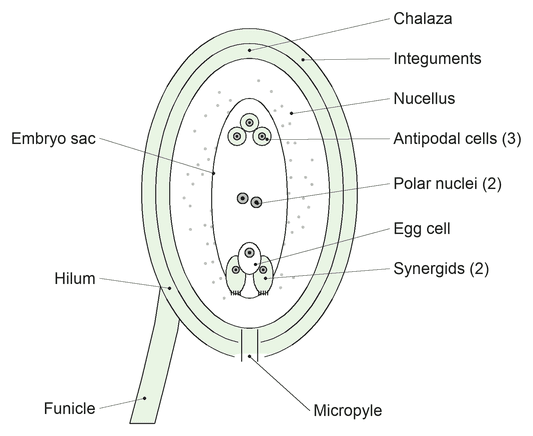
Step 2 — Label the outer parts.
The funicle is the stalk that attaches the ovule to the placenta, and the hilum is the point where the funicle joins the body of the ovule. The two integuments are the protective coats; at the tip they leave a small opening, the micropyle, through which the pollen tube usually enters. The chalaza is the base of the ovule, opposite the micropyle, where the integuments, nucellus and funicle meet.
Step 3 — Label the nucellus and the embryo sac.
The nucellus is the mass of cells inside the integuments, rich in food. Embedded in it, towards the micropyle, is the embryo sac, the female gametophyte.
Step 4 — Label the cells of the embryo sac.
At the micropylar end is the egg apparatus: the egg cell and two synergids, whose tips carry the finger-like filiform apparatus. At the chalazal end are the three antipodal cells. The large central cell in the middle holds the two polar nuclei, which often fuse before fertilisation to form the definitive (secondary) nucleus. This gives 7 cells and 8 nuclei in all.
Therefore, the labelled diagram of a mature ovule shows the funicle, hilum, micropyle, chalaza, two integuments, nucellus and the 7-celled, 8-nucleate embryo sac with its egg cell, two synergids, three antipodal cells and the polar nuclei of the central cell.
- 933 marks
Question 93
'Incompatibility is a natural barrier in the fusion of gametes'. Justify the statement.
Solve with AIWritten solution
Solution:
Key idea: Pollination alone does not ensure fertilisation. The pistil can recognise pollen: it accepts compatible pollen and rejects pollen of another species or, in many plants, the plant's own pollen. This pollen–pistil interaction is controlled by genes.
Step 1 — Explain what incompatibility is.
Incompatibility is the failure of fertile pollen to bring about fertilisation on a fertile, mature pistil. Pollen of an unrelated species is rejected (interspecific incompatibility), and in many species the plant's own pollen is rejected too (self-incompatibility).
Step 2 — Explain the genetic basis of self-incompatibility.
Self-incompatibility is controlled by a gene with many alleles at the S locus. When the S allele carried by the pollen matches an S allele of the pistil, the pistil stops that pollen. Pollen from a plant with different alleles is accepted.
Step 3 — Describe the two main types.
In gametophytic self-incompatibility, the pollen's own haploid S allele decides the outcome. The pollen germinates, but its tube stops growing in the style, as in ornamental tobacco (Nicotiana alata), Petunia, apple and pear. In sporophytic self-incompatibility, the diploid genotype of the parent plant that made the pollen decides, because proteins from the anther's tapetum coat the pollen; the pollen fails to germinate on the stigma surface, as in cabbage, mustard and other members of Brassicaceae.
Step 4 — Explain why this is a natural barrier to the fusion of gametes.
In both types the block acts on the stigma or in the style, so the pollen tube never reaches the embryo sac and the male gametes never meet the egg, even though pollination has taken place. The barrier is built into the plant's own genes, so it is natural. It prevents self-fertilisation and crosses with other species, and it promotes out-crossing and genetic variation.
Therefore, incompatibility is a natural barrier to the fusion of gametes, because the pistil's genetic recognition system stops unsuitable pollen from germinating or growing a tube, so its male gametes never reach the egg even after pollination.
- 943 marks
Question 94
What is agamospermy? How is agamospermy different from parthenogenesis and parthenocarpy?
Solve with AIWritten solution
Solution:
Key idea: Apomixis in flowering plants usually means agamospermy: the formation of seeds without meiosis and fertilisation. It is a form of asexual reproduction that mimics sexual reproduction, seen in some species of Asteraceae and grasses.
Step 1 — Define agamospermy.
In agamospermy a seed with an embryo forms without fertilisation. The embryo comes from a diploid cell of the ovule in one of two ways. Either an embryo sac forms without meiosis, from the megaspore mother cell or from a nucellus cell, and its diploid egg grows into an embryo without fertilisation; or a nucellus or integument cell grows directly into an embryo (adventive embryony, as in Citrus and mango). Either way the embryo is genetically identical to the mother plant.
Step 2 — Compare it with parthenogenesis.
Parthenogenesis is the development of an embryo from an unfertilised egg only. If the egg was formed after normal meiosis, the embryo is haploid; if it lies in an embryo sac formed without meiosis, the embryo is diploid, and this diploid parthenogenesis is one way agamospermy occurs. Agamospermy is the wider term, because its embryo may also arise from other diploid cells of the ovule.
Step 3 — Compare it with parthenocarpy.
Parthenocarpy is the development of a fruit from the ovary without fertilisation. No embryo or seed is formed, so the fruit is seedless, as in banana. Agamospermy, by contrast, produces seeds with embryos.
Step 4 — Summarise the three processes.
The table below compares the three.
Process What forms without fertilisation Seeds formed? Agamospermy Embryo, from the egg or another diploid cell of the ovule Yes Parthenogenesis Embryo, from the unfertilised egg only Yes, if the ovule matures Parthenocarpy Fruit, from the ovary No (seedless fruit) Therefore, agamospermy is the formation of seeds without fertilisation; it differs from parthenogenesis, which is only the growth of an unfertilised egg into an embryo, and from parthenocarpy, which is the formation of a seedless fruit without fertilisation.
- 953 marks
Question 95
Write three post-fertilisation changes leading to the formation of seed.
Solve with AIWritten solution
Solution:
Key idea: After double fertilisation the ovule develops into the seed and the ovary develops into the fruit. Inside the ovule, each part changes in a fixed way.
Step 1 — Describe the formation of the endosperm.
The triploid primary endosperm nucleus (formed by triple fusion) divides repeatedly to form the endosperm, the food store. This happens before the embryo develops much, so that food is ready for it. In coconut the endosperm stays free-nuclear in the coconut water and becomes cellular in the white kernel.
Step 2 — Describe the formation of the embryo.
The diploid zygote (the fertilised egg) divides by mitosis and passes through the proembryo, globular and heart-shaped stages to form the mature embryo, with its radicle, plumule and one or two cotyledons.
Step 3 — Describe the formation of the seed coats.
The integuments harden into the protective seed coats: the outer integument forms the testa and the inner one the tegmen. The micropyle remains as a small pore through which water and oxygen enter during germination.
Step 4 — Note the other changes.
The synergids and antipodal cells degenerate, and the nucellus is mostly used up (it persists as perisperm in black pepper and beet). The seed then loses most of its water and becomes dormant.
Therefore, three post-fertilisation changes that form the seed are: the primary endosperm nucleus develops into the endosperm, the zygote develops into the embryo, and the integuments harden into the seed coats.
- 963 marks
Question 96
Give two important adaptations found in anemophilic and wind-pollinated flowers.
Solve with AIWritten solution
Solution:
Key idea: Anemophilous flowers are wind-pollinated. The wind carries pollen at random, so these flowers are built to release pollen into the air and to catch pollen from the air, rather than to attract animals.
Step 1 — Describe the flowers.
The flowers are small, usually green and inconspicuous, with no scent or nectar, because they do not need to attract animals. They are often packed into inflorescences, such as the tassels of maize and the spikelets of grasses, that are held up in the wind.
Step 2 — Describe the stamens and pollen.
The stamens have long filaments and loosely attached anthers that hang outside the flower and swing in the wind. The pollen grains are small, light, dry and non-sticky, and they are produced in enormous numbers (a single maize tassel sheds millions) because most of the pollen is wasted.
Step 3 — Describe the stigma.
The stigmas are large, feathery and exposed, often hanging outside the flower, so they act like nets that trap pollen from the air. The silks of maize are long styles with stigmas of this kind. Each ovary usually has a single ovule.
Therefore, two important adaptations of wind-pollinated flowers are light, dry, non-sticky pollen produced in very large amounts from exposed, dangling stamens, and large, feathery, exposed stigmas that trap pollen from the air.
- 973 marks
Question 97
What is the significance of double fertilisation? Name the cells involved in triple fusion.
Solve with AIWritten solution
Solution:
Key idea: Double fertilisation is the occurrence of two fusions in the same embryo sac: syngamy (male gamete + egg) and triple fusion (male gamete + two polar nuclei).
Step 1 — State the result of the first fusion, syngamy.
One male gamete fuses with the egg to form the diploid zygote, which develops into the embryo and later the new plant. Syngamy restores the diploid chromosome number and brings together the genes of two parents, which gives variation.
Step 2 — State the result of the second fusion, triple fusion.
The other male gamete fuses with the two polar nuclei to form the triploid primary endosperm nucleus. This develops into the endosperm, the tissue that stores food for the growing embryo, and in cereals such as wheat and rice for the young seedling as well.
Step 3 — Explain why linking the two fusions is useful.
Because the endosperm normally forms only after triple fusion has taken place, the plant does not spend food on ovules that have no embryo. Food is laid down only in ovules that will become seeds. The endosperm also carries genes from both parents.
Step 4 — Name the cells involved in triple fusion.
Triple fusion involves the second male gamete and the central cell, with its two polar nuclei (or the secondary nucleus formed from them). The three haploid nuclei fuse to give the triploid nucleus.
Note: Double fertilisation that produces an endosperm is found only in flowering plants. The gymnosperms Ephedra and Gnetum show a second fusion too, but it forms an extra embryo, not an endosperm.
Therefore, double fertilisation forms both the embryo (from the diploid zygote) and its food store, the endosperm (from the triploid primary endosperm nucleus), so that endosperm develops only in fertilised ovules; triple fusion involves one male gamete and the two polar nuclei of the central cell.
- 983 marks
Question 98
What is the site of microsporogenesis? Define parthenocarpy. Give one example in which it occurs naturally.
Solve with AIWritten solution
Solution:
Key idea: Microsporogenesis is the formation of microspores by meiosis. Parthenocarpy is the formation of fruit without fertilisation.
Step 1 — State the site of microsporogenesis.
Microsporogenesis takes place in the microsporangia (pollen sacs) of the anther. A typical anther has four of them. The diploid pollen mother cells of the sporogenous tissue divide by meiosis to form tetrads of haploid microspores, which develop into pollen grains.
Step 2 — Define parthenocarpy.
Normally a fruit develops from the ovary only after fertilisation, and the fertilised ovules become seeds. In parthenocarpy the ovary develops into a fruit without fertilisation. As no ovule is fertilised, no seeds form, so the fruit is seedless.
Step 3 — Give a natural example.
Parthenocarpy occurs naturally in banana. Cultivated bananas form their fruits without fertilisation, and the tiny black specks in the pulp are undeveloped ovules, not seeds.
Therefore, microsporogenesis takes place in the microsporangia (pollen sacs) of the anther; parthenocarpy is the formation of a seedless fruit from an ovary without fertilisation, and it occurs naturally in banana.
- 993 marks
Question 99
Coconut palm is monoecious while date palm is dioecious. Why are they called so?
Solve with AIWritten solution
Solution:
Key idea: The terms come from Greek: mono (one) or di (two) and oikos (house). A monoecious plant is one 'house' for both sexes; in a dioecious plant the two sexes live in two different 'houses'.
Step 1 — Explain why coconut palm is monoecious.
A coconut palm bears unisexual flowers, but every plant bears both kinds: each inflorescence has many male flowers and fewer, larger female flowers. Since male and female flowers are on the same plant, coconut palm is monoecious. Maize and castor are other examples.
Step 2 — Explain why date palm is dioecious.
In date palm each tree bears flowers of only one sex: male trees bear only male flowers and female trees bear only female flowers. Since the sexes are on different plants, date palm is dioecious. Growers keep a few male trees or carry pollen to the female trees by hand. Papaya is another example.
Step 3 — Explain the effect on pollination.
Because every flower of both plants is unisexual, neither plant can pollinate a flower with its own pollen, so autogamy is prevented. In the monoecious coconut, pollen can still pass from a male flower to a female flower of the same palm (geitonogamy). In the dioecious date palm both autogamy and geitonogamy are prevented, so only cross-pollination can occur.
Therefore, coconut palm is called monoecious because one plant bears both male and female flowers, and date palm is called dioecious because its male and female flowers are borne on separate plants, so a date palm flower can be pollinated only with pollen from another plant.
- 1003 marks
Question 100
Explain any two devices by which autogamy is prevented in flowering plants. Name the type of flower which favours cross-pollination.
Solve with AIWritten solution
Solution:
Key idea: Autogamy is the transfer of pollen to the stigma of the same flower. Flowering plants have several outbreeding devices that prevent it: dichogamy, herkogamy (including heterostyly), self-incompatibility and unisexual flowers.
Step 1 — Explain dichogamy.
In many bisexual flowers the anthers and the stigma of the same flower mature at different times, so the flower's own pollen is not shed while its stigma is receptive. In protandry the anthers mature first, as in sunflower and Salvia; in protogyny the stigma matures first, as in the banyan and other figs.
Step 2 — Explain heterostyly.
In heterostyly the plants of a species bear flowers with styles and stamens of different lengths. In Primula (distyly) some plants have pin flowers (long style, short stamens) and others have thrum flowers (short style, long stamens); Lythrum has three forms (tristyly). The anthers and stigma of one flower stand at different levels, so its own pollen does not easily reach its stigma, and an insect carries pollen between anthers and stigmas standing at the same level in the other form.
Step 3 — Name the type of flower that favours cross-pollination.
Unisexual flowers favour cross-pollination, because a female flower has no pollen of its own. On dioecious plants such as date palm and papaya, cross-pollination is the only kind possible.
Therefore, dichogamy and heterostyly are two devices that prevent autogamy, and unisexual flowers (especially on dioecious plants) favour cross-pollination.
- 1012 marks
Question 101
Self-pollination and cross-pollination
Solve with AIWritten solution
Solution:
Key idea: Self-pollination is the transfer of pollen to a stigma of the same plant; cross-pollination (xenogamy) is its transfer to the stigma of a flower on another plant of the same species.
Step 1 — Describe self-pollination.
Self-pollination includes autogamy (pollen to the stigma of the same flower) and geitonogamy (pollen to another flower of the same plant). The pollen and the ovules have the same genetic make-up.
Step 2 — Describe cross-pollination.
In cross-pollination pollen is carried by wind, water or animals to a flower on a different plant, so it brings together genetically different gametes.
Step 3 — Set out the differences.
The table below compares the two kinds of pollination.
Feature Self-pollination Cross-pollination Flowers involved Same flower, or another flower on the same plant Flowers on two different plants of the same species External agent Not needed for autogamy; needed for geitonogamy Always needed (wind, water or animals) Amount of pollen Smaller amount is enough Large amount, as much is wasted Genetic result Keeps lines pure (homozygous); little new variation Brings new combinations of genes (variation) Offspring Uniform; repeated selfing may lower vigour Usually more vigorous and adaptable Therefore, self-pollination transfers pollen within the same plant and keeps the offspring uniform, whereas cross-pollination transfers pollen between different plants of the same species and gives variation and vigour.
- 1022 marks
Question 102
Wind pollinated flowers and insect pollinated flowers
Solve with AIWritten solution
Solution:
Key idea: Flowers are adapted to their pollinating agent. Wind-pollinated (anemophilous) flowers release and catch pollen in the air; insect-pollinated (entomophilous) flowers attract insects and load pollen onto them.
Step 1 — Describe wind-pollinated flowers.
Wind-pollinated flowers, as in maize and grasses, do not need to attract animals. They are built to shed large amounts of light pollen into the air and to trap it with large stigmas.
Step 2 — Describe insect-pollinated flowers.
Insect-pollinated flowers, as in Salvia and sunflower, attract insects with colour, scent and nectar, and their sticky pollen clings to the insect's body.
Step 3 — Set out the differences.
The table below compares the two kinds of flowers.
Feature Wind-pollinated flower Insect-pollinated flower Flowers Small and inconspicuous Usually large and conspicuous, or in showy clusters Petals Reduced, green or absent Large and brightly coloured Scent and nectar Absent Usually present Stamens Long, hanging outside; anthers loosely attached Usually inside the flower; anthers firmly attached Pollen Small, light, dry, smooth; produced in huge numbers Larger, sticky or spiny; produced in smaller numbers Stigma Large, feathery, exposed Small, flat or lobed, sticky Therefore, wind-pollinated flowers are small and dull, with light, abundant pollen and feathery stigmas, whereas insect-pollinated flowers are large, coloured and scented, with nectar, sticky pollen and sticky stigmas.
- 1032 marks
Question 103
Vegetative and generative cell
Solve with AIWritten solution
Solution:
Key idea: A mature pollen grain usually has two cells: a large vegetative cell and a small generative cell. Both are formed when the microspore divides once by an unequal mitosis.
Step 1 — Describe the vegetative cell.
The vegetative cell is the bigger cell. It has abundant food reserves and a large, irregularly shaped nucleus. When the pollen germinates it grows out as the pollen tube, and its nucleus is called the tube nucleus.
Step 2 — Describe the generative cell.
The generative cell is small and spindle-shaped, with dense cytoplasm and a nucleus. It floats in the cytoplasm of the vegetative cell. It divides by mitosis to form the two male gametes, either before the pollen is shed or inside the pollen tube.
Step 3 — Set out the differences.
The table below compares the two cells.
Feature Vegetative cell Generative cell Size Large; forms the bulk of the pollen grain Small Shape and nucleus Large, irregularly shaped nucleus Spindle-shaped cell with dense cytoplasm and a nucleus Food reserve Abundant Little Position Fills the pollen grain Floats in the cytoplasm of the vegetative cell Fate Forms the pollen tube; the tube nucleus finally degenerates Divides by mitosis to form two male gametes Therefore, the vegetative cell is the large food-rich cell that forms the pollen tube, whereas the generative cell is the small spindle-shaped cell that divides to form the two male gametes.
- 1042 marks
Question 104
Apocarpous and syncarpous
Solve with AIWritten solution
Solution:
Key idea: The gynoecium (pistil) of a flower is made of one or more carpels. When a flower has two or more carpels, they may stay free from one another (apocarpous) or be joined together (syncarpous).
Step 1 — State what the two terms describe.
Both terms describe a multicarpellary gynoecium, that is, one with more than one carpel. The two conditions differ only in whether the carpels are free or fused.
Step 2 — Compare the two conditions.
The table below sets the two conditions side by side.
Feature Apocarpous Syncarpous Carpels Free from one another Fused with one another, wholly or partly Pistils seen Several separate pistils, one for each carpel One compound pistil Ovary Each carpel has its own ovary One common ovary formed by the fused carpels Examples Lotus, rose, Michelia China rose (Hibiscus), mustard, tomato Therefore, an apocarpous gynoecium has free carpels (as in lotus and rose), while a syncarpous gynoecium has fused carpels forming one compound pistil (as in China rose and mustard).
- 1052 marks
Question 105
Autogamy and geitonogamy
Solve with AIWritten solution
Solution:
Key idea: Self-pollination in the wide sense is of two kinds: autogamy, in which pollen reaches the stigma of the same flower, and geitonogamy, in which pollen reaches the stigma of another flower on the same plant.
Step 1 — Define autogamy.
Autogamy is the transfer of pollen from the anther to the stigma of the same flower. It needs a bisexual flower whose anthers and stigma mature at the same time and lie close together. It is assured in cleistogamous flowers, such as some flowers of Viola, Oxalis and Commelina, which never open.
Step 2 — Define geitonogamy.
Geitonogamy is the transfer of pollen from the anther of one flower to the stigma of another flower on the same plant. It works like cross-pollination, because a pollinating agent has to carry the pollen between flowers. Genetically, however, it is the same as autogamy, because the pollen comes from the same plant.
Step 3 — Compare the two kinds.
The table below lists the differences.
Feature Autogamy Geitonogamy Pollen goes to The stigma of the same flower The stigma of another flower on the same plant Kind of flower Bisexual flowers only Bisexual or unisexual flowers (for example, in monoecious plants) Pollinating agent Usually not needed Needed (wind, insects or other agents) Genetic result Pollen and egg come from the same plant Pollen and egg also come from the same plant, so no genes from another plant enter Examples Pea, wheat, rice; cleistogamous flowers Maize, when pollen from the tassel falls on the silks of the same plant; cucurbits Therefore, autogamy carries pollen within the same flower, while geitonogamy carries it to another flower of the same plant; geitonogamy needs an agent but is genetically the same as self-pollination.
- 1062 marks
Question 106
Microsporogenesis and megasporogenesis
Solve with AIWritten solution
Solution:
Key idea: Sporogenesis is the formation of haploid spores from diploid mother cells by meiosis. In a flower it takes place in two organs: in the anther (microsporogenesis) and in the ovule (megasporogenesis).
Step 1 — Describe microsporogenesis.
In each pollen sac (microsporangium) of the anther there are many diploid pollen mother cells (microspore mother cells). Each one divides by meiosis to form four haploid microspores, held together as a tetrad. All four microspores usually develop into pollen grains.
Step 2 — Describe megasporogenesis.
In the nucellus of the ovule (megasporangium), usually one diploid megaspore mother cell near the micropyle divides by meiosis to form four haploid megaspores, usually in a row (a linear tetrad). In most flowering plants only one of them, usually the one at the chalazal end, is functional; the other three degenerate.
Step 3 — Compare the two processes.
The table below sets out the differences.
Feature Microsporogenesis Megasporogenesis Site Pollen sacs (microsporangia) of the anther Nucellus of the ovule (megasporangium) Mother cells Many pollen mother cells in each pollen sac Usually one megaspore mother cell in each ovule Arrangement of the four spores Usually a tetrahedral or isobilateral tetrad Usually a linear tetrad Fate of the spores All four usually form pollen grains (male gametophytes) Usually only one survives and forms the embryo sac (female gametophyte) Therefore, microsporogenesis forms four functional microspores from each pollen mother cell in the anther, while megasporogenesis forms four megaspores from one megaspore mother cell in the ovule, of which usually only one survives.
- 1072 marks
Question 107
Hypocotyl and epicotyl
Solve with AIWritten solution
Solution:
Key idea: An embryo has a central embryonal axis with the cotyledon or cotyledons attached to it. The point of attachment divides the axis into a part above it (the epicotyl) and a part below it (the hypocotyl).
Step 1 — Locate the hypocotyl.
The hypocotyl is the part of the embryonal axis below the point where the cotyledons are attached. Its lower end is the radicle, the future root. In the seedling the radicle forms the root, and the hypocotyl forms the short stem region just above it. In epigeal germination (bean, castor) the hypocotyl lengthens and lifts the cotyledons above the soil.
Step 2 — Locate the epicotyl.
The epicotyl is the part of the embryonal axis above the point where the cotyledons are attached. It ends in the plumule, the shoot tip, which forms the shoot. In hypogeal germination (pea, gram) the epicotyl lengthens, while the cotyledons stay below the soil.
Step 3 — Compare the two parts.
The table below sets out the differences.
Feature Hypocotyl Epicotyl Position Below the point of attachment of the cotyledons Above the point of attachment of the cotyledons Ends in The radicle The plumule In the seedling Forms the stem region just above the root (the radicle forms the root) Forms the stem above the cotyledons (the plumule forms the shoot) Lengthens in Epigeal germination (bean, castor) Hypogeal germination (pea, gram) Therefore, the hypocotyl is the part of the embryonal axis below the cotyledons and ends in the radicle, while the epicotyl is the part above the cotyledons and ends in the plumule.
- 1082 marks
Question 108
Maize seed and gram seed
Solve with AIWritten solution
Solution:
Key idea: Maize is a monocot whose grain is really a one-seeded fruit (a caryopsis) with a large endosperm. Gram (chickpea, Cicer arietinum) is a dicot whose mature seed has no endosperm left, because its food has moved into the two cotyledons.
Step 1 — Describe the maize grain.
In the maize grain the seed coat is fused with the fruit wall (pericarp). Most of the grain is endosperm, which stores starch and is bounded on the outside by a protein-rich aleurone layer. The embryo has a single shield-shaped cotyledon, the scutellum. Its plumule is enclosed in a sheath, the coleoptile, and its radicle in another sheath, the coleorhiza.
Step 2 — Describe the gram seed.
The gram seed lies inside a pod, and its seed coat is free from the fruit wall. The endosperm is used up while the seed develops, so the mature seed is non-endospermic. The two large cotyledons store the food: mainly starch, with a high share of protein (about 20 %). The plumule and radicle are not covered by any sheath.
Step 3 — Compare the two seeds.
The table below sets out the differences.
Feature Maize grain Gram seed Class Monocot: one cotyledon (scutellum) Dicot: two cotyledons Endosperm Present (endospermic or albuminous seed) Absent in the mature seed (non-endospermic or exalbuminous seed) Seed coat Fused with the fruit wall (pericarp) Free from the fruit wall (pod) Main food store Endosperm, mainly starch Cotyledons, starch with much protein Plumule and radicle Covered by the coleoptile and the coleorhiza Not covered by any sheath Therefore, the maize grain is an endospermic monocot seed fused with its fruit wall, with a scutellum, coleoptile and coleorhiza, while the gram seed is a non-endospermic dicot seed whose two cotyledons store the food.
- 1092 marks
Question 109
Racemose and cymose inflorescence
Solve with AIWritten solution
Solution:
Key idea: An inflorescence is the arrangement of flowers on the floral axis. Its two basic types differ in whether the main axis keeps growing (racemose) or ends in a flower (cymose).
Step 1 — Describe a racemose inflorescence.
In a racemose inflorescence the main axis goes on growing and does not end in a flower. Flowers arise on its sides in acropetal order, so the oldest flowers are at the base and the youngest near the tip. When the axis is flattened into a head, as in the sunflower, the oldest flowers are at the edge and the flowers open from the edge towards the centre (centripetal order).
Step 2 — Describe a cymose inflorescence.
In a cymose inflorescence the main axis ends in a flower, so its growth is limited. Further flowers arise on side branches below it, so the terminal flower is the oldest (basipetal order) and the flowers open from the centre outwards (centrifugal order).
Step 3 — Compare the two types.
The table below sets out the differences.
Feature Racemose Cymose Growth of the main axis Unlimited; it does not end in a flower Limited; it ends in a flower Order of flowers Acropetal: the oldest flowers are at the base Basipetal: the terminal flower is the oldest Opening of flowers Centripetal: from the base or edge towards the tip or centre Centrifugal: from the tip or centre outwards Examples Mustard (raceme), sunflower (head) Jasmine (dichasial cyme), Begonia Therefore, a racemose inflorescence has an axis of unlimited growth with flowers in acropetal order, while a cymose inflorescence has an axis ending in a flower with flowers in basipetal order.
- 1102 marks
Question 110
True fruit and false fruit
Solve with AIWritten solution
Solution:
Key idea: After fertilisation the ovary develops into the fruit. If the fruit forms only from the ovary it is a true fruit; if another floral part, most often the thalamus (receptacle), also forms a large part of it, it is a false fruit.
Step 1 — Describe a true fruit.
In a true fruit the ovary wall becomes the pericarp and the ovules become the seeds; no other floral part joins in. In mango the edible part is the fleshy mesocarp, in tomato the fleshy pericarp and placenta, and in coconut the endosperm of the seed.
Step 2 — Describe a false fruit.
In a false fruit another part of the flower grows along with the ovary. In apple the thalamus becomes fleshy and surrounds the ovary, so the edible part is the thalamus and the core is the true fruit. In strawberry the receptacle becomes fleshy and carries tiny true fruits on its surface. In cashew the swollen pedicel forms the cashew apple, and the true fruit is the kidney-shaped nut.
Step 3 — Compare the two kinds of fruit.
The table below sets out the differences.
Feature True fruit False fruit Develops from The ovary only The ovary together with another floral part, mostly the thalamus Edible part Part of the pericarp or the seed (mesocarp of mango, endosperm of coconut) Often the fleshy non-ovary part (thalamus of apple, receptacle of strawberry, pedicel of cashew) Examples Mango, tomato, coconut Apple, strawberry, cashew Therefore, a true fruit develops from the ovary alone (mango, tomato), while a false fruit develops from the ovary together with other floral parts such as the thalamus (apple, strawberry).
- 1115 marks
Question 111
Explain the development of the male gametophyte in plants.
Solve with AIWritten solution
Solution:
Key idea: The pollen grain is the male gametophyte of a flowering plant. It forms inside the anther in two stages: microsporogenesis, in which meiosis of pollen mother cells gives haploid microspores, and the development of each microspore, by mitosis, into a two- or three-celled pollen grain.
Step 1 — Describe the microsporangium.
A typical anther is bilobed, and each lobe has two pollen sacs (microsporangia), so there are four in all. Each microsporangium is surrounded by four wall layers: the epidermis, the endothecium, the middle layers and the innermost tapetum. The outer three layers protect the sac and help it split open to release the pollen. The tapetum has cells with dense cytoplasm, often with more than one nucleus, and it nourishes the developing pollen grains.
Step 2 — Describe the sporogenous tissue.
In a young anther the centre of each microsporangium is filled with compactly arranged sporogenous cells. These may divide by mitosis a few times. Each cell finally formed is a diploid pollen mother cell (PMC), also called a microspore mother cell or microsporocyte, and each can form one tetrad of microspores.
Step 3 — Explain microsporogenesis.
Each PMC divides by meiosis. Meiosis I separates the homologous chromosomes and meiosis II separates the sister chromatids, so four haploid (n) cells are formed. These microspores stay together for a while as a microspore tetrad. Because meiosis halves the chromosome number, every pollen grain is haploid.
Step 4 — Describe how the pollen wall forms.
As the anther matures and dries, the microspores separate from each tetrad. Each one forms a two-layered wall: a tough outer exine of sporopollenin, with a pattern typical of the species and thin areas called germ pores, and a thin inner intine of cellulose and pectin.
Step 5 — Explain the first mitosis inside the microspore.
The microspore nucleus moves to one side and divides by mitosis with an unequal (asymmetric) spindle. This gives a large vegetative cell, with plenty of food and a large irregular nucleus, and a small spindle-shaped generative cell that floats in the cytoplasm of the vegetative cell. The microspore has now become a pollen grain, the male gametophyte.
Step 6 — Explain how the male gametes form.
The generative cell divides once more by mitosis to give two male gametes. In over 60 % of flowering plants the pollen is shed at the two-celled stage, and this division takes place later inside the growing pollen tube. In the rest it takes place before shedding, so the pollen is shed at the three-celled stage.
Step 7 — Describe how the pollen is released.
When the pollen is mature, the wall between the two pollen sacs of each lobe breaks down. The anther then splits along a line of dehiscence and the pollen grains are released.
Step 8 — Show the stages in a diagram.
The diagram below shows the sequence: a diploid microspore mother cell divides by meiosis I and meiosis II into a tetrad of four haploid microspores; these separate, and one mitosis turns each microspore into a mature pollen grain with an exine, an intine, a vegetative nucleus and a generative nucleus.
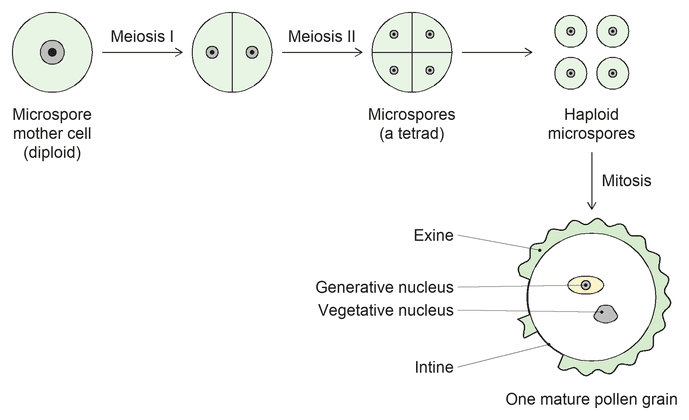
Therefore, the male gametophyte develops when each diploid pollen mother cell in the anther divides by meiosis into four haploid microspores, and each microspore forms an exine and an intine and divides by mitosis into a vegetative cell and a generative cell, which later divides to give two male gametes.
- 1125 marks
Question 112
Explain the development of a pollen grain in the anther.
Solve with AIWritten solution
Solution:
Key idea: The pollen grain is the male gametophyte of a flowering plant. It forms inside the anther in two stages: microsporogenesis, in which meiosis of pollen mother cells gives haploid microspores, and the development of each microspore, by mitosis, into a two- or three-celled pollen grain.
Step 1 — Describe the microsporangium.
A typical anther is bilobed, and each lobe has two pollen sacs (microsporangia), so there are four in all. Each microsporangium is surrounded by four wall layers: the epidermis, the endothecium, the middle layers and the innermost tapetum. The outer three layers protect the sac and help it split open to release the pollen. The tapetum has cells with dense cytoplasm, often with more than one nucleus, and it nourishes the developing pollen grains.
Step 2 — Describe the sporogenous tissue.
In a young anther the centre of each microsporangium is filled with compactly arranged sporogenous cells. These may divide by mitosis a few times. Each cell finally formed is a diploid pollen mother cell (PMC), also called a microspore mother cell or microsporocyte, and each can form one tetrad of microspores.
Step 3 — Explain microsporogenesis.
Each PMC divides by meiosis. Meiosis I separates the homologous chromosomes and meiosis II separates the sister chromatids, so four haploid (n) cells are formed. These microspores stay together for a while as a microspore tetrad. Because meiosis halves the chromosome number, every pollen grain is haploid.
Step 4 — Describe how the pollen wall forms.
As the anther matures and dries, the microspores separate from each tetrad. Each one forms a two-layered wall: a tough outer exine of sporopollenin, with a pattern typical of the species and thin areas called germ pores, and a thin inner intine of cellulose and pectin.
Step 5 — Explain the first mitosis inside the microspore.
The microspore nucleus moves to one side and divides by mitosis with an unequal (asymmetric) spindle. This gives a large vegetative cell, with plenty of food and a large irregular nucleus, and a small spindle-shaped generative cell that floats in the cytoplasm of the vegetative cell. The microspore has now become a pollen grain, the male gametophyte.
Step 6 — Explain how the male gametes form.
The generative cell divides once more by mitosis to give two male gametes. In over 60 % of flowering plants the pollen is shed at the two-celled stage, and this division takes place later inside the growing pollen tube. In the rest it takes place before shedding, so the pollen is shed at the three-celled stage.
Step 7 — Describe how the pollen is released.
When the pollen is mature, the wall between the two pollen sacs of each lobe breaks down. The anther then splits along a line of dehiscence and the pollen grains are released.
Step 8 — Show the stages in a diagram.
The diagram below shows the sequence: a diploid microspore mother cell divides by meiosis I and meiosis II into a tetrad of four haploid microspores; these separate, and one mitosis turns each microspore into a mature pollen grain with an exine, an intine, a vegetative nucleus and a generative nucleus.
Therefore, a pollen grain develops in the anther when each diploid pollen mother cell in the anther divides by meiosis into four haploid microspores, and each microspore forms an exine and an intine and divides by mitosis into a vegetative cell and a generative cell, which later divides to give two male gametes.
- 1135 marks
Question 113
Discuss the development of an ovule till the formation of an embryo-sac.
Solve with AIWritten solution
Solution:
Key idea: The female gametophyte (embryo sac) develops inside the ovule in two stages: megasporogenesis, in which meiosis of a megaspore mother cell gives four haploid megaspores, and the development of one megaspore, by three rounds of free-nuclear mitosis, into the eight-nucleate, seven-celled embryo sac.
Step 1 — Describe the young ovule.
The ovule (megasporangium) arises from the placenta on the inner wall of the ovary as a small knob. It is attached by a stalk, the funicle, and the point where the body of the ovule meets the funicle is the hilum. Its main body is the nucellus, a mass of cells with reserve food, covered by one or two integuments except at a small opening, the micropyle. The opposite end, where the integuments and the nucellus join, is the chalaza.
Step 2 — Identify the megaspore mother cell.
A single cell of the nucellus near the micropylar end enlarges, gains dense cytoplasm and a large nucleus, and becomes the megaspore mother cell (MMC). Like the rest of the ovule, it is diploid (2n).
Step 3 — Explain megasporogenesis.
The MMC divides by meiosis. Meiosis I gives two cells (a dyad), and meiosis II gives four haploid (n) megaspores, usually arranged in a row (a linear tetrad).
Step 4 — State which megaspore survives.
In most flowering plants only one megaspore, usually the one at the chalazal end, is functional, and the other three degenerate. Because the embryo sac develops from this single megaspore, the development is called monosporic.
Step 5 — Describe the free-nuclear divisions.
The functional megaspore enlarges and its nucleus divides by mitosis. The two daughter nuclei move to opposite poles, giving the two-nucleate embryo sac. Two more mitoses at each pole give the four-nucleate and then the eight-nucleate stage, with four nuclei at each pole. These divisions are free nuclear: each nuclear division is not followed at once by the formation of a cell wall.
Step 6 — Describe how the cells are organised.
After the eight-nucleate stage, cell walls form. One nucleus from each pole moves to the centre; these two polar nuclei lie in the large central cell. The three nuclei left at the micropylar end become three cells, one egg cell and two synergids, which together form the egg apparatus. The three nuclei left at the chalazal end become the three antipodal cells.
Step 7 — State the structure of the mature embryo sac.
The mature embryo sac, the female gametophyte, therefore has 8 nuclei but only 7 cells: 3 antipodal cells, 1 central cell with 2 polar nuclei, 2 synergids and 1 egg cell. This monosporic pattern, first described in Polygonum, is called the Polygonum type, and it is found in most flowering plants.
Step 8 — Show the stages in a diagram.
The diagram below traces the whole sequence, from the megaspore mother cell to the mature embryo sac.
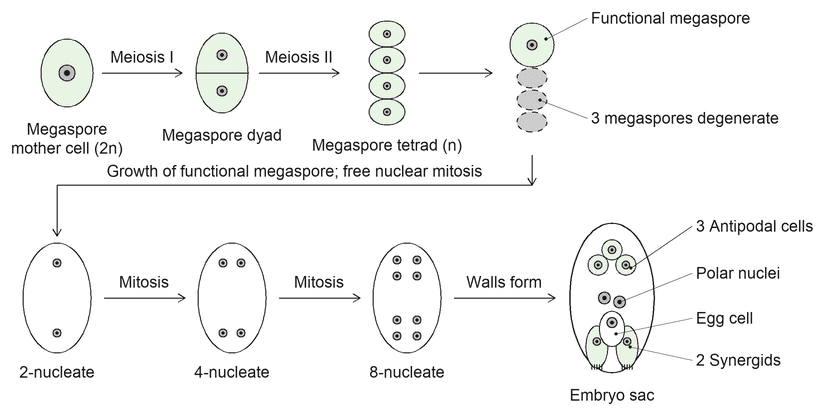
Therefore, inside the ovule a diploid megaspore mother cell divides by meiosis into four haploid megaspores, only one of which survives; its nucleus divides three times by free-nuclear mitosis, and walls then form to give the eight-nucleate, seven-celled embryo sac.
- 1145 marks
Question 114
Pollination is an important phenomenon in the life cycle of a flowering plant. Describe the agencies responsible for it.
Solve with AIWritten solution
Solution:
Key idea: Pollination is the transfer of pollen grains from the anther to the stigma. Pollen cannot move by itself, so plants use outside agents: abiotic agents (wind and water) and biotic agents (animals such as insects, birds and bats). Each kind of flower has features that suit its agent.
Step 1 — Describe pollination by wind (anemophily).
Wind is the commonest abiotic agent. Wind-pollinated flowers are small and inconspicuous, often green, and have no colour, scent or nectar. Their stamens are long and hang out of the flower so that the wind can shake out the pollen, which is light, dry, non-sticky and produced in huge amounts. The stigmas are large, feathery and exposed to trap pollen from the air, and each ovary usually has a single ovule. Examples are grasses such as wheat and rice, maize (the long silks of the cob are styles with stigmas that wave in the wind), Cannabis and the date palm.
Step 2 — Describe pollination by water (hydrophily).
Water pollination is rare: it is found in only about 30 genera, mostly monocots, such as Vallisneria and Hydrilla in fresh water and Zostera (a sea grass) in the sea. In Vallisneria the female flower reaches the water surface on a long stalk, and the male flowers or pollen are released onto the surface and drift with the water currents until some reach the female flowers. In sea grasses the flowers stay under water, and the long, ribbon-like pollen grains are carried inside the water. The pollen of most water-pollinated plants has a mucilage covering that keeps it from getting wet. Most water plants whose flowers stand above the water, such as water hyacinth and water lily, are pollinated by insects or wind, not by water.
Step 3 — Describe pollination by insects (entomophily).
Insects, especially bees, are the commonest biotic agents; butterflies, moths, flies, wasps and beetles also pollinate. Insect-pollinated flowers are usually large, brightly coloured, scented and rich in nectar, and small flowers are grouped into showy inflorescences. The pollen is often sticky or spiny, so it clings to the insect's body. Some flowers have special devices: the lever mechanism of Salvia dusts pollen on a bee's back, and the flower of the orchid Ophrys looks and smells like a female bee and attracts male bees. In return the insect gets a reward, such as nectar or pollen, or, in the yucca and its moth, a safe place to lay its eggs.
Step 4 — Describe pollination by birds (ornithophily).
Birds such as sunbirds pollinate flowers that are usually large, tubular and bright red or orange, with plenty of watery nectar and little or no scent, because birds find flowers by sight. Examples are the silk cotton tree (Bombax), the coral tree (Erythrina), flame of the forest (Butea monosperma) and the bottle brush (Callistemon).
Step 5 — Describe pollination by bats (chiropterophily).
Bats feed at night, so bat-pollinated flowers open at night. They are large, dull white or cream, strong-smelling, and give a lot of nectar and pollen; they are often borne on long stalks or on the trunk, where bats can reach them. Examples are the baobab (Adansonia), the sausage tree (Kigelia), Agave and wild bananas.
Step 6 — Mention other animal pollinators.
In a few plants other animals also carry pollen, such as lemurs, some tree-dwelling rodents and some lizards.
Therefore, pollination is brought about by abiotic agents, namely wind (anemophily) and water (hydrophily), and by biotic agents, namely insects (entomophily), birds (ornithophily), bats (chiropterophily) and a few other animals, and each kind of flower has features that suit its agent.
- 1155 marks
Question 115
What modifications do plants have for
(i) hydrophily
(ii) entomophily
(iii) anemophily and
(iv) cross-pollination?
Solve with AIWritten solution
Solution:
Key idea: The structure of a flower suits the way its pollen is carried. Water- and wind-pollinated flowers spend nothing on attracting animals, insect-pollinated flowers spend a great deal, and plants that depend on cross-pollination have devices that stop or discourage self-pollination.
Step 1 — (i) Describe the features of water-pollinated flowers.
Hydrophilous flowers are small and inconspicuous, without colour, scent or nectar, and their pollen has a mucilage covering that keeps it from getting wet. In Vallisneria, whose male and female flowers are on separate plants, the female flower reaches the water surface on a long stalk. The tiny male flowers break off, rise to the surface and float until some touch a female flower. After pollination the stalk of the female flower coils and pulls it under water, where the fruit develops. In the sea grass Zostera the flowers stay under water, and the pollen grains are long and thread-like, without an exine, so they wind round the long stigmas.
Step 2 — (ii) Describe the features of insect-pollinated flowers.
Entomophilous flowers have large, brightly coloured petals, or small flowers grouped into showy heads, as in the sunflower. They give scent and nectar, and many have lines or spots (nectar guides) that lead the insect to the nectar. The pollen is large and sticky or spiny, and is made in smaller amounts than in wind-pollinated flowers; the stigma is sticky. Some flowers have special devices, such as the lever mechanism of Salvia and landing platforms for bees.
Step 3 — (iii) Describe the features of wind-pollinated flowers.
Anemophilous flowers are small, often green, and have no nectar or scent. Their stamens have long filaments and anthers that hang outside the flower. The pollen is small, smooth, dry, light and non-sticky, and is made in huge amounts. The stigmas are large, feathery and exposed, and each ovary usually has a single ovule. The flowers are often packed into catkins or spikes, and in some trees they open before the leaves.
Step 4 — (iv) Explain unisexuality as a device for cross-pollination.
When flowers are unisexual, pollen cannot reach a stigma in the same flower. In dioecious plants, such as papaya and date palm, male and female flowers are on different plants, so both autogamy and geitonogamy are prevented. In monoecious plants, such as maize and castor, only autogamy is prevented.
Step 5 — Explain dichogamy.
In dichogamy the anthers and the stigma of the same flower mature at different times. In protandry the anthers shed their pollen before the stigma is receptive, as in the sunflower and Salvia. In protogyny the stigma is receptive before the anthers open, as in the fig family, such as the banyan.
Step 6 — Explain herkogamy and heterostyly.
In herkogamy the anthers and the stigma are placed so that pollen cannot fall on the stigma of the same flower, as in Calotropis and Gloriosa. In heterostyly the flowers of different plants have styles and stamens of different lengths: two forms in Primula (distyly) and three forms in Lythrum (tristyly). Pollen moves best between flowers whose anthers and stigma are at the same level.
Step 7 — Explain self-incompatibility.
Self-incompatibility is a genetic mechanism in which the pistil recognises pollen from the same plant and stops it from germinating or stops its pollen tube from growing, so only pollen from another plant can fertilise the ovules.
Therefore, water-pollinated flowers are small with water-proofed or thread-like pollen, insect-pollinated flowers are showy, scented and nectar-rich with sticky pollen, wind-pollinated flowers have hanging anthers, light pollen and feathery stigmas, and cross-pollination is ensured by unisexuality, dichogamy, herkogamy and self-incompatibility.
- 1165 marks
Question 116
Write a note on the need and significance of pollination in plants.
Solve with AIWritten solution
Solution:
Key idea: Pollination is the transfer of pollen grains from the anther to the stigma. In flowering plants the male gametes are carried inside the pollen grain and cannot swim to the egg, so pollination is the first step towards fertilisation.
Step 1 — Explain why pollination is needed.
The male gametes of flowering plants are non-motile and develop inside the pollen grain, while the egg lies deep inside the ovule. Pollen grains cannot move by themselves, and the anthers and stigma are often in different flowers or on different plants. The pollen must therefore be carried to the stigma, either by an agent or by the flower's own arrangement. Only then can it germinate and send a pollen tube that carries the male gametes to the egg.
Step 2 — Link pollination to fertilisation, seeds and fruits.
Without pollination there is no fertilisation, so no embryo, seed or fruit is formed (apart from special cases such as apomixis and parthenocarpy). Pollination is thus the start of the whole chain that gives seeds and fruits.
Step 3 — Explain how pollination starts fruit growth.
When compatible pollen lands and germinates, the pistil makes growth hormones (auxins and gibberellins). These stimulate the ovary to grow and stop the flower and young ovary from being shed (abscission). This is called fruit set.
Step 4 — Explain the significance for plant life and food.
Seeds carry the next generation, help the plant spread to new places and survive bad seasons, so they keep plant life going. Seeds and fruits are also food for humans and animals: cereals, pulses, oil seeds and fruits all depend on pollination, and many fruit and seed crops depend on insect pollinators such as bees.
Step 5 — Explain the significance of cross-pollination.
Cross-pollination brings together genes from two different plants, so the offspring show variation. They are often more vigorous and better able to adapt to a changing environment, and the variation is the raw material for evolution.
Step 6 — Explain the use of pollination in plant breeding.
Plant breeders carry out controlled cross-pollination, using emasculation and bagging, to combine useful characters of two parents, such as high yield and disease resistance, and to produce hybrid seeds.
Step 7 — Explain the significance of self-pollination.
Self-pollination gives assured seed set without any outside agent, as in the cleistogamous flowers of Viola, Oxalis and Commelina. It helps rare or isolated plants that have no partner nearby, and over a few generations it gives pure lines that keep the parents' characters.
Therefore, pollination is needed because non-motile male gametes inside pollen must be brought to the stigma, and it is significant because it leads to fertilisation, fruit set and seeds, gives variation through cross-pollination, is used to make hybrid seeds, and assures seed set through self-pollination.
- 1175 marks
Question 117
Describe the structure of a pollen grain and the process of its germination.
Solve with AIWritten solution
Solution:
Key idea: The pollen grain is the male gametophyte. It has a two-layered wall and, when shed, usually two cells. On a compatible stigma it germinates and forms a pollen tube that carries the male gametes to the ovule.
Step 1 — Describe the shape and size of the pollen grain.
Pollen grains are generally spherical and measure about 25 to 50 µm across. Each grain has a two-layered wall and living cells inside.
Step 2 — Describe the exine.
The exine is the thick, hard outer layer. It is made of sporopollenin, the most resistant organic material known: it withstands high temperatures and strong acids and alkalis, and no enzyme that breaks it down is known so far. This is why pollen survives for a very long time and is well preserved as fossils. The surface pattern of the exine, such as spines or ridges, is typical of each species.
Step 3 — Describe the germ pores.
In some places the exine is very thin or absent, because sporopollenin is not laid down there. These places are the germ pores, and the pollen tube comes out through one of them.
Step 4 — Describe the intine.
The intine is the thin, continuous inner layer, made of cellulose and pectin. When the pollen grain germinates, the intine grows out through a germ pore as the pollen tube.
Step 5 — Describe the cells inside the grain.
A mature pollen grain usually has two cells. The vegetative cell is large, has plenty of stored food and a large, irregular nucleus. The generative cell is small and spindle-shaped, with dense cytoplasm, and floats in the cytoplasm of the vegetative cell. In over 60 % of flowering plants pollen is shed at this two-celled stage; in the rest the generative cell divides first into two male gametes, and the pollen is shed at the three-celled stage.
Step 6 — Show the structure in a diagram.
The diagram below shows a mature two-celled pollen grain in section, with its parts labelled.
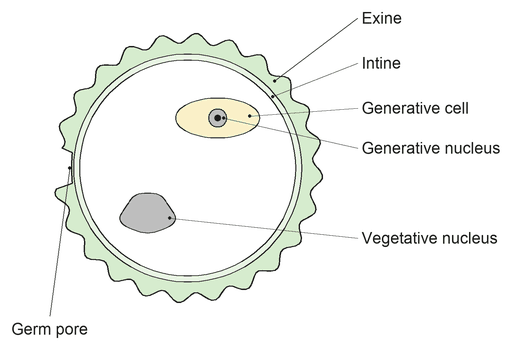
Step 7 — Explain how germination begins on the stigma.
When a pollen grain lands on the stigma, the pistil checks whether it is compatible, that is, of the same species and not rejected by self-incompatibility. A compatible grain takes up water and nutrients from the stigma surface, and the intine, with the contents of the grain, comes out through a germ pore as the pollen tube.
Step 8 — Describe the growth of the pollen tube.
The pollen tube grows only at its tip and makes its way through the tissues of the stigma and style, using enzymes and food from the pistil. The vegetative (tube) nucleus and the generative cell move into the tube. The tube is guided towards the ovule by chemical signals, mainly small proteins released by the synergids of the embryo sac; calcium and boron in the stigma and style help the tube to grow.
Step 9 — Describe how the male gametes reach the embryo sac.
If the pollen was shed at the two-celled stage, the generative cell divides by mitosis inside the tube to form two male gametes. The tube enters the ovule, usually through the micropyle, passes into one synergid through its filiform apparatus and releases the two male gametes there. The tube nucleus then degenerates.
Therefore, a pollen grain has a tough sporopollenin exine with germ pores, a thin cellulose and pectin intine, and a vegetative and a generative cell; on a compatible stigma its intine grows out through a germ pore as a pollen tube, which carries two male gametes to the embryo sac.
- 1185 marks
Question 118
Write an essay on the development of female gametophyte. Illustrate the answer with suitable diagrams.
Solve with AIWritten solution
Solution:
Key idea: The female gametophyte (embryo sac) develops inside the ovule in two stages: megasporogenesis, in which meiosis of a megaspore mother cell gives four haploid megaspores, and the development of one megaspore, by three rounds of free-nuclear mitosis, into the eight-nucleate, seven-celled embryo sac.
Step 1 — Describe the young ovule.
The ovule (megasporangium) arises from the placenta on the inner wall of the ovary as a small knob. It is attached by a stalk, the funicle, and the point where the body of the ovule meets the funicle is the hilum. Its main body is the nucellus, a mass of cells with reserve food, covered by one or two integuments except at a small opening, the micropyle. The opposite end, where the integuments and the nucellus join, is the chalaza.
Step 2 — Identify the megaspore mother cell.
A single cell of the nucellus near the micropylar end enlarges, gains dense cytoplasm and a large nucleus, and becomes the megaspore mother cell (MMC). Like the rest of the ovule, it is diploid (2n).
Step 3 — Explain megasporogenesis.
The MMC divides by meiosis. Meiosis I gives two cells (a dyad), and meiosis II gives four haploid (n) megaspores, usually arranged in a row (a linear tetrad).
Step 4 — State which megaspore survives.
In most flowering plants only one megaspore, usually the one at the chalazal end, is functional, and the other three degenerate. Because the embryo sac develops from this single megaspore, the development is called monosporic.
Step 5 — Describe the free-nuclear divisions.
The functional megaspore enlarges and its nucleus divides by mitosis. The two daughter nuclei move to opposite poles, giving the two-nucleate embryo sac. Two more mitoses at each pole give the four-nucleate and then the eight-nucleate stage, with four nuclei at each pole. These divisions are free nuclear: each nuclear division is not followed at once by the formation of a cell wall.
Step 6 — Describe how the cells are organised.
After the eight-nucleate stage, cell walls form. One nucleus from each pole moves to the centre; these two polar nuclei lie in the large central cell. The three nuclei left at the micropylar end become three cells, one egg cell and two synergids, which together form the egg apparatus. The three nuclei left at the chalazal end become the three antipodal cells.
Step 7 — State the structure of the mature embryo sac.
The mature embryo sac, the female gametophyte, therefore has 8 nuclei but only 7 cells: 3 antipodal cells, 1 central cell with 2 polar nuclei, 2 synergids and 1 egg cell. This monosporic pattern, first described in Polygonum, is called the Polygonum type, and it is found in most flowering plants.
Step 8 — Show the stages in a diagram.
The diagram below traces the whole sequence, from the megaspore mother cell to the mature embryo sac.
Step 9 — Show the mature female gametophyte in a diagram.
The second diagram shows the mature embryo sac with its parts labelled: the antipodal cells at the chalazal end, the two polar nuclei in the central cell, and the egg cell with the two synergids and their filiform apparatus at the micropylar end.
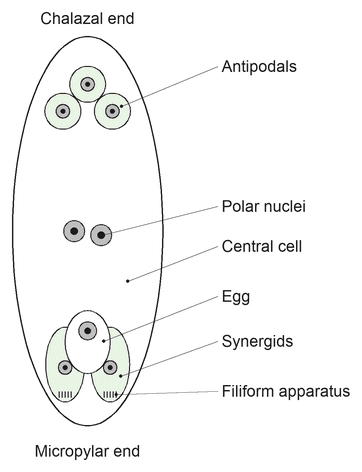
Therefore, the female gametophyte develops when a diploid megaspore mother cell in the nucellus divides by meiosis into four haploid megaspores, only one of which survives; its nucleus divides three times by free-nuclear mitosis, and walls then form to give the eight-nucleate, seven-celled embryo sac.
- 1195 marks
Question 119
Draw a well-labelled diagram of a mature ovule, showing its internal structure.
Solve with AIWritten solution
Solution:
Key idea: The ovule (megasporangium) is the structure that becomes the seed after fertilisation. In section it shows a stalk, protective coats, the nucellus and, inside the nucellus, the embryo sac (female gametophyte). The commonest type is anatropous: its body is turned over so that the micropyle lies close to the funicle.
Step 1 — Draw the ovule.
The labelled diagram below shows a longitudinal section of a mature anatropous ovule. Its labelled parts are the funicle, hilum, integuments, micropyle, chalaza, nucellus and the embryo sac with its antipodal cells, polar nuclei (which fuse to form the definitive nucleus), egg cell and synergids.
Step 2 — Explain the funicle and hilum.
The funicle is the stalk that attaches the ovule to the placenta; it carries water and food to the ovule through a vascular strand. The hilum is the point where the body of the ovule joins the funicle. In an anatropous ovule part of the funicle is fused along the side of the ovule as a ridge called the raphe.
Step 3 — Explain the integuments and micropyle.
One or two integuments (outer and inner) cover and protect the nucellus; after fertilisation they form the seed coats. They leave a small opening at the tip, the micropyle, through which the pollen tube usually enters and, later, water enters the seed at germination.
Step 4 — Explain the chalaza.
The chalaza is the basal end of the ovule, opposite the micropyle, where the integuments and the nucellus join.
Step 5 — Explain the nucellus.
The nucellus is the main body of the ovule, a mass of cells with reserve food. It is covered by the integuments and holds and nourishes the embryo sac.
Step 6 — Describe the embryo sac.
The embryo sac lies in the nucellus. At its micropylar end is the egg apparatus, an egg cell between two synergids that bear the filiform apparatus. At its chalazal end are three antipodal cells. In the large central cell are two polar nuclei, which may fuse before fertilisation to form the diploid definitive (secondary) nucleus.
Therefore, a mature anatropous ovule in section shows the funicle, hilum, integuments, micropyle, chalaza and nucellus, with the seven-celled embryo sac (egg apparatus, central cell and antipodal cells) inside the nucellus.
- 1205 marks
Question 120
Describe the structure of a typical monosporic embryo-sac found in flowering plants.
Solve with AIWritten solution
Solution:
Key idea: The embryo sac is the female gametophyte of a flowering plant. In the commonest (monosporic, Polygonum) type it develops from one megaspore by three free-nuclear mitoses and has seven cells and eight nuclei.
Step 1 — Explain the origin of the embryo sac.
The embryo sac develops from a single functional megaspore; the other three megaspores of the tetrad degenerate. Because only one megaspore takes part, the embryo sac is called monosporic. This type, first described in Polygonum, is called the Polygonum type and is found in about 70 % of flowering plants.
Step 2 — Describe the free-nuclear divisions.
The nucleus of the functional megaspore divides by mitosis three times, giving the two-nucleate, four-nucleate and eight-nucleate stages, with four nuclei at each pole. These divisions are free nuclear: walls do not form at once.
Step 3 — Describe how the eight nuclei are arranged.
One nucleus from each group of four moves to the centre. Walls then form round the three nuclei at each end, so there are three cells at the micropylar end, three cells at the chalazal end and one large central cell.
Step 4 — Describe the egg apparatus.
The three cells at the micropylar end form the egg apparatus: one egg cell (the female gamete) between two synergids. Each synergid has, at its micropylar tip, finger-like thickenings of the cell wall called the filiform apparatus, which guide the pollen tube into the synergid.
Step 5 — Describe the antipodal cells.
The three cells at the chalazal end are the antipodal cells. They take no part in fertilisation and usually degenerate after it.
Step 6 — Describe the central cell.
The central cell is the largest cell and holds the two polar nuclei. In some plants the polar nuclei fuse before fertilisation to form a single diploid secondary (definitive) nucleus; in others they fuse only at fertilisation.
Step 7 — Count the cells and nuclei.
The cells are 3 antipodal cells, 1 central cell and 3 cells of the egg apparatus, which makes 7 cells in all. The nuclei are the 6 nuclei of those six small cells plus the 2 polar nuclei of the central cell, which makes 8 nuclei. So the embryo sac is described as eight-nucleate and seven-celled. If the polar nuclei have already fused, it has seven nuclei: six haploid and one diploid.
Step 8 — Show the structure in a diagram.
The diagram below shows the mature embryo sac with its parts labelled.
Therefore, a typical monosporic embryo sac is eight-nucleate and seven-celled, with an egg apparatus (egg cell and two synergids) at the micropylar end, three antipodal cells at the chalazal end, and a central cell with two polar nuclei.
- 1215 marks
Question 121
What do you understand by the development of an embryo?
Solve with AIWritten solution
Solution:
Key idea: Embryogeny is the development of the embryo from the zygote by mitosis. In a dicot, studied for example in shepherd's purse (Capsella), the zygote passes through the proembryo, globular and heart-shaped stages to the mature embryo, which is fed by the endosperm. The early stages are similar in monocots and dicots.
Step 1 — Note when and where the zygote divides.
The zygote lies at the micropylar end of the embryo sac. In most plants it rests for a while and divides only after some endosperm has formed, so that the young embryo has a ready supply of food.
Step 2 — Describe the first division of the zygote.
The zygote divides transversely and unequally into two cells: a large basal (suspensor) cell towards the micropyle and a small terminal (embryo) cell towards the chalaza.
Step 3 — Describe the suspensor.
The basal cell divides transversely to form a row of about 6 to 10 cells, the suspensor. The cell at its micropylar end is large and absorbs food. The suspensor pushes the developing embryo deeper into the endosperm, from which it draws food. The suspensor cell next to the embryo (the hypophysis) later forms the tip of the radicle and the root cap.
Step 4 — Describe the formation of the proembryo.
The terminal cell divides, first by two vertical walls and then by a transverse wall, into eight cells (the octant stage). This young embryo is the proembryo. The four cells away from the suspensor later form the plumule and the cotyledons, and the four cells next to the suspensor form the hypocotyl and most of the radicle.
Step 5 — Describe the globular and heart-shaped stages.
Further divisions make the proembryo a ball of cells, the globular embryo. Two cotyledons then begin to grow at the end away from the suspensor, so the embryo becomes heart-shaped; the shoot tip (plumule) forms in the notch between the two cotyledons.
Step 6 — Describe the mature dicot embryo.
The cotyledons grow longer, and the mature embryo has an embryonal axis with two cotyledons. The part of the axis above the cotyledons, the epicotyl, ends in the plumule; the part below them, the hypocotyl, ends in the radicle, which points towards the micropyle and is covered by a root cap. The suspensor then degenerates.
Step 7 — Describe the changes in the ovule.
Meanwhile the integuments harden to form the seed coats (the outer one the testa, the inner one the tegmen), and the ovule becomes the seed.
Step 8 — Show the stages in a diagram.
The diagram below shows the main stages: zygote, two-celled stage, proembryo with suspensor, globular embryo, heart-shaped embryo, and embryo with two cotyledons.
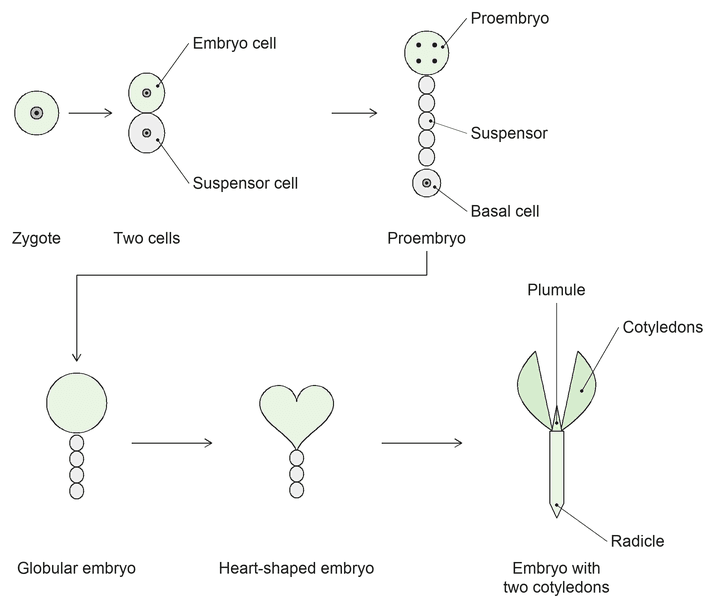
Step 9 — Note how a monocot embryo differs.
In a monocot only one cotyledon develops; in grasses it is the shield-shaped scutellum on one side of the axis. The plumule is enclosed in a sheath, the coleoptile, and the radicle with its root cap in another sheath, the coleorhiza.
Therefore, the development of an embryo (embryogeny) is the series of mitotic divisions by which the zygote forms a suspensor and a proembryo, which passes through the globular and heart-shaped stages to a mature embryo with an embryonal axis, plumule, radicle and cotyledons.
- 1225 marks
Question 122
Write a note on the development of endosperm. Mention the types with examples.
Solve with AIWritten solution
Solution:
Key idea: The endosperm is the food-storing tissue of the seed. It develops from the triploid primary endosperm nucleus (PEN) formed by triple fusion, and its development begins before that of the embryo. Its three types differ in how nuclear division is linked to wall formation: free-nuclear, cellular and helobial.
Step 1 — Explain the origin of the endosperm.
After triple fusion the central cell becomes the primary endosperm cell, with a triploid (3n) nucleus. This nucleus divides by mitosis to form the endosperm, usually before the zygote divides, so that food is ready for the young embryo.
Step 2 — Describe the free-nuclear type.
In the free-nuclear (nuclear) type the PEN divides many times without wall formation, and the free nuclei lie along the edge of the embryo sac round a large central vacuole. Walls form later, from the edge towards the centre, and in some plants part of the endosperm stays free-nuclear. It is the commonest type, seen in wheat, rice, maize and coconut, and also in pea, whose endosperm is later used up by the embryo. In a tender coconut the coconut water is free-nuclear endosperm with thousands of nuclei, and the white kernel round it is cellular endosperm.
Step 3 — Describe the cellular type.
In the cellular type every nuclear division is followed by wall formation, so the endosperm is cellular from the start. Examples are Petunia, Datura and balsam.
Step 4 — Describe the helobial type.
In the helobial type the first division of the PEN is followed by a wall that divides the embryo sac into two unequal chambers, a large micropylar chamber and a small chalazal chamber. Further divisions in each chamber are free nuclear, with many more in the micropylar chamber, and walls form later. This type is common in monocots, especially the order Helobiales, from which it takes its name, for example in Asphodelus and Eremurus.
Step 5 — State the fate of the endosperm.
In some seeds the endosperm is used up by the growing embryo before the seed matures; these are non-endospermic (exalbuminous) seeds, such as pea, gram, groundnut and bean. In others it persists and stores food used at germination; these are endospermic (albuminous) seeds, such as wheat, maize, rice, castor and coconut.
Step 6 — Show the three types in a diagram.
The diagram below shows (a) free-nuclear endosperm with nuclei along the edge, (b) cellular endosperm, and (c) helobial endosperm with its two unequal chambers.
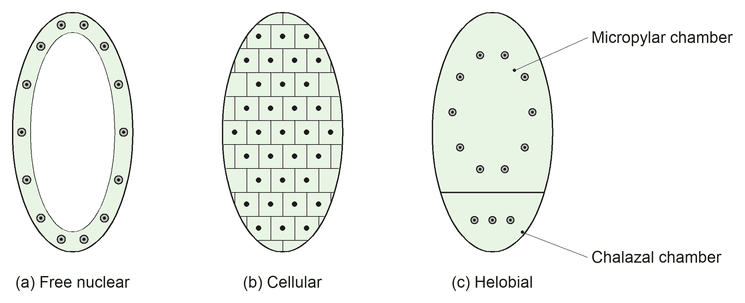
Therefore, the endosperm develops from the triploid primary endosperm nucleus and is of three types: free-nuclear (wheat, maize, coconut), cellular (Petunia, Datura, balsam) and helobial (Asphodelus and other monocots).
- 1235 marks
Question 123
"Incompatibility is a natural barrier in the fusion of gametes". Justify the statement.
Solve with AIWritten solution
Solution:
Key idea: Incompatibility is the inability of fertile pollen to fertilise the ovules of a fertile pistil, because the pistil recognises the pollen and stops it. Self-incompatibility rejects pollen from the same plant, and incompatibility between species rejects pollen of other species. In both, pollination takes place but the gametes never meet.
Step 1 — Explain what self-incompatibility is.
In a self-incompatible plant both the pollen and the ovules are fertile, and the pollen does reach the stigma. Yet no seeds form after self-pollination, because the pistil stops the self pollen either before it germinates or while its tube is growing. The male gametes are therefore never delivered to the egg.
Step 2 — Explain how it is controlled.
Self-incompatibility is genetic. It is controlled by a gene, the S gene (self-incompatibility locus), that has many alleles. When the S allele carried by the pollen matches an S allele of the pistil, the pollen is rejected. It is widespread in flowering plants, for example in the cabbage and mustard family, the potato family (ornamental tobacco (Nicotiana alata), petunia), the rose family (apple, pear, cherry) and many grasses.
Step 3 — Describe sporophytic self-incompatibility.
In sporophytic self-incompatibility the reaction depends on the genotype of the diploid plant (sporophyte) that produced the pollen, because proteins from the anther's tapetum coat the pollen grain. Rejected pollen usually fails to germinate on the stigma. Examples are the cabbage and mustard family (Brassicaceae) and the sunflower family (Asteraceae).
Step 4 — Describe gametophytic self-incompatibility.
In gametophytic self-incompatibility the reaction depends on the genotype of the haploid pollen grain itself. The pollen usually germinates, but the tube stops growing in the style and never reaches the embryo sac. Examples are the potato family (Solanaceae), the rose family (Rosaceae) and some legumes such as red clover; in grasses the tube is stopped at the stigma surface.
Step 5 — Justify the statement.
In every case pollination has taken place, yet the male gametes cannot reach the egg or the polar nuclei, so neither syngamy nor triple fusion can occur. The block is built into the plant's own genes and works in the pistil, through the pollen–pistil interaction, without any outside agent. This is why incompatibility is called a natural barrier to the fusion of gametes.
Step 6 — State its significance.
By preventing self-fertilisation, self-incompatibility prevents inbreeding and promotes cross-fertilisation, which keeps genetic variation high. Plant breeders also use it to produce hybrid seed, for example in cabbage, without having to remove the anthers by hand.
Therefore, incompatibility is a natural barrier to the fusion of gametes because a genetic recognition system in the pistil stops incompatible pollen from germinating or its tube from growing, so even after pollination the male gametes never reach the egg.
- 1245 marks
Question 124
Describe in brief the various special modes of reproduction. Mention their economic significance.
Solve with AIWritten solution
Solution:
Key idea: Some flowering plants form seeds or fruits in unusual ways: apomixis (seeds without fertilisation), parthenogenesis and adventive embryony (two ways of forming such embryos), polyembryony (more than one embryo in a seed) and parthenocarpy (fruits without fertilisation, usually seedless).
Step 1 — Describe apomixis (agamospermy).
Apomixis is the formation of seeds without fertilisation. It is a form of asexual reproduction that mimics sexual reproduction. The embryo forms from a diploid cell of the ovule: either an embryo sac forms from the megaspore mother cell without meiosis and its diploid egg develops without fertilisation, or a cell of the nucellus or integument develops directly into an embryo. The seed is genetically identical to the mother plant. Apomixis is seen in some species of the sunflower family (such as dandelion) and of grasses; such a plant is an apomict.
Step 2 — Describe parthenogenesis.
Parthenogenesis is the development of an embryo from an unfertilised egg. If the egg is haploid, the embryo and the plant are haploid and usually sterile. If the egg is diploid, because the embryo sac formed without meiosis, the embryo is diploid; this diploid parthenogenesis is one form of apomixis.
Step 3 — Describe adventive embryony (sporophytic budding).
In adventive embryony some diploid cells of the nucellus or integuments (sporophytic tissue) divide, push into the embryo sac and develop into embryos. It occurs in citrus fruits such as orange and lemon, in mango and in Opuntia.
Step 4 — Describe polyembryony.
Polyembryony is the presence of more than one embryo in a seed. Extra embryos may come from nucellar cells (as in citrus and mango), from splitting of the young embryo (common in gymnosperms such as pines), from synergids or antipodal cells, or from more than one embryo sac in an ovule. An orange seed, when germinated, often gives several seedlings.
Step 5 — Describe parthenocarpy.
Parthenocarpy is the development of a fruit from the ovary without fertilisation, so the fruit is usually seedless. It is natural in banana, pineapple and some seedless grapes. It can be induced by spraying the flowers with growth hormones such as auxins or gibberellins, as in tomato and cucumber.
Step 6 — Explain the economic significance.
These special modes are useful in agriculture and horticulture:
- Hybrid seeds lose their hybrid vigour when grown again, so farmers must buy new hybrid seed every year. If hybrids could be made apomictic, their seeds would keep the hybrid characters, and farmers could save their own seed; scientists are working to bring apomixis into crop hybrids.
- The nucellar embryos of citrus are genetically identical to the parent and usually free of virus disease, so they give uniform, healthy seedlings and rootstocks.
- Parthenocarpic seedless fruits such as banana, seedless grapes, tomato and cucumber are preferred by consumers and by the juice and jam industries, and parthenocarpy gives fruits even when pollination fails.
Therefore, the special modes of reproduction are apomixis (including parthenogenesis and adventive embryony), polyembryony and parthenocarpy; they are economically important because they keep desirable characters unchanged, give uniform healthy citrus seedlings and give seedless fruits.
- 1255 marks
Question 125
Trace the development of embryo after syngamy in a dicot plant.
Solve with AIWritten solution
Solution:
Key idea: After syngamy the diploid zygote develops into the embryo by repeated mitosis. In a dicot, studied for example in shepherd's purse (Capsella), it passes through the proembryo, globular and heart-shaped stages to the mature embryo with two cotyledons, fed all the while by the endosperm.
Step 1 — Note when and where the zygote divides.
The zygote lies at the micropylar end of the embryo sac. In most plants it rests for a while and divides only after some endosperm has formed, so that the young embryo has a ready supply of food.
Step 2 — Describe the first division of the zygote.
The zygote divides transversely and unequally into two cells: a large basal (suspensor) cell towards the micropyle and a small terminal (embryo) cell towards the chalaza.
Step 3 — Describe the suspensor.
The basal cell divides transversely to form a row of about 6 to 10 cells, the suspensor. The cell at its micropylar end is large and absorbs food. The suspensor pushes the developing embryo deeper into the endosperm, from which it draws food. The suspensor cell next to the embryo (the hypophysis) later forms the tip of the radicle and the root cap.
Step 4 — Describe the formation of the proembryo.
The terminal cell divides, first by two vertical walls and then by a transverse wall, into eight cells (the octant stage). This young embryo is the proembryo. The four cells away from the suspensor later form the plumule and the cotyledons, and the four cells next to the suspensor form the hypocotyl and most of the radicle.
Step 5 — Describe the globular and heart-shaped stages.
Further divisions make the proembryo a ball of cells, the globular embryo. Two cotyledons then begin to grow at the end away from the suspensor, so the embryo becomes heart-shaped; the shoot tip (plumule) forms in the notch between the two cotyledons.
Step 6 — Describe the mature dicot embryo.
The cotyledons grow longer, and the mature embryo has an embryonal axis with two cotyledons. The part of the axis above the cotyledons, the epicotyl, ends in the plumule; the part below them, the hypocotyl, ends in the radicle, which points towards the micropyle and is covered by a root cap. The suspensor then degenerates.
Step 7 — Describe the changes in the ovule.
Meanwhile the integuments harden to form the seed coats (the outer one the testa, the inner one the tegmen), and the ovule becomes the seed.
Step 8 — Show the stages in a diagram.
The diagram below shows the main stages: zygote, two-celled stage, proembryo with suspensor, globular embryo, heart-shaped embryo, and embryo with two cotyledons.
Therefore, after syngamy the zygote of a dicot divides into a suspensor cell and an embryo cell; the suspensor pushes the embryo into the endosperm, and the embryo cell forms a proembryo that passes through the globular and heart-shaped stages to a mature embryo with two cotyledons, a plumule and a radicle.
- 1265 marks
Question 126
Trace the development of a mature ovule from a megaspore mother cell.
Solve with AIWritten solution
Solution:
Key idea: An ovule is mature when its nucellus holds a mature embryo sac (female gametophyte). The embryo sac develops in two stages: megasporogenesis, in which meiosis of the megaspore mother cell gives four haploid megaspores, and the development of one megaspore, by three rounds of free-nuclear mitosis, into the eight-nucleate, seven-celled embryo sac.
Step 1 — Describe the young ovule.
The ovule (megasporangium) arises from the placenta on the inner wall of the ovary as a small knob. It is attached by a stalk, the funicle, and the point where the body of the ovule meets the funicle is the hilum. Its main body is the nucellus, a mass of cells with reserve food, covered by one or two integuments except at a small opening, the micropyle. The opposite end, where the integuments and the nucellus join, is the chalaza.
Step 2 — Identify the megaspore mother cell.
A single cell of the nucellus near the micropylar end enlarges, gains dense cytoplasm and a large nucleus, and becomes the megaspore mother cell (MMC). Like the rest of the ovule, it is diploid (2n).
Step 3 — Explain megasporogenesis.
The MMC divides by meiosis. Meiosis I gives two cells (a dyad), and meiosis II gives four haploid (n) megaspores, usually arranged in a row (a linear tetrad).
Step 4 — State which megaspore survives.
In most flowering plants only one megaspore, usually the one at the chalazal end, is functional, and the other three degenerate. Because the embryo sac develops from this single megaspore, the development is called monosporic.
Step 5 — Describe the free-nuclear divisions.
The functional megaspore enlarges and its nucleus divides by mitosis. The two daughter nuclei move to opposite poles, giving the two-nucleate embryo sac. Two more mitoses at each pole give the four-nucleate and then the eight-nucleate stage, with four nuclei at each pole. These divisions are free nuclear: each nuclear division is not followed at once by the formation of a cell wall.
Step 6 — Describe how the cells are organised.
After the eight-nucleate stage, cell walls form. One nucleus from each pole moves to the centre; these two polar nuclei lie in the large central cell. The three nuclei left at the micropylar end become three cells, one egg cell and two synergids, which together form the egg apparatus. The three nuclei left at the chalazal end become the three antipodal cells.
Step 7 — State the structure of the mature embryo sac.
The mature embryo sac, the female gametophyte, therefore has 8 nuclei but only 7 cells: 3 antipodal cells, 1 central cell with 2 polar nuclei, 2 synergids and 1 egg cell. This monosporic pattern, first described in Polygonum, is called the Polygonum type, and it is found in most flowering plants.
Step 8 — Show the stages in a diagram.
The diagram below traces the whole sequence, from the megaspore mother cell to the mature embryo sac.
Step 9 — Describe the mature ovule.
The ovule now holds a mature embryo sac inside its nucellus, with the egg apparatus facing the micropyle. It is a mature ovule, ready for pollination and fertilisation; after fertilisation it develops into the seed.
Therefore, a mature ovule is formed when the diploid megaspore mother cell in its nucellus divides by meiosis into four haploid megaspores, one of which survives and, by three free-nuclear mitoses followed by wall formation, becomes the eight-nucleate, seven-celled embryo sac.
- 1275 marks
Question 127
Draw a diagram of the transverse section of an angiospermic anther. Label any six parts.
Solve with AIWritten solution
Solution:
Key idea: The anther is the pollen-producing part of the stamen. In transverse section a young anther shows four pollen sacs (microsporangia), each with four wall layers round a central mass of sporogenous cells, and a central connective.
Step 1 — Describe the outline of the section.
A typical anther is bilobed and dithecous: each of its two lobes has two pollen sacs, so the T.S. shows four pollen sacs at the four corners. The two lobes are joined by the connective, which carries a vascular bundle.
Step 2 — Draw the section.
The diagram below shows the T.S. of a young anther with six parts labelled: the epidermis, endothecium, middle layers, tapetum, sporogenous cells and connective.
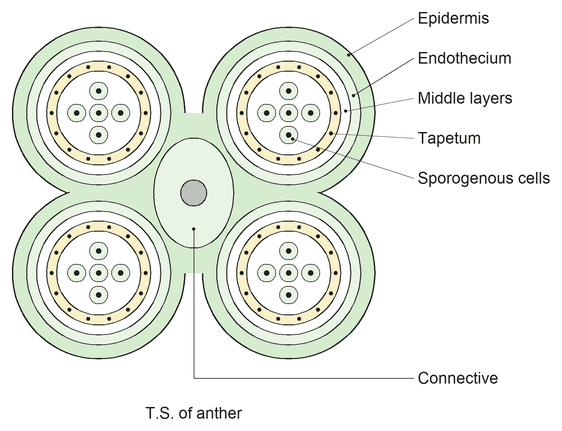
Step 3 — Explain the outer wall layers.
The epidermis is the outermost protective layer. Below it the endothecium has fibrous thickenings in its cell walls, which help the anther to split open when it dries. The middle layers, two to three layers of cells, protect the sac and usually break down as the anther matures.
Step 4 — Explain the tapetum.
The tapetum is the innermost wall layer. Its cells have dense cytoplasm and often more than one nucleus, and they nourish the developing pollen grains.
Step 5 — Explain the sporogenous cells and connective.
The sporogenous cells fill the centre of each pollen sac; they act as pollen mother cells and form pollen grains by meiosis. The connective is the sterile tissue that joins the two lobes and carries the vascular bundle that supplies the anther.
Therefore, the T.S. of an anther shows four pollen sacs, each with an epidermis, endothecium, middle layers and tapetum round the sporogenous cells, joined by a central connective.
- 1285 marks
Question 128
Describe the structure of a typical monosporic embryo-sac found in flowering plants.
Solve with AIWritten solution
Solution:
Key idea: The embryo sac is the female gametophyte of a flowering plant. In the commonest (monosporic, Polygonum) type it develops from one megaspore by three free-nuclear mitoses and has seven cells and eight nuclei.
Step 1 — Explain the origin of the embryo sac.
The embryo sac develops from a single functional megaspore; the other three megaspores of the tetrad degenerate. Because only one megaspore takes part, the embryo sac is called monosporic. This type, first described in Polygonum, is called the Polygonum type and is found in about 70 % of flowering plants.
Step 2 — Describe the free-nuclear divisions.
The nucleus of the functional megaspore divides by mitosis three times, giving the two-nucleate, four-nucleate and eight-nucleate stages, with four nuclei at each pole. These divisions are free nuclear: walls do not form at once.
Step 3 — Describe how the eight nuclei are arranged.
One nucleus from each group of four moves to the centre. Walls then form round the three nuclei at each end, so there are three cells at the micropylar end, three cells at the chalazal end and one large central cell.
Step 4 — Describe the egg apparatus.
The three cells at the micropylar end form the egg apparatus: one egg cell (the female gamete) between two synergids. Each synergid has, at its micropylar tip, finger-like thickenings of the cell wall called the filiform apparatus, which guide the pollen tube into the synergid.
Step 5 — Describe the antipodal cells.
The three cells at the chalazal end are the antipodal cells. They take no part in fertilisation and usually degenerate after it.
Step 6 — Describe the central cell.
The central cell is the largest cell and holds the two polar nuclei. In some plants the polar nuclei fuse before fertilisation to form a single diploid secondary (definitive) nucleus; in others they fuse only at fertilisation.
Step 7 — Count the cells and nuclei.
The cells are 3 antipodal cells, 1 central cell and 3 cells of the egg apparatus, which makes 7 cells in all. The nuclei are the 6 nuclei of those six small cells plus the 2 polar nuclei of the central cell, which makes 8 nuclei. So the embryo sac is described as eight-nucleate and seven-celled. If the polar nuclei have already fused, it has seven nuclei: six haploid and one diploid.
Step 8 — Show the structure in a diagram.
The diagram below shows the mature embryo sac with its parts labelled.
Therefore, a typical monosporic embryo sac is eight-nucleate and seven-celled, with an egg apparatus (egg cell and two synergids) at the micropylar end, three antipodal cells at the chalazal end, and a central cell with two polar nuclei.
- 1295 marks
Question 129
Draw labelled diagrams
(i) T.S. of bilobed anther
(ii) Internal structure of pollen grain.
Solve with AIWritten solution
Solution:
Key idea: The anther is the pollen-producing part of the stamen, and the pollen grain it produces is the male gametophyte. A transverse section of the anther shows its four pollen sacs; a section of the pollen grain shows its two-layered wall and its two cells.
Step 1 — (i) Describe the T.S. of a bilobed anther.
A typical anther is bilobed and dithecous: each of its two lobes has two pollen sacs, so the T.S. shows four pollen sacs at the four corners. The two lobes are joined by the connective, which carries a vascular bundle. Each pollen sac has four wall layers, the epidermis, endothecium, middle layers and tapetum, round a central mass of sporogenous cells.
Step 2 — Draw the T.S. of the anther.
The diagram below shows the T.S. of the anther with the epidermis, endothecium, middle layers, tapetum, sporogenous cells and connective labelled.
Step 3 — (ii) Describe the internal structure of the pollen grain.
A mature pollen grain has a thick outer exine of sporopollenin, with germ pores where the exine is absent, and a thin inner intine of cellulose and pectin. Inside are a large vegetative cell with an irregular nucleus and a small spindle-shaped generative cell.
Step 4 — Draw the pollen grain.
The diagram below shows a mature two-celled pollen grain in section, with the exine, intine, germ pore, generative cell with its nucleus, and vegetative nucleus labelled.
Therefore, the T.S. of a bilobed anther shows four pollen sacs, each with an epidermis, endothecium, middle layers, tapetum and sporogenous cells, joined by a connective, and a pollen grain shows an exine with germ pores, an intine, a vegetative cell and a generative cell.
- 1305 marks
Question 130
(i) What is double fertilisation? Write three post-fertilisation changes leading to the formation of seed.
(ii) Differentiate monoecious and dioecious plants. Give one example of each.
Solve with AIWritten solution
Solution:
Key idea: In double fertilisation two separate fusions take place in the same embryo sac: syngamy (male gamete + egg) and triple fusion (male gamete + two polar nuclei). Monoecious and dioecious describe where the male and female flowers of a species are borne.
Step 1 — (i) Describe how the male gametes are delivered.
The pollen tube enters the ovule, usually through the micropyle, passes into one synergid and releases its two male gametes there.
Step 2 — Describe syngamy.
One male gamete fuses with the egg cell. This fusion is syngamy, and it forms the diploid (2n) zygote.
Step 3 — Describe triple fusion.
The other male gamete moves into the central cell and fuses with the two polar nuclei. This fusion of three haploid nuclei is triple fusion, and it forms the triploid (3n) primary endosperm nucleus; the central cell becomes the primary endosperm cell.
Step 4 — Define double fertilisation.
Since two kinds of fusion, syngamy and triple fusion, take place in the same embryo sac, the process is called double fertilisation.
Step 5 — State three post-fertilisation changes that lead to the seed.
After fertilisation the ovule changes into the seed in these ways:
- The primary endosperm nucleus divides to form the endosperm, the food tissue.
- The zygote divides to form the embryo.
- The integuments harden to form the seed coats (testa and tegmen), while the micropyle remains as a small pore.
Meanwhile the nucellus is usually used up (it persists as perisperm in a few seeds such as black pepper and beet), and the ovary develops into the fruit.
Step 6 — (ii) Compare monoecious and dioecious plants.
In a monoecious plant male and female flowers are borne on the same plant; in a dioecious plant they are borne on separate plants. The table below sets out the differences.
Feature Monoecious plant Dioecious plant Flowers Male and female flowers on the same plant Male and female flowers on different plants Self-pollination Autogamy prevented, but geitonogamy possible Both autogamy and geitonogamy prevented Examples Maize (also castor, cucurbits, coconut palm) Papaya (also date palm) Therefore, double fertilisation is the occurrence of syngamy and triple fusion in the same embryo sac, after which the endosperm, the embryo and the seed coats form; a monoecious plant such as maize bears male and female flowers on the same plant, while a dioecious plant such as papaya bears them on separate plants.
- 1315 marks
Question 131
What are the differences between self and cross-pollination?
Solve with AIWritten solution
Solution:
Key idea: In self-pollination the pollen comes from the same flower (autogamy) or from another flower of the same plant (geitonogamy). In cross-pollination (xenogamy) the pollen comes from a flower on a different plant of the same species.
Step 1 — Define self-pollination.
Self-pollination is the transfer of pollen to the stigma of the same flower or of another flower on the same plant. The pollen and the egg therefore come from the same plant.
Step 2 — Define cross-pollination.
Cross-pollination is the transfer of pollen from a flower of one plant to the stigma of a flower on another plant of the same species. It always needs an agent to carry the pollen, and it brings together genes from two plants.
Step 3 — List the differences.
The table below sets out the main differences.
Feature Self-pollination Cross-pollination Source of pollen The same flower, or another flower of the same plant A flower on a different plant of the same species Pollinating agent Not needed in autogamy; needed in geitonogamy Always needed (wind, water, insects, birds or other animals) Maturing of anthers and stigma At the same time Often at different times (dichogamy) Flowers Often small and inconspicuous; some never open (cleistogamous) Suited to the agent: showy, scented and with nectar, or with feathery stigmas and much pollen Amount of pollen Small; little is wasted Large; much is wasted, especially in wind and water pollination Certainty of seed set High Lower, because it depends on the agent Genetic result Pure lines (homozygous plants) after a few generations; continued selfing can weaken the offspring (inbreeding depression) New combinations of genes and variation; offspring often more vigorous and adaptable Therefore, self-pollination uses pollen from the same plant, needs little or no outside help and gives pure lines, while cross-pollination uses pollen from another plant, always needs an agent and gives variation and vigorous offspring.
- 1325 marks
Question 132
Draw a labelled diagram of the longitudinal section of a pistil showing pollen germination.
Solve with AIWritten solution
Solution:
Key idea: The pistil has three parts: the stigma, which receives pollen; the style, through which the pollen tube grows; and the ovary, which holds the ovules. A compatible pollen grain germinates on the stigma, and its tube carries two male gametes to an ovule.
Step 1 — Say what the diagram must show.
The longitudinal section must show pollen grains on the stigma, one of them germinating, and its pollen tube running down the style into the ovary and entering an ovule through the micropyle.
Step 2 — Draw the section.
The diagram below shows the L.S. of the pistil. Its labelled parts are the pollen grains, stigma, style, pollen tube, tube nucleus, male gametes, ovary, ovary wall, the cavity in which the ovule lies, the ovule, its micropyle and the embryo sac.
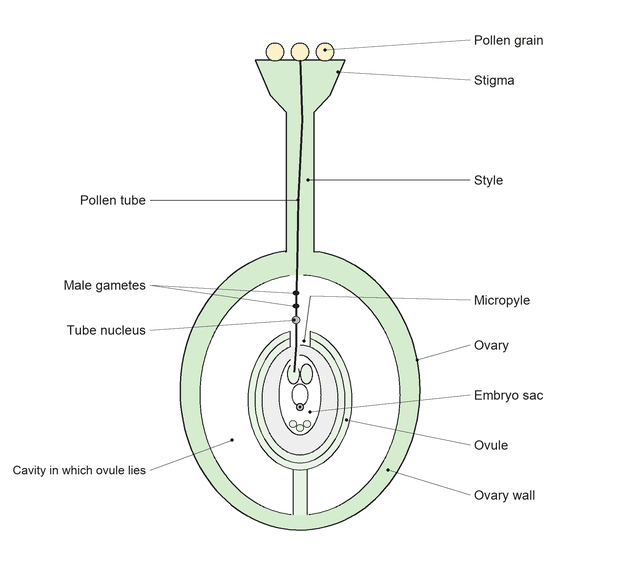
Step 3 — Describe the path of the pollen tube.
The pollen grain germinates on the stigma, and its tube grows down through the tissue of the style into the cavity of the ovary. It reaches an ovule and usually enters it through the micropyle; in a few plants it enters through the chalaza (as in Casuarina) or through the integuments (as in cucurbits). Inside the ovule it enters one synergid through its filiform apparatus.
Step 4 — Describe the contents of the pollen tube.
The tube (vegetative) nucleus usually lies near the growing tip of the tube, followed by the two male gametes, formed from the generative cell. When the tube reaches the synergid it bursts and releases the two male gametes into the embryo sac.
Therefore, the L.S. of the pistil shows a pollen grain germinating on the stigma and its pollen tube growing down the style and ovary to enter the ovule through the micropyle, carrying the tube nucleus and two male gametes to the embryo sac.
- 1335 marks
Question 133
What is double fertilisation? Explain.
Solve with AIWritten solution
Solution:
Key idea: Double fertilisation is the occurrence of two fusions in the same embryo sac: syngamy, which forms the zygote, and triple fusion, which forms the primary endosperm nucleus. It is a characteristic feature of flowering plants.
Step 1 — Describe the entry of the pollen tube.
The pollen tube enters the ovule, usually through the micropyle, and passes into one of the synergids through its filiform apparatus.
Step 2 — Describe the release of the male gametes.
The tip of the tube bursts and releases the two male gametes into the cytoplasm of the synergid, from where they move to the egg and the central cell.
Step 3 — Explain syngamy.
One male gamete fuses with the egg cell. This fusion of two haploid nuclei is syngamy, and it forms the diploid (2n) zygote, which divides by mitosis to form the embryo.
Step 4 — Explain triple fusion.
The other male gamete moves into the central cell and fuses with the two polar nuclei (or with the diploid secondary nucleus formed by their fusion). This fusion of three haploid nuclei is triple fusion, and it forms the triploid (3n) primary endosperm nucleus, which develops into the endosperm that nourishes the embryo.
Step 5 — Explain the name.
Since two kinds of fusion, syngamy and triple fusion, take place in the same embryo sac, the process is called double fertilisation.
Step 6 — State its significance.
Because the endosperm forms only after fertilisation, the plant spends food on endosperm only in ovules that have been fertilised. The triploid endosperm then feeds the developing embryo.
Note: Some gymnosperms related to flowering plants (Ephedra and Gnetum) also show a second fusion of a male gamete, but it does not form an endosperm. Double fertilisation that forms an endosperm is found only in flowering plants.
Step 7 — Show the fertilised embryo sac in a diagram.
The diagram below shows the embryo sac after double fertilisation, with the diploid zygote at the micropylar end, the triploid primary endosperm nucleus in the centre, the synergids, the antipodal cells and the pollen tube.
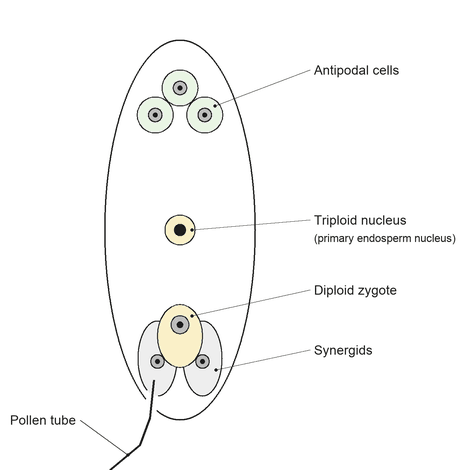
Therefore, double fertilisation is the fusion of one male gamete with the egg (syngamy, forming the diploid zygote) and of the other male gamete with the two polar nuclei (triple fusion, forming the triploid primary endosperm nucleus) in the same embryo sac.
- 1345 marks
Question 134
List four advantages of self-pollination.
Solve with AIWritten solution
Solution:
Key idea: Self-pollination is the transfer of pollen to the stigma of the same flower or of another flower on the same plant. Because it does not depend on another plant, it has several advantages for the plant and for plant breeders.
Step 1 — State the first advantage.
Self-pollination does not depend on outside agents such as wind, water or insects, because the pollen is already close to the stigma.
Step 2 — State the second advantage.
It gives assured seed set. Cleistogamous flowers, such as some flowers of Viola, Oxalis and Commelina, never open and still form seeds; and rare or isolated plants with no partner nearby can still reproduce.
Step 3 — State the third advantage.
Little pollen is wasted, and the plant need not spend food on large, showy flowers, scent or nectar to attract pollinators.
Step 4 — State the fourth advantage.
After a few generations self-pollination gives pure lines (homozygous plants), so the good characters of the parent are kept unchanged. Plant breeders use this to keep desirable varieties pure.
Note: Continued self-pollination also has a drawback: it reduces variation and can weaken the offspring (inbreeding depression).
Therefore, four advantages of self-pollination are that it needs no outside agent, it gives assured seed set, it wastes little pollen and needs no showy flowers, and it gives pure lines that keep the parental characters.
- 1355 marks
Question 135
What is agamospermy? How is agamospermy different from parthenogenesis and parthenocarpy?
Solve with AIWritten solution
Solution:
Key idea: Agamospermy (apomixis) is the formation of seeds without fertilisation. Parthenogenesis is the formation of an embryo from an unfertilised egg, and parthenocarpy is the formation of a fruit without fertilisation.
Step 1 — Define agamospermy.
Agamospermy is a special mode of reproduction in which seeds are formed without the fusion of gametes. It is a form of asexual reproduction that mimics sexual reproduction, and such a plant is called an apomict.
Step 2 — Explain how the embryo forms in agamospermy.
The embryo forms from a diploid cell of the ovule. Either an embryo sac forms from the megaspore mother cell without meiosis, and its diploid egg develops into an embryo without fertilisation, or a diploid cell of the nucellus or integument develops directly into an embryo. The rest of the ovule forms the seed and the ovary forms the fruit. The seed is genetically identical to the mother plant.
Step 3 — Explain parthenogenesis.
In parthenogenesis an embryo develops from an unfertilised egg. If the egg is haploid, the embryo is haploid; if the egg is diploid because meiosis was skipped, the embryo is diploid, and this diploid parthenogenesis is one way in which agamospermy takes place.
Step 4 — Explain parthenocarpy.
In parthenocarpy the ovary develops into a fruit without fertilisation. No embryo forms, so the fruit is usually seedless, as in banana and pineapple. It can also be induced by growth hormones.
Step 5 — Compare the three processes.
The table below sets out the differences.
Feature Agamospermy Parthenogenesis Parthenocarpy Formed without fertilisation A seed with an embryo An embryo from the egg A fruit Cell giving the embryo A diploid cell: an unreduced egg, or a nucellus or integument cell The unfertilised egg No embryo is formed Ploidy of the embryo Diploid, like the mother plant Haploid or diploid Not applicable Seeds Present; genetically identical to the mother plant Present if the embryo develops in a seed Usually absent Examples Some species of the sunflower family (dandelion) and grasses Diploid eggs of apomicts such as dandelion Banana, pineapple Step 6 — State how they are related.
Agamospermy concerns the seed and parthenogenesis concerns the embryo, so diploid parthenogenesis is one kind of agamospermy. Parthenocarpy concerns only the fruit and forms no embryo.
Therefore, agamospermy is the formation of seeds without fertilisation from a diploid cell of the ovule; it differs from parthenogenesis, which is only the development of an embryo from an unfertilised egg, and from parthenocarpy, which is the formation of a usually seedless fruit without fertilisation.
- 1365 marks
Question 136
Draw the diagram of a monocot embryo and label the position of scutellum, coleorrhiza and root cap.
Solve with AIWritten solution
Solution:
Key idea: A grass (monocot) embryo has one cotyledon, the scutellum, placed on one side of the embryonal axis. The shoot end of the axis is covered by the coleoptile, and the root end, with the radicle and root cap, by the coleorhiza.
Step 1 — Draw the embryo.
The diagram below shows an L.S. of a monocot embryo with the scutellum, coleoptile, shoot apex, radicle, root cap and coleorhiza labelled.

Step 2 — Describe the position of the scutellum.
The scutellum is the single, shield-shaped cotyledon. It lies on one side (laterally) of the embryonal axis, pressed against the endosperm, from which it absorbs food during germination.
Step 3 — Describe the position of the coleorhiza.
The coleorhiza is an undifferentiated sheath at the lower end of the axis. It encloses the radicle and the root cap, and at germination the radicle grows out through it.
Step 4 — Describe the position of the root cap.
The root cap covers the tip of the radicle, inside the coleorhiza, and protects the root tip as it grows through the soil.
Step 5 — Name the other parts shown.
At the upper end of the axis the shoot apex and a few leaf primordia are enclosed in a hollow sheath, the coleoptile, which protects the young shoot as it pushes up through the soil.
Therefore, in a monocot embryo the scutellum lies on one side of the embryonal axis, the coleorhiza sheathes the lower (root) end, and the root cap covers the tip of the radicle inside the coleorhiza.
- 1375 marks
Question 137
Draw a labelled diagram of the sectional view of a mature pollen grain in angiosperms. Explain the functions of its different parts.
Solve with AIWritten solution
Solution:
Key idea: The pollen grain is the male gametophyte. Its wall protects it and lets out the pollen tube, its vegetative cell feeds and forms the tube, and its generative cell gives the two male gametes.
Step 1 — Draw the pollen grain.
The diagram below shows a mature two-celled pollen grain in section, with its parts labelled. The labelled parts are the exine, the intine, a germ pore, the generative cell with its nucleus, and the vegetative nucleus.
Step 2 — Explain the function of the exine.
The exine is the thick outer wall of sporopollenin, the most resistant organic material known. It protects the living contents from drying, high temperatures, strong acids and alkalis and microbes, so pollen can survive the journey to a stigma and is even preserved as fossils. Its species-typical pattern helps the pollen stick to animals and is used to identify plants.
Step 3 — Explain the function of the germ pores.
Germ pores are thin places in the exine where sporopollenin is absent. At germination the pollen tube comes out through one of them.
Step 4 — Explain the function of the intine.
The intine is the thin inner wall of cellulose and pectin. At germination it grows out through a germ pore to form the wall of the pollen tube.
Step 5 — Explain the function of the vegetative cell.
The vegetative cell is the large cell with plenty of stored food. It supplies energy and materials for the growth of the pollen tube, and its nucleus (the tube nucleus) moves into the tube near its tip.
Step 6 — Explain the function of the generative cell.
The generative cell is the small spindle-shaped cell. It divides by mitosis, either before the pollen is shed or inside the pollen tube, to form the two male gametes. One fuses with the egg and the other with the two polar nuclei in double fertilisation.
Therefore, in a mature pollen grain the exine protects, the germ pores let out the pollen tube, the intine forms the wall of the tube, the vegetative cell feeds the growing tube, and the generative cell forms the two male gametes.
- 1385 marks
Question 138
(i) Draw a diagrammatic sketch of a sectional view of a typical anatropous ovule.
(ii) List the components of the embryo sac and mention their fate on fertilisation.
Solve with AIWritten solution
Solution:
Key idea: An anatropous ovule is turned over so that its micropyle lies close to the funicle. Inside its nucellus lies the seven-celled embryo sac. At fertilisation the egg and the central cell are fertilised, and the other cells degenerate.
Step 1 — (i) Draw the anatropous ovule.
The labelled diagram below shows a longitudinal section of a mature anatropous ovule. Its labelled parts are the funicle, hilum, integuments, micropyle, chalaza, nucellus and the embryo sac with its antipodal cells, polar nuclei (which fuse to form the definitive nucleus), egg cell and synergids.
Step 2 — Describe the parts shown.
The funicle attaches the ovule to the placenta, and the hilum is the point where it joins the body of the ovule. The integuments cover the nucellus and leave an opening, the micropyle; the opposite end is the chalaza. The nucellus holds the embryo sac.
Step 3 — (ii) List the components of the embryo sac.
A mature embryo sac has seven cells: one egg cell and two synergids (the egg apparatus) at the micropylar end, three antipodal cells at the chalazal end, and one large central cell with two polar nuclei (or the definitive nucleus formed by their fusion).
Step 4 — State the fate of the egg cell.
One male gamete fuses with the egg (syngamy) to form the diploid zygote, which divides by mitosis to form the embryo.
Step 5 — State the fate of the synergids.
The pollen tube enters one synergid through its filiform apparatus and releases the two male gametes into it; this synergid degenerates. The other synergid also degenerates soon after fertilisation.
Step 6 — State the fate of the central cell.
The second male gamete fuses with the two polar nuclei (triple fusion) to form the triploid primary endosperm nucleus. The central cell becomes the primary endosperm cell, which divides to form the endosperm, the food tissue for the embryo.
Step 7 — State the fate of the antipodal cells.
The antipodal cells take no part in fertilisation. They usually degenerate, although in some plants, such as grasses, they multiply for a while and may help to feed the embryo sac.
Therefore, the embryo sac has an egg cell, two synergids, three antipodal cells and a central cell with two polar nuclei; on fertilisation the egg forms the zygote and then the embryo, the central cell forms the endosperm, and the synergids and antipodal cells degenerate.
- 1395 marks
Question 139
(i) Draw a labelled diagram of a fertilised embryo-sac of an angiosperm.
(ii) Describe the stages in embryo development in a dicot plant.
(iii) Endosperm development precedes embryo development. Explain.
(iv) Draw a diagram of a mature dicot embryo and label cotyledons, plumule, radicle and hypocotyl in it.
Solve with AIWritten solution
Solution:
Key idea: After double fertilisation the embryo sac holds a diploid zygote and a triploid primary endosperm nucleus. The endosperm develops first and feeds the embryo, which grows from the zygote through the proembryo, globular and heart-shaped stages to a mature embryo.
Step 1 — (i) Draw the fertilised embryo sac.
The diagram below shows the embryo sac just after double fertilisation: the diploid zygote at the micropylar end, the triploid primary endosperm nucleus in the central cell, the synergids (one entered by the pollen tube), the antipodal cells at the chalazal end, and the pollen tube.
Step 2 — (ii) Describe the first division of the zygote.
The zygote divides transversely into a large basal (suspensor) cell towards the micropyle and a small terminal (embryo) cell towards the chalaza.
Step 3 — Describe the suspensor and proembryo.
The basal cell forms a row of cells, the suspensor, which pushes the young embryo into the endosperm. The terminal cell divides into eight cells, the proembryo: the four cells away from the suspensor later form the plumule and cotyledons, and the four next to it form the hypocotyl and radicle.
Step 4 — Describe the globular and heart-shaped stages.
Further divisions give a ball of cells, the globular embryo. Two cotyledons then grow at the end away from the suspensor, so the embryo becomes heart-shaped, with the plumule forming in the notch between them.
Step 5 — Describe the mature embryo.
The cotyledons grow longer, and the mature embryo has two cotyledons on an embryonal axis, with the plumule at its upper end and the radicle, covered by a root cap, at its lower end facing the micropyle. The diagram below shows the stages.
Step 6 — (iii) Explain why endosperm development comes first.
The primary endosperm nucleus starts dividing soon after triple fusion, while the zygote usually rests for a time and divides only after some endosperm has formed. The embryo cannot make its own food while it is inside the seed, so it depends on the endosperm for nourishment. Forming the endosperm first makes sure that food is ready as soon as the embryo starts to grow.
Step 7 — (iv) Draw the mature dicot embryo.
The diagram below shows a mature dicot embryo. The two cotyledons are attached to the embryonal axis; above them the axis ends in the plumule, and below them the hypocotyl ends in the radicle, covered by the root cap.
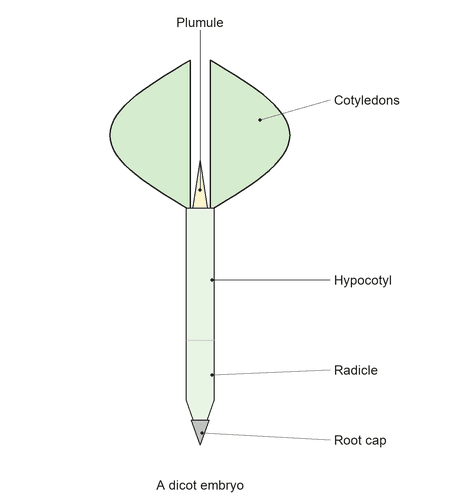
Therefore, the fertilised embryo sac holds a diploid zygote and a triploid primary endosperm nucleus; the zygote develops through the proembryo, globular and heart-shaped stages into an embryo with two cotyledons, a plumule, a hypocotyl and a radicle, and the endosperm forms first so that the embryo is fed from the start.
- 1405 marks
Question 140
How does the pollen mother cell develop into a mature pollen grain? Illustrate the stages with labelled diagrams.
Solve with AIWritten solution
Solution:
Key idea: A pollen grain develops from a diploid pollen mother cell in two stages: meiosis (microsporogenesis) gives four haploid microspores, and one mitosis inside each microspore gives the two-celled pollen grain, the male gametophyte.
Step 1 — Describe the pollen mother cell.
Each pollen mother cell (PMC), also called a microspore mother cell, is a diploid (2n) cell in the centre of a pollen sac. It is nourished by the tapetum, the innermost layer of the anther wall.
Step 2 — Describe meiosis I.
In meiosis I the homologous chromosomes separate, and the PMC forms two haploid nuclei (or two cells).
Step 3 — Describe meiosis II.
In meiosis II the sister chromatids separate, so four haploid (n) microspores are formed. They stay together for a while as a microspore tetrad. This whole process is microsporogenesis.
Step 4 — Describe the separation of the microspores.
As the anther matures and dries, the microspores separate from the tetrad.
Step 5 — Describe the formation of the pollen wall.
Each microspore forms a thick outer exine of sporopollenin, with germ pores where the exine is absent, and a thin inner intine of cellulose and pectin.
Step 6 — Describe the mitosis that forms the pollen grain.
The microspore nucleus divides by mitosis with an unequal spindle, giving a large vegetative cell and a small generative cell. The microspore is now a mature two-celled pollen grain, the male gametophyte. In some plants the generative cell divides again before shedding to give two male gametes, so the pollen is shed at the three-celled stage.
Step 7 — Describe the release of the pollen.
The anther splits along its line of dehiscence and the pollen grains are released.
Step 8 — Show the stages in a diagram.
The diagram below shows the stages: a diploid microspore mother cell divides by meiosis I and meiosis II into a tetrad of four haploid microspores; these separate, and one mitosis turns each microspore into a mature pollen grain with an exine, an intine, a vegetative nucleus and a generative nucleus.
Therefore, a diploid pollen mother cell divides by meiosis into a tetrad of four haploid microspores; each microspore separates, forms an exine and an intine, and divides by mitosis into a vegetative cell and a generative cell to become a mature pollen grain.
- 1415 marks
Question 141
Draw a vertical section of a maize grain and label pericarp, scutellum, coleoptile and radicle.
Solve with AIWritten solution
Solution:
Key idea: The maize grain is a one-seeded fruit (a caryopsis) in which the seed coat is fused with the fruit wall. Most of the grain is endosperm, and the embryo lies to one side with its single cotyledon, the scutellum, pressed against the endosperm.
Step 1 — Draw the vertical section.
The diagram below shows the V.S. of a maize grain with the pericarp, endosperm, aleurone layer, scutellum, its epithelial layer, coleoptile, plumule, radicle and coleorhiza labelled.
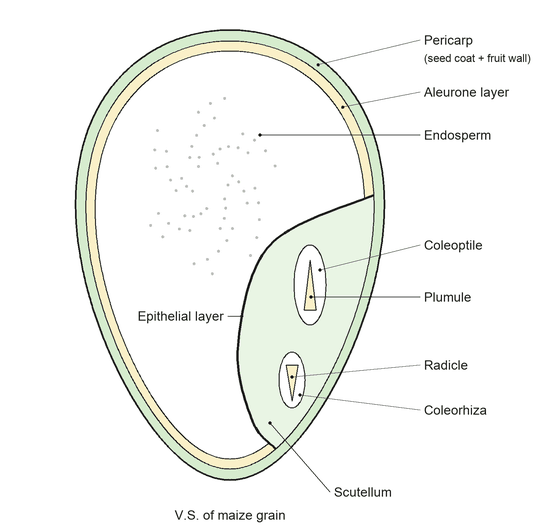
Step 2 — Describe the pericarp.
The outermost layer is the pericarp, the fruit wall, which is fused with the thin seed coat. It protects the grain.
Step 3 — Describe the endosperm and aleurone layer.
The large endosperm stores starch. Its outermost layer of cells is the protein-rich aleurone layer, which makes enzymes that digest the stored food at germination.
Step 4 — Describe the scutellum.
The scutellum is the single shield-shaped cotyledon. It lies against the endosperm, and its surface layer, the epithelial layer, absorbs the digested food and passes it to the growing embryo.
Step 5 — Describe the coleoptile and plumule.
At the upper end of the embryonal axis the plumule (shoot tip with leaf primordia) is enclosed in a hollow sheath, the coleoptile.
Step 6 — Describe the radicle and coleorhiza.
At the lower end of the axis the radicle, with its root cap, is enclosed in a sheath, the coleorhiza.
Therefore, the V.S. of a maize grain shows the pericarp fused with the seed coat, a large starchy endosperm with an aleurone layer, and an embryo with a scutellum against the endosperm, a coleoptile round the plumule and a coleorhiza round the radicle.
- 1425 marks
Question 142
(i) Draw a labelled diagram of a mature embryo-sac.
(ii) Why does a pollen grain possess two male gametes? Explain.
Solve with AIWritten solution
Solution:
Key idea: The mature embryo sac is eight-nucleate and seven-celled. Flowering plants show double fertilisation, in which two separate fusions take place inside the embryo sac, so each pollen grain must deliver two male gametes.
Step 1 — (i) Draw the mature embryo sac.
The diagram below shows a mature embryo sac with its parts labelled.
Step 2 — Describe the parts shown.
At the micropylar end is the egg apparatus: the egg cell between two synergids, which bear the filiform apparatus. At the chalazal end are three antipodal cells. In the large central cell are two polar nuclei.
Step 3 — (ii) Explain where the two male gametes come from.
The generative cell of the pollen grain divides by mitosis, either before the pollen is shed or inside the pollen tube, to form two male gametes. Both are carried by the pollen tube into a synergid and released there.
Step 4 — Explain the first fusion.
One male gamete fuses with the egg cell. This fusion is syngamy, and it forms the diploid zygote, which develops into the embryo.
Step 5 — Explain the second fusion.
The other male gamete fuses with the two polar nuclei in the central cell. This fusion is triple fusion, and it forms the triploid primary endosperm nucleus, which develops into the endosperm, the food store for the embryo.
Step 6 — Explain why both gametes are needed.
Because both the embryo and its food tissue come from fertilisation, a single male gamete could start only one of them. Having two male gametes allows both fusions to take place, so a seed forms with an embryo and the endosperm that feeds it.
Therefore, a pollen grain has two male gametes because flowering plants show double fertilisation: one gamete fuses with the egg to form the zygote (embryo), and the other fuses with the two polar nuclei to form the primary endosperm nucleus (endosperm).
- 1435 marks
Question 143
Name the cell from which the endosperm of coconut develops. Give the characteristics features of endosperm of coconut.
Solve with AIWritten solution
Solution:
Key idea: The endosperm develops from the triploid primary endosperm nucleus formed by triple fusion in the central cell of the embryo sac. In coconut it is of the free-nuclear type, and it is unusual because part of it stays liquid.
Step 1 — Name the cell from which the endosperm develops.
The endosperm of coconut develops from the central cell of the embryo sac. After the second male gamete fuses with the two polar nuclei (triple fusion), the central cell becomes the primary endosperm cell, with a triploid (3n) primary endosperm nucleus.
Step 2 — State its type.
The primary endosperm nucleus divides repeatedly without wall formation, so the endosperm of coconut is of the free-nuclear type.
Step 3 — Describe the coconut water.
The water of a tender coconut is liquid free-nuclear endosperm, containing thousands of free nuclei.
Step 4 — Describe the kernel.
Cell walls then form from the edge inwards, so a layer of cellular endosperm builds up along the inner side of the shell. This is the white kernel (meat) of the coconut. As the fruit ripens the kernel thickens and the amount of water decreases.
Step 5 — Describe its persistence and use.
The endosperm persists in the ripe seed, so coconut is an endospermic seed. It stores oil and other food that the small embryo uses at germination, and it is the edible part of the coconut; dried kernel (copra) gives coconut oil.
Therefore, the endosperm of coconut develops from the central cell (primary endosperm cell) with its triploid primary endosperm nucleus; it is of the free-nuclear type, with coconut water as free-nuclear endosperm and the white kernel as cellular endosperm, and it persists in the ripe seed as a food store.
What Class 12 Biology Ch 2 covers
The sections of the chapter, in the order the book takes them. Every question above comes from one of these.
- 01Flower - A Fascinating Organ of Angiosperms
- 02Stamen, Microsporangium and Pollen Grain
- 03Pistil, Megasporangium (Ovule) and Embryo Sac
- 04Pollination
- 05Outbreeding Devices
- 06Pollen-Pistil Interaction and Pollen Germination
More ways to study this chapter
The same chapter asked three other ways. Practise it, revise it, and see what the board has set on Ch 2 before.
- Competency-Based Questions (CBQ)Case study questions: a situation, and the part of the chapter that answers it.40questionsOpen
- Previous Year QuestionsQuestions that have actually appeared in board papers, each tagged with its year.39questionsOpen
- Practice QuestionsExtra questions per chapter, for when one attempt at a method is not enough.134questionsOpen
Ch 2 in past ISC papers
The same chapter as the board has actually asked it. These are worded differently from the textbook exercise, which is the point of reading them.
- 11 mark
Board paper question 1
Each of the following question(s)/statement(s) has four suggested answers. Choose the correct option in each case.
Triple Fusion involves :
Solve with AIAnswer
(A) Fusion of one male gamete with female gamete
(B) Fusion of tube nucleus with generative nucleus
(C) Fusion of two polar nuclei
- Correct
(D) Fusion of second male gamete with two polar nuclei
Answer: (D) Fusion of second male gamete with two polar nuclei
Key idea: In flowering plants the pollen tube releases two male gametes into the embryo sac. One fuses with the egg (syngamy), and the other fuses with the two polar nuclei of the central cell. Because three haploid nuclei fuse, the second fusion is called triple fusion.
Step 1 — Follow the second male gamete.
The second male gamete moves into the central cell, which contains the two polar nuclei (or the secondary nucleus formed by their fusion).
Step 2 — Count the nuclei that fuse.
One male gamete nucleus () and two polar nuclei () fuse, so three nuclei take part. The product is the triploid () primary endosperm nucleus.
Why the others are wrong:
- (A) Fusion of one male gamete with the female gamete (egg) is syngamy, which forms the diploid zygote; only two nuclei take part.
- (B) The tube nucleus and the generative nucleus never fuse; the generative cell divides to form the two male gametes.
- (C) The two polar nuclei fusing with each other give a diploid secondary nucleus; without the male gamete it is not triple fusion.
Therefore, triple fusion is the fusion of the second male gamete with the two polar nuclei, so the answer is (D).
- 24 marks
Board paper question 2
Give four adaptations in flowers pollinated by insects.
Solve with AIWritten solution
Solution:
Key idea: An insect-pollinated (entomophilous) flower must first attract an insect, then reward it, and finally make sure pollen sticks to the insect and is picked up by the stigma of the next flower.
Step 1 — State the adaptations that attract insects.
The flowers are large and brightly coloured, or small flowers are grouped into a showy inflorescence, so that insects can see them. They are usually scented, which attracts insects from a distance, even at night.
Step 2 — State the adaptation that rewards the insect.
The flowers produce nectar (and often extra pollen) as food. The reward makes the insect visit many flowers of the same kind.
Step 3 — State the adaptations that move the pollen.
The pollen grains are sticky or spiny, coated with a sticky layer called pollenkitt, so they cling to the insect's body. The stigma is sticky and placed where the insect brushes against it, so it collects this pollen.
The main adaptations are summed up in the table.
Feature How it helps insect pollination Large, brightly coloured petals (or a showy inflorescence) Can be seen from a distance and attract insects Scent (fragrance) Attracts insects, including those active at night Nectar and edible pollen Reward that brings the insect back to flowers of the same kind Sticky or spiny pollen grains (coated with pollenkitt) Pollen clings to the insect's body Sticky stigma, placed where the insect brushes against it Picks up pollen from the visiting insect A landing platform (lip) or guide marks on the petals Helps the insect to land and find the nectar Therefore, four adaptations of insect-pollinated flowers are: large, brightly coloured petals; scent; nectar as a reward; and sticky or spiny pollen with a sticky stigma.
- 31 mark
Board paper question 3
Give a brief answer for each of the following:
Explain the term perianth.
Solve with AIWritten solution
Solution:
Key idea: A typical flower has two outer non-essential whorls: the calyx (sepals) and the corolla (petals).
Step 1 — Recall when the term is used.
In some flowers the sepals and petals look alike, so the calyx and the corolla cannot be told apart.
Step 2 — Define perianth.
In such flowers the two outer whorls together are called the perianth, and each member is called a tepal. Examples are lily and onion.
Therefore, the perianth is the outer floral whorl formed when the calyx and corolla are not distinguishable from each other; its members are called tepals, as in lily.
- 41 mark
Board paper question 4
Each of the following question(s) / statement(s) has four suggested answers. Choose the correct option in each case.
After fertilisation, the integuments of an ovule develop into :
Solve with AIAnswer
(A) Seed
- Correct
(B) Seed coat
(C) Fruit
(D) Fruit wall
Answer: (B) Seed coat
Key idea: After fertilisation each part of the flower has a fixed fate: the ovule becomes the seed, the ovary becomes the fruit, and the ovary wall becomes the fruit wall (pericarp).
Step 1 — Find the part that the integuments form.
The integuments are the protective layers around the ovule. After fertilisation they harden and become the protective coat of the seed: the outer integument forms the testa and the inner integument forms the tegmen.
Step 2 — Match with the options.
So the integuments develop into the seed coat, which is option (B).
Why the others are wrong:
- (A) The seed develops from the whole ovule (embryo, endosperm and coats together), not from the integuments alone.
- (C) The fruit develops from the ovary, not from the integuments of an ovule.
- (D) The fruit wall (pericarp) develops from the ovary wall.
Therefore, the integuments of an ovule develop into the seed coat, so the answer is (B).
- 54 marks
Board paper question 5
Give four adaptations shown by flowers pollinated by wind.
Solve with AIWritten solution
Solution:
Key idea: Wind is a random carrier and does not need to be attracted. A wind-pollinated (anemophilous) flower therefore spends nothing on colour, scent or nectar; instead it releases huge amounts of light pollen and has a large surface to catch it.
Step 1 — State the adaptations of the flower as a whole.
The flowers are small and inconspicuous, without bright colour, scent or nectar, because no animal has to be attracted. They are often packed into an inflorescence, such as the tassel of maize.
Step 2 — State the adaptations of the stamens and pollen.
The pollen grains are light, dry, non-sticky and produced in very large numbers, so the wind can carry them far and enough of them reach a stigma. The stamens are well exposed, with long filaments and loosely attached (versatile) anthers that swing in the wind and shed pollen easily.
Step 3 — State the adaptations of the pistil.
The stigma is large, often feathery and well exposed, so it can trap pollen grains from the air. There is usually a single ovule in each ovary, so one pollen grain is enough.
Therefore, four adaptations of wind-pollinated flowers are: small flowers without colour, scent or nectar; light, dry pollen produced in large numbers; well-exposed stamens with long filaments; and large, feathery stigmas.
- 61 mark
Board paper question 6
Give a brief answer for each of the following:
Define Apomixis.
Solve with AIWritten solution
Solution:
Key idea: Normally a seed forms only after fertilisation, and its embryo comes from the zygote.
Step 1 — Recall what is different in some plants.
In some plants, such as certain grasses and members of the sunflower family, seeds develop without any fertilisation. The embryo forms from an unfertilised diploid cell of the ovule.
Step 2 — Define apomixis.
This production of seeds without fertilisation is called apomixis. It is a form of asexual reproduction that imitates sexual reproduction, so the offspring are genetically identical to the mother plant.
Therefore, apomixis is the formation of seeds without fertilisation, a type of asexual reproduction that mimics sexual reproduction.
All 39 board paper questions for this chapter, solved the same way.
Class 12 Biology Ch 2 questions students ask
How many questions are there in Class 12 Biology Ch 2?
143 questions. Every one is solved step by step on this page.
Are these Class 12 Biology solutions free?
Yes. Every question and its full working is free to read, with no account needed.
Can I download the Class 12 Biology Ch 2 solutions as a PDF?
There is no PDF to download. Every solution is on this page instead, which means it is searchable, always the current syllabus, and readable on a phone. Use your browser's print option if you want it on paper.