
Question 1215 marksMedium
What do you understand by the development of an embryo?
Confirming your payment
Sign up now and get 250 free tokens.
Sexual Reproduction in Flowering Plants · Question 121 of 143
What do you understand by the development of an embryo?
Solution:
Key idea: Embryogeny is the development of the embryo from the zygote by mitosis. In a dicot, studied for example in shepherd's purse (Capsella), the zygote passes through the proembryo, globular and heart-shaped stages to the mature embryo, which is fed by the endosperm. The early stages are similar in monocots and dicots.
Step 1 — Note when and where the zygote divides.
The zygote lies at the micropylar end of the embryo sac. In most plants it rests for a while and divides only after some endosperm has formed, so that the young embryo has a ready supply of food.
Step 2 — Describe the first division of the zygote.
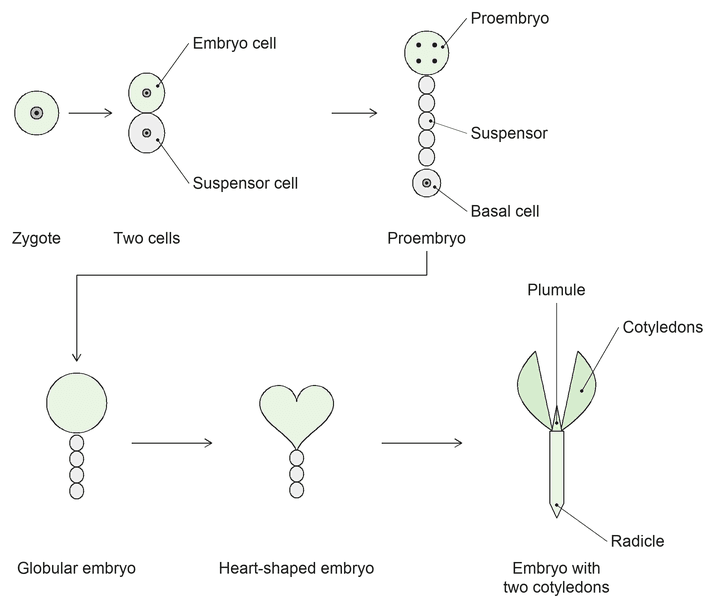
The zygote divides transversely and unequally into two cells: a large basal (suspensor) cell towards the micropyle and a small terminal (embryo) cell towards the chalaza.
Step 3 — Describe the suspensor.
The basal cell divides transversely to form a row of about 6 to 10 cells, the suspensor. The cell at its micropylar end is large and absorbs food. The suspensor pushes the developing embryo deeper into the endosperm, from which it draws food. The suspensor cell next to the embryo (the hypophysis) later forms the tip of the radicle and the root cap.
Step 4 — Describe the formation of the proembryo.
The terminal cell divides, first by two vertical walls and then by a transverse wall, into eight cells (the octant stage). This young embryo is the proembryo. The four cells away from the suspensor later form the plumule and the cotyledons, and the four cells next to the suspensor form the hypocotyl and most of the radicle.
Step 5 — Describe the globular and heart-shaped stages.
Further divisions make the proembryo a ball of cells, the globular embryo. Two cotyledons then begin to grow at the end away from the suspensor, so the embryo becomes heart-shaped; the shoot tip (plumule) forms in the notch between the two cotyledons.
Step 6 — Describe the mature dicot embryo.
The cotyledons grow longer, and the mature embryo has an embryonal axis with two cotyledons. The part of the axis above the cotyledons, the epicotyl, ends in the plumule; the part below them, the hypocotyl, ends in the radicle, which points towards the micropyle and is covered by a root cap. The suspensor then degenerates.
Step 7 — Describe the changes in the ovule.
Meanwhile the integuments harden to form the seed coats (the outer one the testa, the inner one the tegmen), and the ovule becomes the seed.
Step 8 — Show the stages in a diagram.
The diagram below shows the main stages: zygote, two-celled stage, proembryo with suspensor, globular embryo, heart-shaped embryo, and embryo with two cotyledons.
Step 9 — Note how a monocot embryo differs.
In a monocot only one cotyledon develops; in grasses it is the shield-shaped scutellum on one side of the axis. The plumule is enclosed in a sheath, the coleoptile, and the radicle with its root cap in another sheath, the coleorhiza.
Therefore, the development of an embryo (embryogeny) is the series of mitotic divisions by which the zygote forms a suspensor and a proembryo, which passes through the globular and heart-shaped stages to a mature embryo with an embryonal axis, plumule, radicle and cotyledons.