
Question 1225 marksMedium
Write a note on the development of endosperm. Mention the types with examples.
Confirming your payment
Sign up now and get 250 free tokens.
Sexual Reproduction in Flowering Plants · Question 122 of 143
Write a note on the development of endosperm. Mention the types with examples.
Solution:
Key idea: The endosperm is the food-storing tissue of the seed. It develops from the triploid primary endosperm nucleus (PEN) formed by triple fusion, and its development begins before that of the embryo. Its three types differ in how nuclear division is linked to wall formation: free-nuclear, cellular and helobial.
Step 1 — Explain the origin of the endosperm.
After triple fusion the central cell becomes the primary endosperm cell, with a triploid (3n) nucleus. This nucleus divides by mitosis to form the endosperm, usually before the zygote divides, so that food is ready for the young embryo.
Step 2 — Describe the free-nuclear type.
In the free-nuclear (nuclear) type the PEN divides many times without wall formation, and the free nuclei lie along the edge of the embryo sac round a large central vacuole. Walls form later, from the edge towards the centre, and in some plants part of the endosperm stays free-nuclear. It is the commonest type, seen in wheat, rice, maize and coconut, and also in pea, whose endosperm is later used up by the embryo. In a tender coconut the coconut water is free-nuclear endosperm with thousands of nuclei, and the white kernel round it is cellular endosperm.
Step 3 — Describe the cellular type.
In the cellular type every nuclear division is followed by wall formation, so the endosperm is cellular from the start. Examples are Petunia, Datura and balsam.
Step 4 — Describe the helobial type.
In the helobial type the first division of the PEN is followed by a wall that divides the embryo sac into two unequal chambers, a large micropylar chamber and a small chalazal chamber. Further divisions in each chamber are free nuclear, with many more in the micropylar chamber, and walls form later. This type is common in monocots, especially the order Helobiales, from which it takes its name, for example in Asphodelus and Eremurus.
Step 5 — State the fate of the endosperm.
In some seeds the endosperm is used up by the growing embryo before the seed matures; these are non-endospermic (exalbuminous) seeds, such as pea, gram, groundnut and bean. In others it persists and stores food used at germination; these are endospermic (albuminous) seeds, such as wheat, maize, rice, castor and coconut.
Step 6 — Show the three types in a diagram.
The diagram below shows (a) free-nuclear endosperm with nuclei along the edge, (b) cellular endosperm, and (c) helobial endosperm with its two unequal chambers.
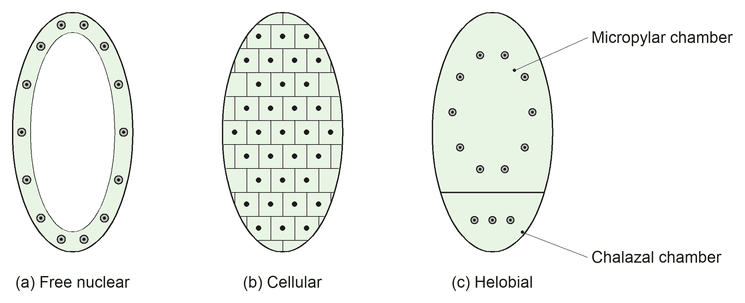
Therefore, the endosperm develops from the triploid primary endosperm nucleus and is of three types: free-nuclear (wheat, maize, coconut), cellular (Petunia, Datura, balsam) and helobial (Asphodelus and other monocots).