
Question 1405 marksMedium
How does the pollen mother cell develop into a mature pollen grain? Illustrate the stages with labelled diagrams.
Confirming your payment
Sign up now and get 250 free tokens.
Sexual Reproduction in Flowering Plants · Question 140 of 143
How does the pollen mother cell develop into a mature pollen grain? Illustrate the stages with labelled diagrams.
Solution:
Key idea: A pollen grain develops from a diploid pollen mother cell in two stages: meiosis (microsporogenesis) gives four haploid microspores, and one mitosis inside each microspore gives the two-celled pollen grain, the male gametophyte.
Step 1 — Describe the pollen mother cell.
Each pollen mother cell (PMC), also called a microspore mother cell, is a diploid (2n) cell in the centre of a pollen sac. It is nourished by the tapetum, the innermost layer of the anther wall.
Step 2 — Describe meiosis I.
In meiosis I the homologous chromosomes separate, and the PMC forms two haploid nuclei (or two cells).
Step 3 — Describe meiosis II.
In meiosis II the sister chromatids separate, so four haploid (n) microspores are formed. They stay together for a while as a microspore tetrad. This whole process is microsporogenesis.
Step 4 — Describe the separation of the microspores.
As the anther matures and dries, the microspores separate from the tetrad.
Step 5 — Describe the formation of the pollen wall.
Each microspore forms a thick outer exine of sporopollenin, with germ pores where the exine is absent, and a thin inner intine of cellulose and pectin.
Step 6 — Describe the mitosis that forms the pollen grain.
The microspore nucleus divides by mitosis with an unequal spindle, giving a large vegetative cell and a small generative cell. The microspore is now a mature two-celled pollen grain, the male gametophyte. In some plants the generative cell divides again before shedding to give two male gametes, so the pollen is shed at the three-celled stage.
Step 7 — Describe the release of the pollen.
The anther splits along its line of dehiscence and the pollen grains are released.
Step 8 — Show the stages in a diagram.
The diagram below shows the stages: a diploid microspore mother cell divides by meiosis I and meiosis II into a tetrad of four haploid microspores; these separate, and one mitosis turns each microspore into a mature pollen grain with an exine, an intine, a vegetative nucleus and a generative nucleus.
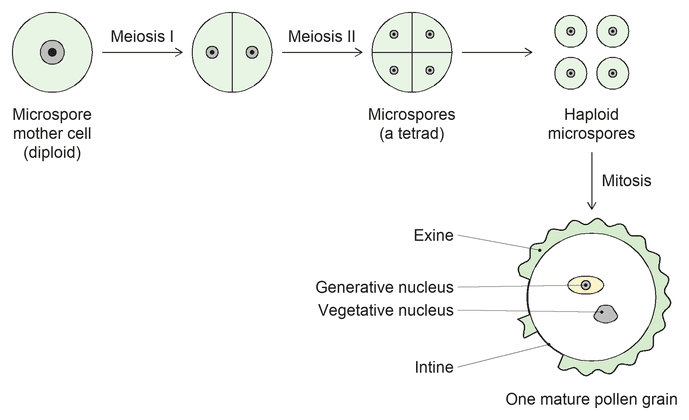
Therefore, a diploid pollen mother cell divides by meiosis into a tetrad of four haploid microspores; each microspore separates, forms an exine and an intine, and divides by mitosis into a vegetative cell and a generative cell to become a mature pollen grain.