Solution:
Key idea: After double fertilisation the embryo sac holds a diploid zygote and a triploid primary endosperm nucleus. The endosperm develops first and feeds the embryo, which grows from the zygote through the proembryo, globular and heart-shaped stages to a mature embryo.
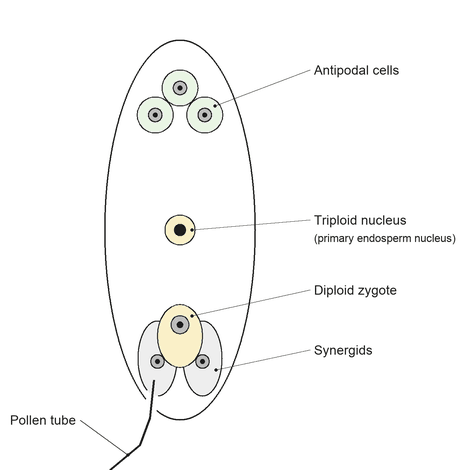
Step 1 — (i) Draw the fertilised embryo sac.
The diagram below shows the embryo sac just after double fertilisation: the diploid zygote at the micropylar end, the triploid primary endosperm nucleus in the central cell, the synergids (one entered by the pollen tube), the antipodal cells at the chalazal end, and the pollen tube.
Step 2 — (ii) Describe the first division of the zygote.
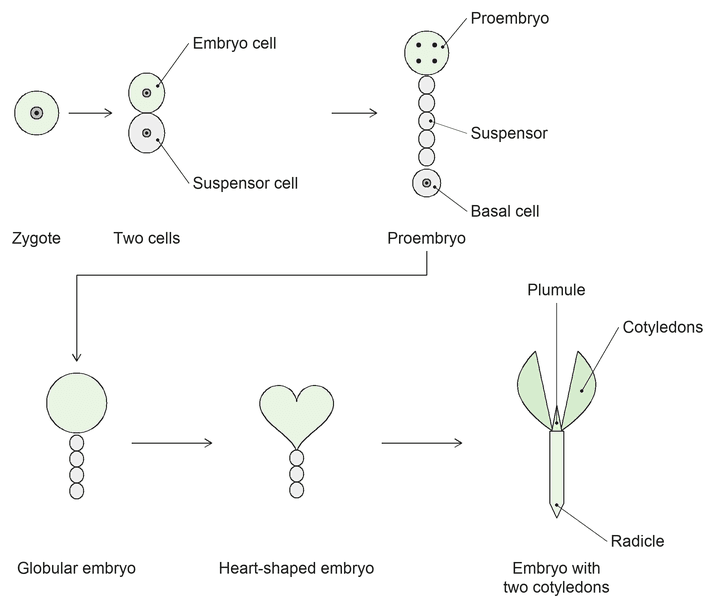
The zygote divides transversely into a large basal (suspensor) cell towards the micropyle and a small terminal (embryo) cell towards the chalaza.
Step 3 — Describe the suspensor and proembryo.
The basal cell forms a row of cells, the suspensor, which pushes the young embryo into the endosperm. The terminal cell divides into eight cells, the proembryo: the four cells away from the suspensor later form the plumule and cotyledons, and the four next to it form the hypocotyl and radicle.
Step 4 — Describe the globular and heart-shaped stages.
Further divisions give a ball of cells, the globular embryo. Two cotyledons then grow at the end away from the suspensor, so the embryo becomes heart-shaped, with the plumule forming in the notch between them.
Step 5 — Describe the mature embryo.
The cotyledons grow longer, and the mature embryo has two cotyledons on an embryonal axis, with the plumule at its upper end and the radicle, covered by a root cap, at its lower end facing the micropyle. The diagram below shows the stages.
Step 6 — (iii) Explain why endosperm development comes first.
The primary endosperm nucleus starts dividing soon after triple fusion, while the zygote usually rests for a time and divides only after some endosperm has formed. The embryo cannot make its own food while it is inside the seed, so it depends on the endosperm for nourishment. Forming the endosperm first makes sure that food is ready as soon as the embryo starts to grow.
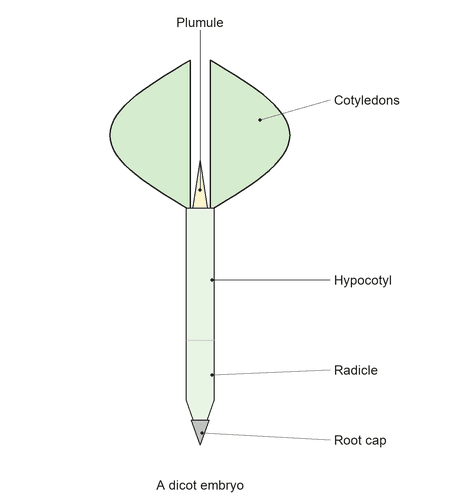
Step 7 — (iv) Draw the mature dicot embryo.
The diagram below shows a mature dicot embryo. The two cotyledons are attached to the embryonal axis; above them the axis ends in the plumule, and below them the hypocotyl ends in the radicle, covered by the root cap.
Therefore, the fertilised embryo sac holds a diploid zygote and a triploid primary endosperm nucleus; the zygote develops through the proembryo, globular and heart-shaped stages into an embryo with two cotyledons, a plumule, a hypocotyl and a radicle, and the endosperm forms first so that the embryo is fed from the start.
