
Question 1385 marksMedium
(i) Draw a diagrammatic sketch of a sectional view of a typical anatropous ovule.
(ii) List the components of the embryo sac and mention their fate on fertilisation.
Confirming your payment
Sign up now and get 250 free tokens.
Sexual Reproduction in Flowering Plants · Question 138 of 143
(i) Draw a diagrammatic sketch of a sectional view of a typical anatropous ovule.
(ii) List the components of the embryo sac and mention their fate on fertilisation.
Solution:
Key idea: An anatropous ovule is turned over so that its micropyle lies close to the funicle. Inside its nucellus lies the seven-celled embryo sac. At fertilisation the egg and the central cell are fertilised, and the other cells degenerate.
Step 1 — (i) Draw the anatropous ovule.
The labelled diagram below shows a longitudinal section of a mature anatropous ovule. Its labelled parts are the funicle, hilum, integuments, micropyle, chalaza, nucellus and the embryo sac with its antipodal cells, polar nuclei (which fuse to form the definitive nucleus), egg cell and synergids.
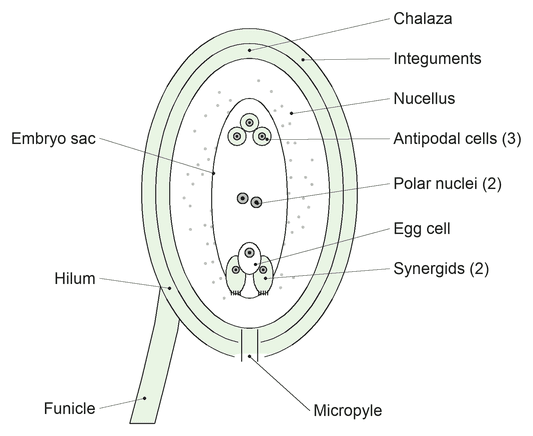
Step 2 — Describe the parts shown.
The funicle attaches the ovule to the placenta, and the hilum is the point where it joins the body of the ovule. The integuments cover the nucellus and leave an opening, the micropyle; the opposite end is the chalaza. The nucellus holds the embryo sac.
Step 3 — (ii) List the components of the embryo sac.
A mature embryo sac has seven cells: one egg cell and two synergids (the egg apparatus) at the micropylar end, three antipodal cells at the chalazal end, and one large central cell with two polar nuclei (or the definitive nucleus formed by their fusion).
Step 4 — State the fate of the egg cell.
One male gamete fuses with the egg (syngamy) to form the diploid zygote, which divides by mitosis to form the embryo.
Step 5 — State the fate of the synergids.
The pollen tube enters one synergid through its filiform apparatus and releases the two male gametes into it; this synergid degenerates. The other synergid also degenerates soon after fertilisation.
Step 6 — State the fate of the central cell.
The second male gamete fuses with the two polar nuclei (triple fusion) to form the triploid primary endosperm nucleus. The central cell becomes the primary endosperm cell, which divides to form the endosperm, the food tissue for the embryo.
Step 7 — State the fate of the antipodal cells.
The antipodal cells take no part in fertilisation. They usually degenerate, although in some plants, such as grasses, they multiply for a while and may help to feed the embryo sac.
Therefore, the embryo sac has an egg cell, two synergids, three antipodal cells and a central cell with two polar nuclei; on fertilisation the egg forms the zygote and then the embryo, the central cell forms the endosperm, and the synergids and antipodal cells degenerate.