
Question 1375 marksMedium
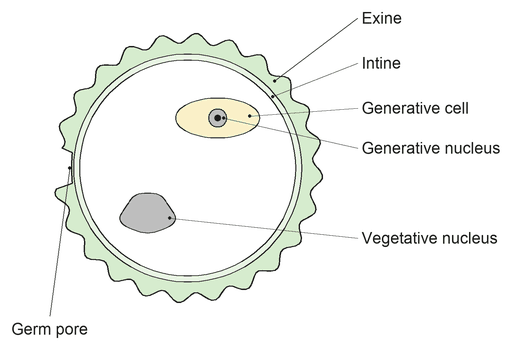
Draw a labelled diagram of the sectional view of a mature pollen grain in angiosperms. Explain the functions of its different parts.
Confirming your payment
Sign up now and get 250 free tokens.
Sexual Reproduction in Flowering Plants · Question 137 of 143
Draw a labelled diagram of the sectional view of a mature pollen grain in angiosperms. Explain the functions of its different parts.
Solution:
Key idea: The pollen grain is the male gametophyte. Its wall protects it and lets out the pollen tube, its vegetative cell feeds and forms the tube, and its generative cell gives the two male gametes.
Step 1 — Draw the pollen grain.
The diagram below shows a mature two-celled pollen grain in section, with its parts labelled. The labelled parts are the exine, the intine, a germ pore, the generative cell with its nucleus, and the vegetative nucleus.
Step 2 — Explain the function of the exine.
The exine is the thick outer wall of sporopollenin, the most resistant organic material known. It protects the living contents from drying, high temperatures, strong acids and alkalis and microbes, so pollen can survive the journey to a stigma and is even preserved as fossils. Its species-typical pattern helps the pollen stick to animals and is used to identify plants.
Step 3 — Explain the function of the germ pores.
Germ pores are thin places in the exine where sporopollenin is absent. At germination the pollen tube comes out through one of them.
Step 4 — Explain the function of the intine.
The intine is the thin inner wall of cellulose and pectin. At germination it grows out through a germ pore to form the wall of the pollen tube.
Step 5 — Explain the function of the vegetative cell.
The vegetative cell is the large cell with plenty of stored food. It supplies energy and materials for the growth of the pollen tube, and its nucleus (the tube nucleus) moves into the tube near its tip.
Step 6 — Explain the function of the generative cell.
The generative cell is the small spindle-shaped cell. It divides by mitosis, either before the pollen is shed or inside the pollen tube, to form the two male gametes. One fuses with the egg and the other with the two polar nuclei in double fertilisation.
Therefore, in a mature pollen grain the exine protects, the germ pores let out the pollen tube, the intine forms the wall of the tube, the vegetative cell feeds the growing tube, and the generative cell forms the two male gametes.