
Question 1415 marksMedium
Draw a vertical section of a maize grain and label pericarp, scutellum, coleoptile and radicle.
Confirming your payment
Sign up now and get 250 free tokens.
Sexual Reproduction in Flowering Plants · Question 141 of 143
Draw a vertical section of a maize grain and label pericarp, scutellum, coleoptile and radicle.
Solution:
Key idea: The maize grain is a one-seeded fruit (a caryopsis) in which the seed coat is fused with the fruit wall. Most of the grain is endosperm, and the embryo lies to one side with its single cotyledon, the scutellum, pressed against the endosperm.
Step 1 — Draw the vertical section.
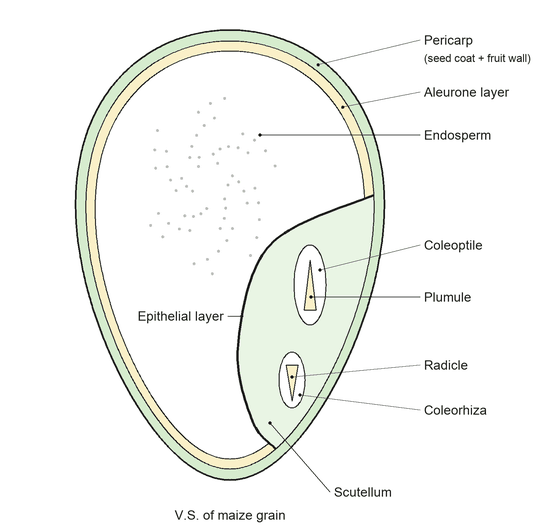
The diagram below shows the V.S. of a maize grain with the pericarp, endosperm, aleurone layer, scutellum, its epithelial layer, coleoptile, plumule, radicle and coleorhiza labelled.
Step 2 — Describe the pericarp.
The outermost layer is the pericarp, the fruit wall, which is fused with the thin seed coat. It protects the grain.
Step 3 — Describe the endosperm and aleurone layer.
The large endosperm stores starch. Its outermost layer of cells is the protein-rich aleurone layer, which makes enzymes that digest the stored food at germination.
Step 4 — Describe the scutellum.
The scutellum is the single shield-shaped cotyledon. It lies against the endosperm, and its surface layer, the epithelial layer, absorbs the digested food and passes it to the growing embryo.
Step 5 — Describe the coleoptile and plumule.
At the upper end of the embryonal axis the plumule (shoot tip with leaf primordia) is enclosed in a hollow sheath, the coleoptile.
Step 6 — Describe the radicle and coleorhiza.
At the lower end of the axis the radicle, with its root cap, is enclosed in a sheath, the coleorhiza.
Therefore, the V.S. of a maize grain shows the pericarp fused with the seed coat, a large starchy endosperm with an aleurone layer, and an embryo with a scutellum against the endosperm, a coleoptile round the plumule and a coleorhiza round the radicle.