
Question 1425 marksMedium
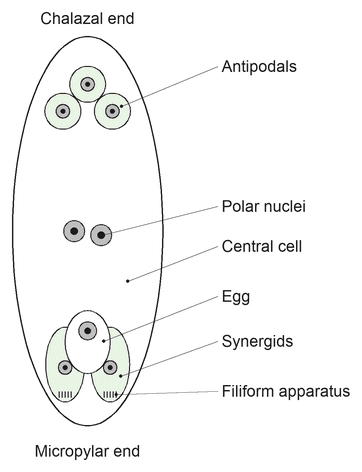
(i) Draw a labelled diagram of a mature embryo-sac.
(ii) Why does a pollen grain possess two male gametes? Explain.
Confirming your payment
Sign up now and get 250 free tokens.
Sexual Reproduction in Flowering Plants · Question 142 of 143
(i) Draw a labelled diagram of a mature embryo-sac.
(ii) Why does a pollen grain possess two male gametes? Explain.
Solution:
Key idea: The mature embryo sac is eight-nucleate and seven-celled. Flowering plants show double fertilisation, in which two separate fusions take place inside the embryo sac, so each pollen grain must deliver two male gametes.
Step 1 — (i) Draw the mature embryo sac.
The diagram below shows a mature embryo sac with its parts labelled.
Step 2 — Describe the parts shown.
At the micropylar end is the egg apparatus: the egg cell between two synergids, which bear the filiform apparatus. At the chalazal end are three antipodal cells. In the large central cell are two polar nuclei.
Step 3 — (ii) Explain where the two male gametes come from.
The generative cell of the pollen grain divides by mitosis, either before the pollen is shed or inside the pollen tube, to form two male gametes. Both are carried by the pollen tube into a synergid and released there.
Step 4 — Explain the first fusion.
One male gamete fuses with the egg cell. This fusion is syngamy, and it forms the diploid zygote, which develops into the embryo.
Step 5 — Explain the second fusion.
The other male gamete fuses with the two polar nuclei in the central cell. This fusion is triple fusion, and it forms the triploid primary endosperm nucleus, which develops into the endosperm, the food store for the embryo.
Step 6 — Explain why both gametes are needed.
Because both the embryo and its food tissue come from fertilisation, a single male gamete could start only one of them. Having two male gametes allows both fusions to take place, so a seed forms with an embryo and the endosperm that feeds it.
Therefore, a pollen grain has two male gametes because flowering plants show double fertilisation: one gamete fuses with the egg to form the zygote (embryo), and the other fuses with the two polar nuclei to form the primary endosperm nucleus (endosperm).