
Opening your dashboard
Class 12 Biology Chapter 2 Sexual Reproduction in Flowering Plants: Competency-Based Questions (CBQ)
40 questions on Chapter 2, each worked through on its own page with the AI tutor. Class 12 Biology, ICSE 2026-27.
40 questions
1–5 marks · Mixed difficulty
- 13 marks
Question 1
During a visit to a mango orchard near Ratnagiri, a group of students examined one inflorescence of a mango tree and sorted its flowers as shown below. (Hypothetical data.)
Kind of flower Number Stamens and pistil both present 60 Stamens present, pistil absent 420 (a) What is the largest number of fruits this inflorescence could form? Give a reason.
(b) Every mango fruit contains a single seed, while a papaya fruit contains many seeds. What does this tell you about the ovary of each flower?
(c) One student wrote "the mango tree is monoecious". Why is this not a complete description of the mango tree?
- 21 mark
Question 2
A gardener notices that on a pumpkin (Cucurbita) vine, many flowers have sepals, petals and stamens but no pistil. These flowers wither without forming fruits, while some other flowers on the same vine grow into pumpkins. Which description fits the flowers that wither?
- 33 marks
Question 3
A student studied sections of mustard anthers taken at three stages of development and wrote these notes. (Hypothetical observations.)
Stage I: Each of the four pollen sacs is filled with a mass of similar cells.
Stage II: Each pollen sac contains many groups of four cells.
Stage III: The anther has dried. In each lobe the two pollen sacs appear as a single cavity, and the anther wall has split along two lines. Single, separate pollen grains are seen.
(a) Name the cells that divided to form the groups of four seen in Stage II, the kind of division involved and the name of the whole process.
(b) Why are the cells that were in groups of four in Stage II seen as single grains in Stage III?
(c) Explain why each lobe shows a single cavity in Stage III and how the pollen grains are set free.
- 41 mark
Question 4
Assertion (A): Pollen grains of many plant species can be identified just by looking at their exine.
Reason (R): Germ pores are the regions on the pollen grain where the exine is thin or absent.
- 51 mark
Question 5
In an experiment (hypothetical), young ovules are treated with a chemical that blocks meiosis but does not affect mitosis. The ovules are treated just when the megaspore mother cell has formed in the nucellus. Which structure will fail to form in these ovules?
- 61 mark
Question 6
Assertion (A): A mature embryo sac of the Polygonum type is described as 8-nucleate but 7-celled.
Reason (R): The three antipodal cells fuse together to form a single cell.
- 73 marks
Question 7
A plant researcher kept Commelina plants in an insect-free greenhouse with still air. These plants bear two kinds of flowers. The researcher tagged 50 flowers of each kind and recorded how many set seed. (Hypothetical data.)
Kind of flower Flowers tagged Flowers that set seed Open flowers (anthers and stigma exposed) 50 18 Flowers that never open 50 50 (a) Explain why every flower of the second kind set seed even though no insects or wind were present.
(b) Some open flowers also set seed without any pollinator, but most did not. Explain both observations.
(c) If insects were let into the greenhouse, seeds from which kind of flower could show new combinations of characters? Give a reason.
- 81 mark
Question 8
In a school garden, a student uses a fine brush to carry pollen from one flower of a China rose plant to the stigma of another flower on the same plant. How is this pollination best described?
- 91 mark
Question 9
Assertion (A): Seed set by cross-pollination is less certain than seed set by self-pollination.
Reason (R): Cross-pollination depends on external agencies such as wind, water or animals to carry the pollen.
- 103 marks
Question 10
A farmer in Kutch raised 20 date palm trees from seed. When they flowered, 9 trees bore flowers with stamens only and 11 trees bore flowers with carpels only. (Hypothetical data.) A neighbouring farmer grows maize, where each plant bears male flowers in a tassel at the top and female flowers in a cob lower down.
(a) How many of the date palm trees can bear fruits? Give a reason.
(b) If the farmer cut down all 9 trees bearing stamens, and no other date palm grew nearby, would the remaining trees produce seeds? Explain.
(c) Which kinds of self-pollination are prevented in date palm, and which in maize? Explain.
- 111 mark
Question 11
In a research plot, ground cherry (Physalis) plants have perfect (bisexual) flowers whose anthers and stigma mature at the same time. When single plants are kept isolated, so that only their own pollen reaches their stigmas, almost no seeds form. (Hypothetical observation.) Which is the best explanation?
- 124 marks
Question 12
In a school laboratory, students dusted pea pollen on four glass slides, each with a drop of sucrose solution of a different strength. After 15 minutes they counted, under the low power of the microscope, the pollen grains that had formed pollen tubes. (Hypothetical data.)
Slide Sucrose solution Pollen grains counted Grains with a pollen tube 1 0% (plain water) 200 6 2 5% 200 70 3 10% 200 150 4 20% 200 50 (a) Calculate the percentage germination on each slide.
(b) Which slide gave the best germination? What, in the pistil, does the sugar solution stand in for, and what is its role there?
(c) Through which structure of the pollen grain does the pollen tube come out, and which wall layer forms the tube?
- 131 mark
Question 13
Assertion (A): A pollen grain begins to germinate on a stigma only when the stigma is receptive and the pollen is compatible.
Reason (R): The pollen tube is formed by the exine, which grows out through a germ pore.
- 143 marks
Question 14
At an agricultural research station, a breeder crossed variety P (female parent, bisexual flowers) with variety Q (male parent) in two ways and grew plants from the seeds. (Hypothetical data.)
Treatment of P flowers Seedlings grown Hybrid seedlings (P × Q) Seedlings like P only T1: anthers removed from buds, bagged, stigma dusted with Q pollen, rebagged 100 98 2 T2: anthers NOT removed, bagged, stigma dusted with Q pollen, rebagged 100 45 55 (a) Explain why more than half the seedlings in T2 were like variety P only.
(b) Name the step left out in T2. State when and how it should be done.
(c) Why do plant breeders use artificial hybridisation in crop improvement?
- 154 marks
Question 15
A watermelon from a farm in Rajasthan contained 320 mature seeds. (Hypothetical data.) Assume that each seed came from one ovule that was fertilised normally, that one pollen tube entered each ovule, and that every embryo sac developed in the usual (Polygonum) way.
(a) What is the least number of pollen grains that must have germinated successfully on the stigma? How many male gametes did their pollen tubes deliver in all?
(b) How many egg cells and how many polar nuclei took part in the fusions?
(c) How many megaspore mother cells must have undergone meiosis to give these embryo sacs, and how many megaspores degenerated? Show your reasoning.
- 161 mark
Question 16
Assertion (A): Double fertilisation in an ovule needs two pollen grains, one for each fusion.
Reason (R): One male gamete fuses with the egg, and the other fuses with the two polar nuclei.
- 171 mark
Question 17
A student compares the covering of a young ovule with the covering of a mature seed from the same pea plant. The first is thin, made of one or two integuments of living cells; the second is a thick, tough coat made mostly of dead, thick-walled cells. Which post-fertilisation change explains this?
- 181 mark
Question 18
Assertion (A): In maize, the endosperm persists as the food store of the mature grain.
Reason (R): Maize endosperm develops by the free-nuclear method.
- 193 marks
Question 19
In a seed-testing laboratory, a technician cut a soaked maize grain lengthwise. The figure shows the cut surface with three parts lettered A, B and C.
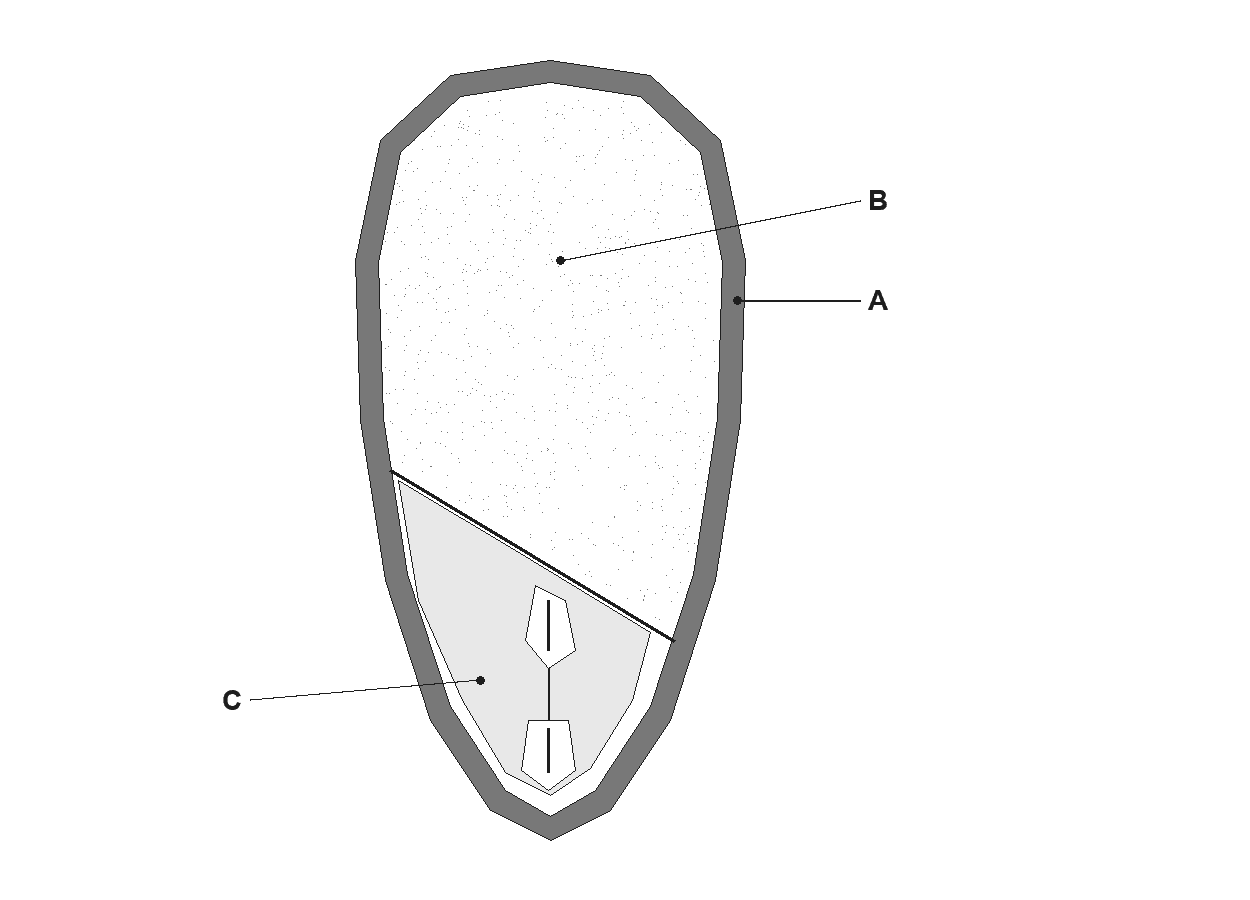
(a) Identify part A. Why can it not be peeled off as a separate seed coat, as it can be from a soaked gram seed?
(b) Identify part C and state its role when the grain germinates.
(c) Part B fills most of the grain. From which nucleus does it develop, and what is the ploidy of its cells?
- 201 mark
Question 20
A student soaks a castor seed and splits it open. Inside are two thin, papery cotyledons lying against a large, white food-storing tissue that fills most of the seed. How should this seed be described?
- 213 marks
Question 21
On a school field trip, students placed ripe balsam plants on a large sheet and recorded how far 200 seeds landed from the plants after the fruits burst. (Hypothetical data.)
Distance from plant Number of seeds 0 to 0.5 m 30 more than 0.5 m to 1 m 50 more than 1 m to 1.5 m 70 more than 1.5 m to 2 m 50 (a) Name the mechanism by which balsam disperses its seeds and describe how it works.
(b) What percentage of the seeds landed more than 1 m away from the plants?
(c) Some green, unripe balsam fruits that were picked did not burst. Explain why.
- 221 mark
Question 22
Along a wire fence on a farm where birds often perch, a farmer finds many young guava plants, although the nearest guava tree is far away. Which explanation fits best?
- 231 mark
Question 23
Assertion (A): Orchid seeds are dispersed by wind.
Reason (R): Orchid seeds are very small, light and dry.
- 243 marks
Question 24
A horticulturist emasculated and bagged 80 tomato flowers so that no pollen could reach them. The unfertilised ovaries of 40 of these flowers were then sprayed with an auxin solution, and the other 40 were left unsprayed. (Hypothetical data.)
Group Flowers Fruits formed Seeds in the fruits Sprayed with auxin 40 36 none Not sprayed 40 0 — (a) Name the process seen in the sprayed group and explain why the fruits had no seeds.
(b) Calculate the percentage of flowers that formed fruit in each group. What does the unsprayed group show?
(c) If the flowers had instead been allowed to be pollinated and fertilised normally, how would their fruits differ from those of the sprayed group? Give a reason.
- 251 mark
Question 25
Assertion (A): Seeds formed by parthenogenesis are always haploid.
Reason (R): In parthenogenesis, seeds develop from an unfertilised female gamete (egg).
- 264 marks
Question 26
Pollen grains from a plant of genotype S₁S₂ land on the stigma of another plant of genotype S₂S₃ of the same species.
(a) If the species shows sporophytic self-incompatibility, which of these pollen grains fail, and at what stage? Name one family in which this type is seen.
(b) If the species shows gametophytic self-incompatibility, which pollen grains are stopped and where? Name one family in which this type is seen.
- 275 marks
Question 27
In angiosperms, the pollination is mainly of two types, self-pollination and cross-pollination. Self-pollination is transfer of pollens from the anthers of a flower to the stigma of the same flower or another flower on the same plant. Cross pollination also known as xenogamy is transfer of pollens from the anther of a flower to the stigma of a flower on another plant. The agents involved in cross pollination could be abiotic or biotic agents. Abiotic agents include wind and water. Biotic agents include insects, birds, bats and other animals. Wind-pollinated flowers are generally colourless, small and light. Flowers have well-exposed stamens with feathery stigma. Pollens are light and non-sticky. Water-pollinated flowers have ribbon-like pollen grains for easy transport via water. The insect-pollinated flowers are usually colourful and have fragrance or nectar. The diagram given below shows two plants of the same species showing different types of pollination.
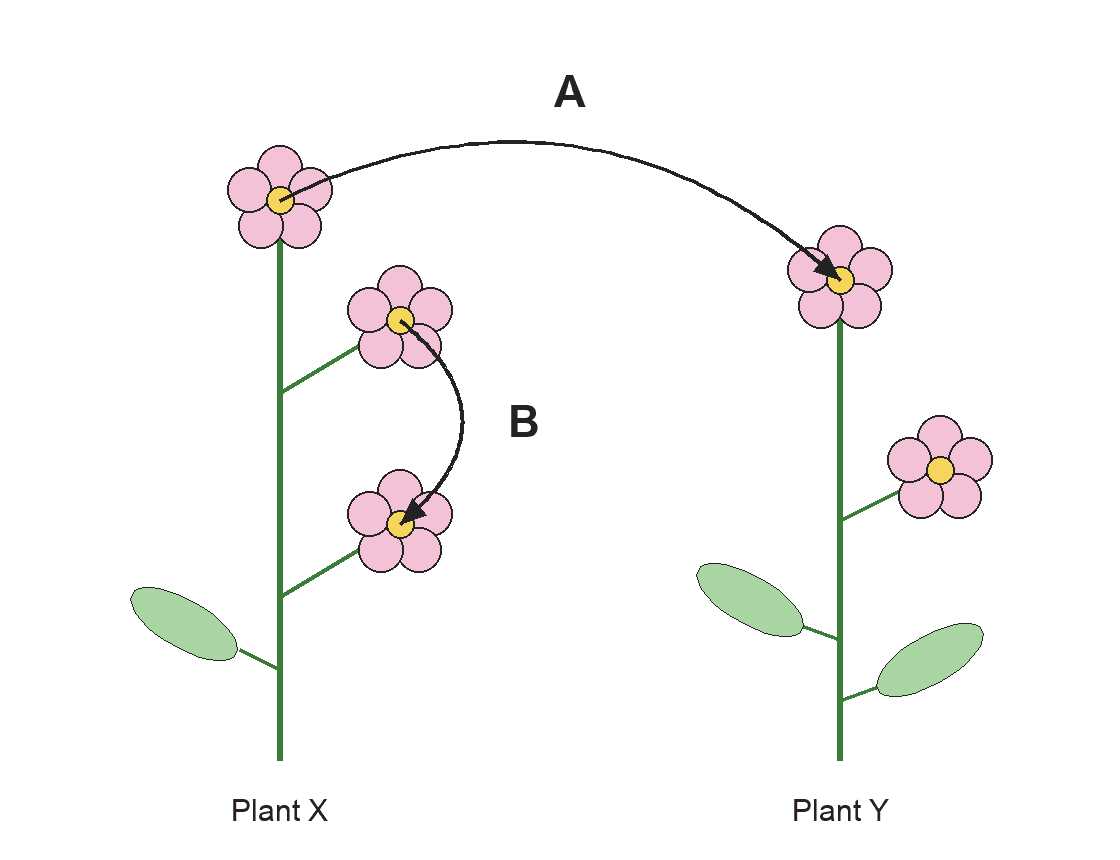
1. What is transferred between the plants in the process indicated by arrow A?
(a) nectar (b) nutrients (c) pollens (d) seeds
2. Name the process shown by the arrow B.
(a) fertilisation (b) self-pollination (c) cross-pollination (d) xenogamy
3. If flower of plant X and plant Y are wind pollinated.
(a) pollens will be sticky (b) pollens will be light (c) flowers will have fragrance (d) pollens are ribbon-like
4. Which of the following is a biotic agent that helps in pollination?
(a) air (b) water (c) wind (d) bats
5. The following feature helps in the pollination of water-pollinated flowers.
(a) fragrant flowers (b) feathery stigma (c) ribbon-like pollen grains (d) bright colours
- 285 marks
Question 28
The formation of microspores or pollen grains from a pollen mother cell by meiosis is called microsporogenesis. When the anther is young, a layer of homogenous cells, the sporogenous tissue, occupies the centre of each microsporangium. It is diploid in nature. The sporogenous tissue undergo meiotic divisions to form microspore tetrads (four microspores) which are haploid. These microspores mature to form pollen grains. Pollen grains are spherical structures with two-layered wall: an outer exine and inner intine. Exine is covered by the deposition of sporopollenin, a resistant layer that can withstand high temperature and pressure. Exine contains apertures known as germ pores, where sporopollenin is absent. The intine is made up of pectin and cellulose.
1. The special outer cover of pollen grains has deposition of
(a) cellulose (b) sporopollenin (c) exine (d) intine
2. The formation of pollen grains from pollen mother cell is called
(a) sporopollenin (b) sporogenesis (c) homogenesis (d) microsporogenesis
3. The sporogenous tissue is
(a) haploid (b) diploid (c) forms outer layer of microsporangium (d) present in microspores
4. The places where exine is absent in the pollen grain are called
(a) intinepore (b) germ pore (c) stoma (d) micropore
5. Which of the following undergoes meiotic divisions?
(a) sporogenous tissue (b) microspore tetrads (c) microspores (d) pollen grains
- 295 marks
Question 29
The most important structure formed after double fertilisation is endosperm. Endosperm is triploid in nature and serves for the nourishment of the growing embryo. The cells of this tissue store reserve food materials. Zygote forms the embryo. A dicot embryo consists of embryonal axis with two cotyledons. The portion of embryonal axis which is above the level of cotyledons is the epicotyl. Epicotyl gives rise to plumule or stem tip. The portion below the level of cotyledons is hypocotyl. Hypocotyl terminates at its lower end in the radicle or root tip. The root tip is protected by root cap. Monocots have only single cotyledon. The cotyledon of monocot is known as scutellum. At its lower end, the embryonal axis has the radical and root cap enclosed in an undifferentiated sheath called coleorhiza. The epicotyl has a shoot apex which is enclosed in a hollow structure called coleoptile.
1. Which of the following is not true for the endosperm?
(a) stores food (b) diploid (c) triploid (d) formed as a result of double fertilisation
2. Part of the embryonal axis which is above the level of cotyledons is called
(a) cotyledon (b) epicotyl (c) hypocotyl (d) embryo
3. Hypocotyl has ______ at its lower end.
(a) radicle (b) plumule (c) cotyledon (d) shoot tip
4. The cotyledon in the monocots is known as
(a) endosperm (b) coleoptile (c) embryonal axis (d) scutellum
5. In monocots, the epicotyl is enclosed in the
(a) coleoptile (b) coleorhiza (c) root cap (d) radicle
- 303 marks
Question 30
What is bagging technique? How is it useful in a plant breeding programme?
- 313 marks
Question 31
What is triple fusion? Where and how does it take place? Name the nuclei involved in triple fusion.
- 323 marks
Question 32
What is meant by emasculation? When and why does a plant breeder employ this technique?
- 333 marks
Question 33
"Apomictic genes are trying to be inserted in hybrid varieties". Explain.
- 343 marks
Question 34
Describe the process of double fertilisation in angiosperms. What is its significance?
- 353 marks
Question 35
Draw neat and well labeled diagram of L.S. of an anatropous ovule.
- 361 mark
Question 36
In Torenia, a small garden plant, the embryo sac grows out through the micropyle of the ovule, so single cells inside it can be destroyed with a fine laser beam. A researcher placed such ovules in a culture dish near growing pollen tubes. In each batch one kind of cell of the embryo sac was destroyed, and the researcher recorded the percentage of ovules into which a pollen tube grew. (Hypothetical data.)
Cell destroyed in the embryo sac Ovules that attracted a pollen tube None 98% Egg cell 94% Central cell 96% One synergid 71% Both synergids 0% Which conclusion is best supported by these data?
- 371 mark
Question 37
Assertion (A): A carpenter bee that bites a hole at the base of a long, tubular corolla and drinks the nectar through it usually does not pollinate that flower.
Reason (R): An animal visitor pollinates a flower only when pollen carried on its body is brought into contact with the stigma.
- 382 marks
Question 38
On a seed farm in Karnataka, hybrid maize seed is produced by sowing four rows of variety P after every two rows of variety Q. Before the tassels of variety P begin to shed pollen, workers pull out every tassel from the P plants. The tassels of Q are left in place, and the nearest other maize field is about 200 m away. (Hypothetical example.)
(a) Which step of artificial hybridisation does the removal of the P tassels take the place of? Why is it needed, even though maize flowers are unisexual?
(b) The cobs of which rows give the hybrid seed? Why are these cobs not covered with bags?
- 393 marks
Question 39
A farmer in Punjab grew a white-kernelled maize variety in a field next to a yellow-kernelled variety. At harvest, cobs of the white variety from the rows nearest the yellow field carried a mixture of white and yellow kernels. (Hypothetical observation.) In maize, the colour of a kernel seen from outside is mainly the colour of its endosperm, seen through the thin, colourless fruit wall. The allele for yellow endosperm (Y) is dominant over the allele for white endosperm (y). The white variety is pure-breeding (yy), and so is the yellow variety (YY).
(a) Explain how a yellow kernel can form on a cob of the white variety.
(b) Give the genotype of the endosperm and of the embryo in such a yellow kernel.
(c) Some cobs of the yellow variety also received pollen from the white field, yet all their kernels were yellow. Explain why, giving the genotype of the endosperm of these kernels.
- 405 marks
Question 40
A farmer near Nashik grows a cucumber variety that is not parthenocarpic. Each cucumber plant bears separate male and female flowers, and the female flower has an inferior ovary with many ovules. Cucumber pollen is heavy and sticky, and it is carried mainly by honey bees. As each fertilised ovule grows into a seed, it releases auxin, which makes the part of the ovary wall around it grow. The flowers open in the early morning, when bees visit them most. Last season the farmer sprayed an insecticide every morning, and many of the fruits were small and curved. This season the farmer tagged female flowers and counted the honey-bee visits to each one. (Hypothetical data.)
Bee visits to a flower Flowers tagged Fruits formed Mean number of seeds per fruit Curved fruits 0 40 0 — — 1 to 3 50 20 60 14 4 to 8 60 48 210 5 more than 8 50 46 330 1 (a) Calculate the percentage of tagged flowers that formed fruit in each group, and describe how fruit set and seed number change with the number of bee visits.
(b) Explain why no unvisited flower formed a fruit, and why many fruits from flowers with only 1 to 3 visits were curved.
(c) Evaluate the farmer's practice of spraying insecticide in the morning while the flowers are open, and suggest two changes.