
In angiosperms, the pollination is mainly of two types, self-pollination and cross-pollination. Self-pollination is transfer of pollens from the anthers of a flower to the stigma of the same flower or another flower on the same plant. Cross pollination also known as xenogamy is transfer of pollens from the anther of a flower to the stigma of a flower on another plant. The agents involved in cross pollination could be abiotic or biotic agents. Abiotic agents include wind and water. Biotic agents include insects, birds, bats and other animals. Wind-pollinated flowers are generally colourless, small and light. Flowers have well-exposed stamens with feathery stigma. Pollens are light and non-sticky. Water-pollinated flowers have ribbon-like pollen grains for easy transport via water. The insect-pollinated flowers are usually colourful and have fragrance or nectar. The diagram given below shows two plants of the same species showing different types of pollination.
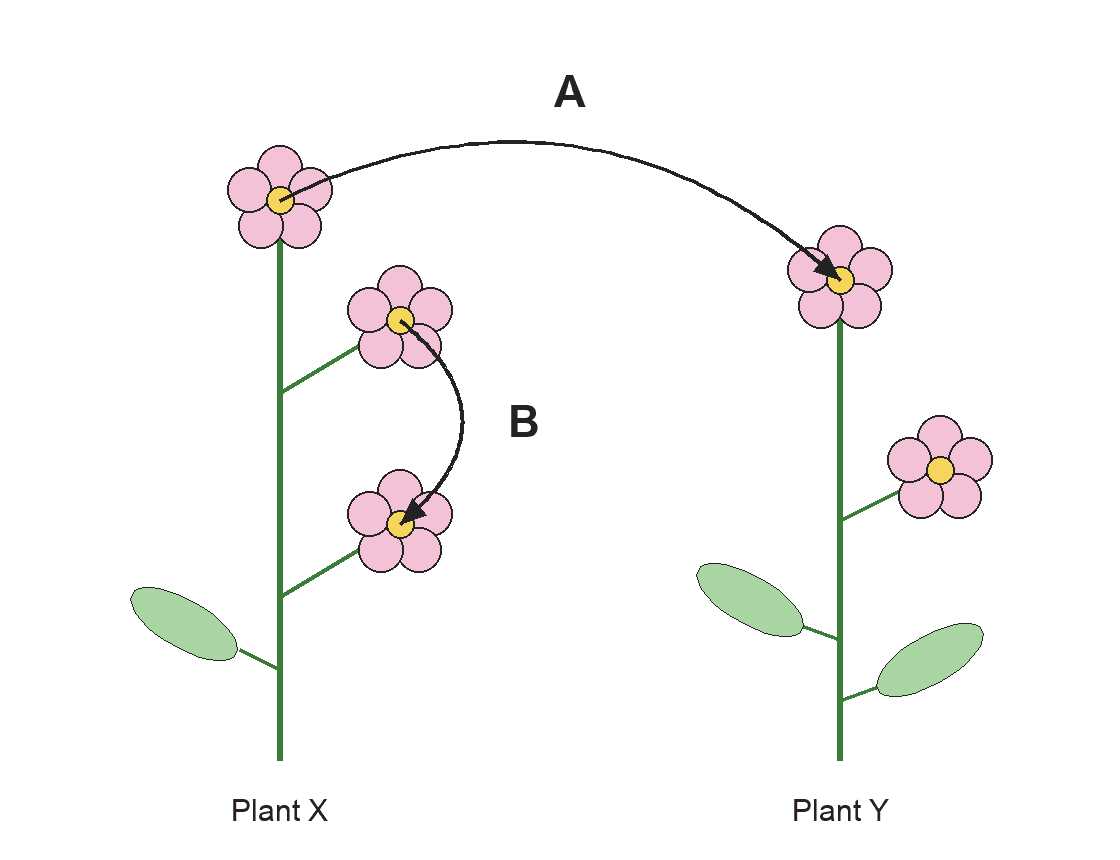
1. What is transferred between the plants in the process indicated by arrow A?
(a) nectar (b) nutrients (c) pollens (d) seeds
2. Name the process shown by the arrow B.
(a) fertilisation (b) self-pollination (c) cross-pollination (d) xenogamy
3. If flower of plant X and plant Y are wind pollinated.
(a) pollens will be sticky (b) pollens will be light (c) flowers will have fragrance (d) pollens are ribbon-like
4. Which of the following is a biotic agent that helps in pollination?
(a) air (b) water (c) wind (d) bats
5. The following feature helps in the pollination of water-pollinated flowers.
(a) fragrant flowers (b) feathery stigma (c) ribbon-like pollen grains (d) bright colours