
Question 1325 marksMedium
Draw a labelled diagram of the longitudinal section of a pistil showing pollen germination.
Confirming your payment
Sign up now and get 250 free tokens.
Sexual Reproduction in Flowering Plants · Question 132 of 143
Draw a labelled diagram of the longitudinal section of a pistil showing pollen germination.
Solution:
Key idea: The pistil has three parts: the stigma, which receives pollen; the style, through which the pollen tube grows; and the ovary, which holds the ovules. A compatible pollen grain germinates on the stigma, and its tube carries two male gametes to an ovule.
Step 1 — Say what the diagram must show.
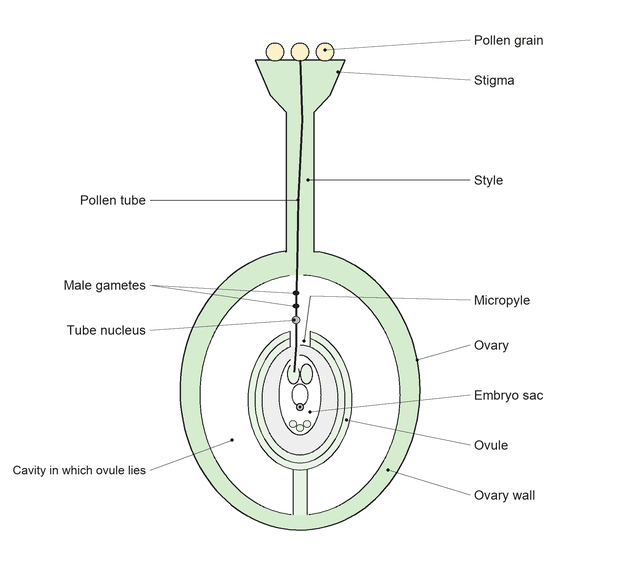
The longitudinal section must show pollen grains on the stigma, one of them germinating, and its pollen tube running down the style into the ovary and entering an ovule through the micropyle.
Step 2 — Draw the section.
The diagram below shows the L.S. of the pistil. Its labelled parts are the pollen grains, stigma, style, pollen tube, tube nucleus, male gametes, ovary, ovary wall, the cavity in which the ovule lies, the ovule, its micropyle and the embryo sac.
Step 3 — Describe the path of the pollen tube.
The pollen grain germinates on the stigma, and its tube grows down through the tissue of the style into the cavity of the ovary. It reaches an ovule and usually enters it through the micropyle; in a few plants it enters through the chalaza (as in Casuarina) or through the integuments (as in cucurbits). Inside the ovule it enters one synergid through its filiform apparatus.
Step 4 — Describe the contents of the pollen tube.
The tube (vegetative) nucleus usually lies near the growing tip of the tube, followed by the two male gametes, formed from the generative cell. When the tube reaches the synergid it bursts and releases the two male gametes into the embryo sac.
Therefore, the L.S. of the pistil shows a pollen grain germinating on the stigma and its pollen tube growing down the style and ovary to enter the ovule through the micropyle, carrying the tube nucleus and two male gametes to the embryo sac.