
Question 1335 marksMedium
What is double fertilisation? Explain.
Confirming your payment
Sign up now and get 250 free tokens.
Sexual Reproduction in Flowering Plants · Question 133 of 143
What is double fertilisation? Explain.
Solution:
Key idea: Double fertilisation is the occurrence of two fusions in the same embryo sac: syngamy, which forms the zygote, and triple fusion, which forms the primary endosperm nucleus. It is a characteristic feature of flowering plants.
Step 1 — Describe the entry of the pollen tube.
The pollen tube enters the ovule, usually through the micropyle, and passes into one of the synergids through its filiform apparatus.
Step 2 — Describe the release of the male gametes.
The tip of the tube bursts and releases the two male gametes into the cytoplasm of the synergid, from where they move to the egg and the central cell.
Step 3 — Explain syngamy.
One male gamete fuses with the egg cell. This fusion of two haploid nuclei is syngamy, and it forms the diploid (2n) zygote, which divides by mitosis to form the embryo.
Step 4 — Explain triple fusion.
The other male gamete moves into the central cell and fuses with the two polar nuclei (or with the diploid secondary nucleus formed by their fusion). This fusion of three haploid nuclei is triple fusion, and it forms the triploid (3n) primary endosperm nucleus, which develops into the endosperm that nourishes the embryo.
Step 5 — Explain the name.
Since two kinds of fusion, syngamy and triple fusion, take place in the same embryo sac, the process is called double fertilisation.
Step 6 — State its significance.
Because the endosperm forms only after fertilisation, the plant spends food on endosperm only in ovules that have been fertilised. The triploid endosperm then feeds the developing embryo.
Note: Some gymnosperms related to flowering plants (Ephedra and Gnetum) also show a second fusion of a male gamete, but it does not form an endosperm. Double fertilisation that forms an endosperm is found only in flowering plants.
Step 7 — Show the fertilised embryo sac in a diagram.
The diagram below shows the embryo sac after double fertilisation, with the diploid zygote at the micropylar end, the triploid primary endosperm nucleus in the centre, the synergids, the antipodal cells and the pollen tube.
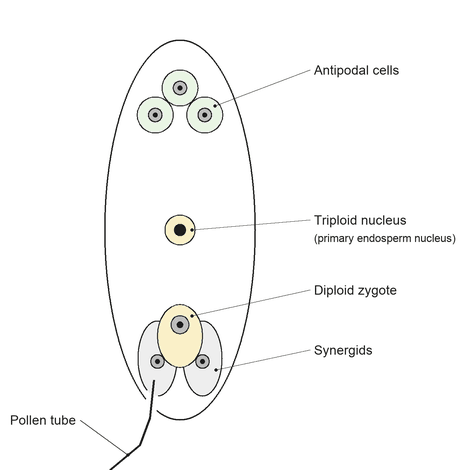
Therefore, double fertilisation is the fusion of one male gamete with the egg (syngamy, forming the diploid zygote) and of the other male gamete with the two polar nuclei (triple fusion, forming the triploid primary endosperm nucleus) in the same embryo sac.