
Question 1115 marksMedium
Explain the development of the male gametophyte in plants.
Confirming your payment
Sign up now and get 250 free tokens.
Sexual Reproduction in Flowering Plants · Question 111 of 143
Explain the development of the male gametophyte in plants.
Solution:
Key idea: The pollen grain is the male gametophyte of a flowering plant. It forms inside the anther in two stages: microsporogenesis, in which meiosis of pollen mother cells gives haploid microspores, and the development of each microspore, by mitosis, into a two- or three-celled pollen grain.
Step 1 — Describe the microsporangium.
A typical anther is bilobed, and each lobe has two pollen sacs (microsporangia), so there are four in all. Each microsporangium is surrounded by four wall layers: the epidermis, the endothecium, the middle layers and the innermost tapetum. The outer three layers protect the sac and help it split open to release the pollen. The tapetum has cells with dense cytoplasm, often with more than one nucleus, and it nourishes the developing pollen grains.
Step 2 — Describe the sporogenous tissue.
In a young anther the centre of each microsporangium is filled with compactly arranged sporogenous cells. These may divide by mitosis a few times. Each cell finally formed is a diploid pollen mother cell (PMC), also called a microspore mother cell or microsporocyte, and each can form one tetrad of microspores.
Step 3 — Explain microsporogenesis.
Each PMC divides by meiosis. Meiosis I separates the homologous chromosomes and meiosis II separates the sister chromatids, so four haploid (n) cells are formed. These microspores stay together for a while as a microspore tetrad. Because meiosis halves the chromosome number, every pollen grain is haploid.
Step 4 — Describe how the pollen wall forms.
As the anther matures and dries, the microspores separate from each tetrad. Each one forms a two-layered wall: a tough outer exine of sporopollenin, with a pattern typical of the species and thin areas called germ pores, and a thin inner intine of cellulose and pectin.
Step 5 — Explain the first mitosis inside the microspore.
The microspore nucleus moves to one side and divides by mitosis with an unequal (asymmetric) spindle. This gives a large vegetative cell, with plenty of food and a large irregular nucleus, and a small spindle-shaped generative cell that floats in the cytoplasm of the vegetative cell. The microspore has now become a pollen grain, the male gametophyte.
Step 6 — Explain how the male gametes form.
The generative cell divides once more by mitosis to give two male gametes. In over 60 % of flowering plants the pollen is shed at the two-celled stage, and this division takes place later inside the growing pollen tube. In the rest it takes place before shedding, so the pollen is shed at the three-celled stage.
Step 7 — Describe how the pollen is released.
When the pollen is mature, the wall between the two pollen sacs of each lobe breaks down. The anther then splits along a line of dehiscence and the pollen grains are released.
Step 8 — Show the stages in a diagram.
The diagram below shows the sequence: a diploid microspore mother cell divides by meiosis I and meiosis II into a tetrad of four haploid microspores; these separate, and one mitosis turns each microspore into a mature pollen grain with an exine, an intine, a vegetative nucleus and a generative nucleus.
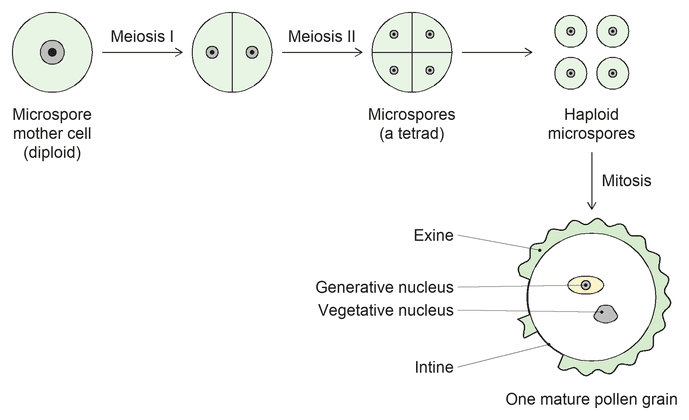
Therefore, the male gametophyte develops when each diploid pollen mother cell in the anther divides by meiosis into four haploid microspores, and each microspore forms an exine and an intine and divides by mitosis into a vegetative cell and a generative cell, which later divides to give two male gametes.