
Opening your dashboard
Class 12 Biology Chapter 2 Sexual Reproduction in Flowering Plants: Previous Year Questions
39 questions on Chapter 2, each solved step by step. Class 12 Biology, ICSE 2026-27.
39 questions with solutions
1–5 marks · Mixed difficulty
- 11 mark
Question 1
Each of the following question(s)/statement(s) has four suggested answers. Choose the correct option in each case.
Triple Fusion involves :
Solve with AIAnswer
(A) Fusion of one male gamete with female gamete
(B) Fusion of tube nucleus with generative nucleus
(C) Fusion of two polar nuclei
- Correct
(D) Fusion of second male gamete with two polar nuclei
Answer: (D) Fusion of second male gamete with two polar nuclei
Key idea: In flowering plants the pollen tube releases two male gametes into the embryo sac. One fuses with the egg (syngamy), and the other fuses with the two polar nuclei of the central cell. Because three haploid nuclei fuse, the second fusion is called triple fusion.
Step 1 — Follow the second male gamete.
The second male gamete moves into the central cell, which contains the two polar nuclei (or the secondary nucleus formed by their fusion).
Step 2 — Count the nuclei that fuse.
One male gamete nucleus () and two polar nuclei () fuse, so three nuclei take part. The product is the triploid () primary endosperm nucleus.
Why the others are wrong:
- (A) Fusion of one male gamete with the female gamete (egg) is syngamy, which forms the diploid zygote; only two nuclei take part.
- (B) The tube nucleus and the generative nucleus never fuse; the generative cell divides to form the two male gametes.
- (C) The two polar nuclei fusing with each other give a diploid secondary nucleus; without the male gamete it is not triple fusion.
Therefore, triple fusion is the fusion of the second male gamete with the two polar nuclei, so the answer is (D).
- 24 marks
Question 2
Give four adaptations in flowers pollinated by insects.
Solve with AIWritten solution
Solution:
Key idea: An insect-pollinated (entomophilous) flower must first attract an insect, then reward it, and finally make sure pollen sticks to the insect and is picked up by the stigma of the next flower.
Step 1 — State the adaptations that attract insects.
The flowers are large and brightly coloured, or small flowers are grouped into a showy inflorescence, so that insects can see them. They are usually scented, which attracts insects from a distance, even at night.
Step 2 — State the adaptation that rewards the insect.
The flowers produce nectar (and often extra pollen) as food. The reward makes the insect visit many flowers of the same kind.
Step 3 — State the adaptations that move the pollen.
The pollen grains are sticky or spiny, coated with a sticky layer called pollenkitt, so they cling to the insect's body. The stigma is sticky and placed where the insect brushes against it, so it collects this pollen.
The main adaptations are summed up in the table.
Feature How it helps insect pollination Large, brightly coloured petals (or a showy inflorescence) Can be seen from a distance and attract insects Scent (fragrance) Attracts insects, including those active at night Nectar and edible pollen Reward that brings the insect back to flowers of the same kind Sticky or spiny pollen grains (coated with pollenkitt) Pollen clings to the insect's body Sticky stigma, placed where the insect brushes against it Picks up pollen from the visiting insect A landing platform (lip) or guide marks on the petals Helps the insect to land and find the nectar Therefore, four adaptations of insect-pollinated flowers are: large, brightly coloured petals; scent; nectar as a reward; and sticky or spiny pollen with a sticky stigma.
- 31 mark
Question 3
Give a brief answer for each of the following:
Explain the term perianth.
Solve with AIWritten solution
Solution:
Key idea: A typical flower has two outer non-essential whorls: the calyx (sepals) and the corolla (petals).
Step 1 — Recall when the term is used.
In some flowers the sepals and petals look alike, so the calyx and the corolla cannot be told apart.
Step 2 — Define perianth.
In such flowers the two outer whorls together are called the perianth, and each member is called a tepal. Examples are lily and onion.
Therefore, the perianth is the outer floral whorl formed when the calyx and corolla are not distinguishable from each other; its members are called tepals, as in lily.
- 41 mark
Question 4
Each of the following question(s) / statement(s) has four suggested answers. Choose the correct option in each case.
After fertilisation, the integuments of an ovule develop into :
Solve with AIAnswer
(A) Seed
- Correct
(B) Seed coat
(C) Fruit
(D) Fruit wall
Answer: (B) Seed coat
Key idea: After fertilisation each part of the flower has a fixed fate: the ovule becomes the seed, the ovary becomes the fruit, and the ovary wall becomes the fruit wall (pericarp).
Step 1 — Find the part that the integuments form.
The integuments are the protective layers around the ovule. After fertilisation they harden and become the protective coat of the seed: the outer integument forms the testa and the inner integument forms the tegmen.
Step 2 — Match with the options.
So the integuments develop into the seed coat, which is option (B).
Why the others are wrong:
- (A) The seed develops from the whole ovule (embryo, endosperm and coats together), not from the integuments alone.
- (C) The fruit develops from the ovary, not from the integuments of an ovule.
- (D) The fruit wall (pericarp) develops from the ovary wall.
Therefore, the integuments of an ovule develop into the seed coat, so the answer is (B).
- 54 marks
Question 5
Give four adaptations shown by flowers pollinated by wind.
Solve with AIWritten solution
Solution:
Key idea: Wind is a random carrier and does not need to be attracted. A wind-pollinated (anemophilous) flower therefore spends nothing on colour, scent or nectar; instead it releases huge amounts of light pollen and has a large surface to catch it.
Step 1 — State the adaptations of the flower as a whole.
The flowers are small and inconspicuous, without bright colour, scent or nectar, because no animal has to be attracted. They are often packed into an inflorescence, such as the tassel of maize.
Step 2 — State the adaptations of the stamens and pollen.
The pollen grains are light, dry, non-sticky and produced in very large numbers, so the wind can carry them far and enough of them reach a stigma. The stamens are well exposed, with long filaments and loosely attached (versatile) anthers that swing in the wind and shed pollen easily.
Step 3 — State the adaptations of the pistil.
The stigma is large, often feathery and well exposed, so it can trap pollen grains from the air. There is usually a single ovule in each ovary, so one pollen grain is enough.
Therefore, four adaptations of wind-pollinated flowers are: small flowers without colour, scent or nectar; light, dry pollen produced in large numbers; well-exposed stamens with long filaments; and large, feathery stigmas.
- 61 mark
Question 6
Give a brief answer for each of the following:
Define Apomixis.
Solve with AIWritten solution
Solution:
Key idea: Normally a seed forms only after fertilisation, and its embryo comes from the zygote.
Step 1 — Recall what is different in some plants.
In some plants, such as certain grasses and members of the sunflower family, seeds develop without any fertilisation. The embryo forms from an unfertilised diploid cell of the ovule.
Step 2 — Define apomixis.
This production of seeds without fertilisation is called apomixis. It is a form of asexual reproduction that imitates sexual reproduction, so the offspring are genetically identical to the mother plant.
Therefore, apomixis is the formation of seeds without fertilisation, a type of asexual reproduction that mimics sexual reproduction.
- 71 mark
Question 7
Give a scientific term for each of the following:
Entry of pollen tube into an ovule through integuments.
Solve with AIWritten solution
Solution:
Key idea: A pollen tube can enter an ovule by three routes, and each route has its own name: through the micropyle (porogamy), through the chalaza (chalazogamy), or through the integuments or funicle (mesogamy).
Step 1 — Identify the route described.
Here the tube enters neither through the micropyle nor through the chalaza, but through the integuments at the side of the ovule.
Step 2 — Give the term.
This middle route is called mesogamy; it is seen, for example, in Cucurbita.
Therefore, the entry of the pollen tube into an ovule through the integuments is called mesogamy.
- 81 mark
Question 8
Name the scientists who have contributed to the following:
Discovered double fertilization.
Solve with AIWritten solution
Solution:
Key idea: Double fertilisation (syngamy plus triple fusion) is found only in flowering plants.
Step 1 — Recall the discovery.
In 1898 the Russian botanist S. G. Nawaschin saw both male gametes taking part in fusions inside the embryo sac of Lilium and Fritillaria. L. Guignard reported the same independently in 1899.
Step 2 — Name the scientist.
The discovery of double fertilisation is therefore credited to Nawaschin.
Therefore, double fertilisation was discovered by S. G. Nawaschin (1898).
- 94 marks
Question 9
Draw a neat labelled diagram of L.S. of anatropous ovule.
Solve with AIWritten solution
Solution:
Key idea: An anatropous ovule is an inverted ovule: its body is turned through 180°, so the micropyle lies close to the funicle (stalk) and the chalaza lies at the opposite end. Its wall is made of two integuments around the nucellus, which holds the embryo sac.
Step 1 — Draw the outline and the stalk.
We draw an oval ovule body with the funicle attached near the bottom. The point where the funicle joins the body is the hilum. In an anatropous ovule the funicle runs along one side of the body as a ridge called the raphe, up to the chalaza.
Step 2 — Draw the wall layers.
We draw two integuments, the outer and the inner, around the body. They leave a small opening at the lower end, beside the funicle, called the micropyle. The upper end, where the integuments and nucellus arise, is the chalaza.
Step 3 — Draw the nucellus and the embryo sac.
Inside the integuments lies the nucellus, a mass of parenchyma cells. In the nucellus lies the oval embryo sac (female gametophyte), with seven cells and eight nuclei: three antipodal cells at the chalazal end, two polar nuclei in the large central cell, and the egg apparatus (one egg cell and two synergids with the filiform apparatus) at the micropylar end.
The labelled diagram is shown below.
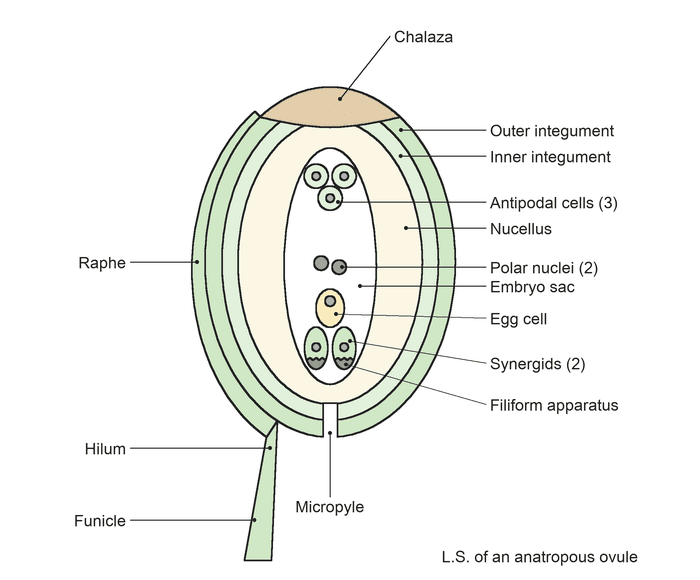
Therefore, the L.S. of an anatropous ovule shows the funicle, hilum and raphe, the outer and inner integuments with the micropyle and chalaza, the nucellus, and the embryo sac with its antipodals, polar nuclei, egg cell and synergids, as labelled in the diagram.
- 101 mark
Question 10
Answer the following questions briefly and to the point:
What is emasculation ?
Solve with AIWritten solution
Solution:
Key idea: In artificial hybridisation the breeder wants only the chosen pollen to reach the stigma. A bisexual flower would pollinate itself, so its own anthers must be removed.
Step 1 — Say what is removed and when.
The anthers are removed from the flower bud of the female parent with forceps, before they dehisce (burst open and shed pollen).
Step 2 — Give the term.
This removal of anthers is called emasculation. It prevents self-pollination.
Therefore, emasculation is the removal of anthers from a bisexual flower bud before the anthers dehisce, so that self-pollination cannot take place.
- 111 mark
Question 11
Give one significant contribution of each of the following scientists :
P. Maheshwari
Solve with AIWritten solution
Solution:
Key idea: Embryology is the study of the development of gametophytes, fertilisation and the embryo.
Step 1 — Recall who P. Maheshwari was.
Panchanan Maheshwari (1904–1966) was an Indian botanist who studied the embryology of flowering plants.
Step 2 — State his contribution.
He made major contributions to angiosperm embryology, and his book An Introduction to the Embryology of Angiosperms (1950) became a standard work. His team also developed the technique of test-tube (in vitro) fertilisation and culture of ovules and embryos in flowering plants.
Therefore, P. Maheshwari is known for his work on the embryology of angiosperms, including test-tube fertilisation and embryo culture.
- 121 mark
Question 12
Define the following :
Parthenocarpy
Solve with AIWritten solution
Solution:
Key idea: Normally a fruit develops only after fertilisation, and it contains seeds.
Step 1 — Recall the exception.
In some plants the ovary develops into a fruit without fertilisation. As no fertilisation takes place, no seeds are formed.
Step 2 — Define parthenocarpy.
The formation of fruit without fertilisation is called parthenocarpy, and such fruits are seedless; banana is an example. It can also be induced by spraying growth hormones such as auxins or gibberellins on flowers.
Therefore, parthenocarpy is the development of fruit without fertilisation, which gives seedless fruits such as banana.
- 131 mark
Question 13
Give a reason for each of the following :
Pollen grains of wind pollinated flowers are produced in large quantities.
Solve with AIWritten solution
Solution:
Key idea: Wind does not carry pollen to a particular flower; it scatters pollen in all directions.
Step 1 — Explain the waste.
Because wind transfer is random, most of the pollen falls on the ground, on water or on other plants, and is wasted.
Step 2 — Give the reason for the large quantity.
Only a very small fraction lands on a stigma of the same species. Producing pollen in enormous numbers makes sure that at least some grains reach a suitable stigma.
Therefore, wind-pollinated flowers produce pollen in large quantities because pollination by wind is random and most pollen is wasted, so large numbers ensure that some grains reach a stigma.
- 143 marks
Question 14
Draw a labelled diagram of the mature embryo sac of angiosperms.
Solve with AIWritten solution
Solution:
Key idea: The mature embryo sac (female gametophyte) of most flowering plants is of the Polygonum type: it develops from one functional megaspore by three mitotic divisions, and at maturity it has 7 cells and 8 nuclei.
Step 1 — Draw the outline and mark its two ends.
We draw an oval sac. The narrow lower end, towards the micropyle, is the micropylar end; the upper end is the chalazal end.
Step 2 — Draw the egg apparatus at the micropylar end.
We draw three cells here: two synergids and one egg cell. The synergids bear finger-like wall thickenings at their tips, called the filiform apparatus, which guide the pollen tube in. The egg cell lies just above the synergids.
Step 3 — Draw the antipodal cells and the central cell.
We draw three antipodal cells at the chalazal end. The rest of the sac is the large central cell, which contains two polar nuclei.
Step 4 — Check the counts.
We count the cells: 3 antipodals, 2 synergids, 1 egg and 1 central cell.
We count the nuclei: one in each of the 6 small cells and 2 polar nuclei in the central cell.
The labelled diagram is shown below.
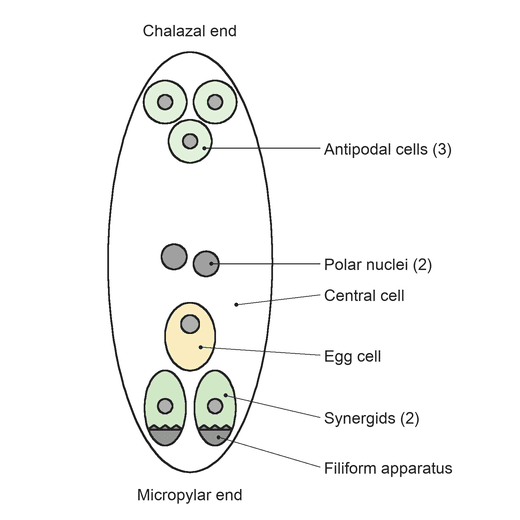
Therefore, the mature embryo sac is a 7-celled, 8-nucleate structure with the egg apparatus (egg cell and two synergids with filiform apparatus) at the micropylar end, three antipodal cells at the chalazal end, and a central cell with two polar nuclei, as labelled in the diagram.
- 151 mark
Question 15
Give reason for each of the following.
Bagging is necessary in artificial hybridization.
Solve with AIWritten solution
Solution:
Key idea: In artificial hybridisation only the pollen chosen by the breeder should reach the stigma of the emasculated flower.
Step 1 — Describe bagging.
After emasculation the flower is covered with a bag, usually made of butter paper.
Step 2 — Give the reason.
The bag keeps out unwanted pollen carried by wind or insects, so the stigma is protected from contamination. The bag is removed only to dust the desired pollen, and the flower is then bagged again.
Therefore, bagging is necessary to protect the stigma of the emasculated flower from unwanted pollen, so that only the selected pollen fertilises it.
- 162 marks
Question 16
List any four features of flower pollinated by insects.
Solve with AIWritten solution
Solution:
Key idea: An insect-pollinated flower has to attract insects, reward them, and make its pollen stick to them.
Step 1 — Give two features that attract insects.
The flowers are large and brightly coloured (or grouped into showy inflorescences) and are usually fragrant, so that insects can find them.
Step 2 — Give two features that reward insects and move the pollen.
The flowers produce nectar as a food reward. Their pollen grains are sticky or spiny (with pollenkitt), so they cling to the insect, and the stigma is sticky so that it picks the pollen up.
The features are summed up in the table.
Feature How it helps insect pollination Large, brightly coloured petals (or a showy inflorescence) Can be seen from a distance and attract insects Scent (fragrance) Attracts insects, including those active at night Nectar and edible pollen Reward that brings the insect back to flowers of the same kind Sticky or spiny pollen grains (coated with pollenkitt) Pollen clings to the insect's body Sticky stigma, placed where the insect brushes against it Picks up pollen from the visiting insect A landing platform (lip) or guide marks on the petals Helps the insect to land and find the nectar Therefore, four features of insect-pollinated flowers are: large, brightly coloured petals; fragrance; nectar; and sticky or spiny pollen grains.
- 173 marks
Question 17
Draw a labeled diagram of the T.S. of a mature anther.
Solve with AIWritten solution
Solution:
Key idea: A typical angiosperm anther is bilobed and dithecous, so its transverse section shows four microsporangia (pollen sacs), two in each lobe, joined by a central connective that carries a vascular bundle. In a mature anther the microspore mother cells have already formed pollen grains, the middle layers and tapetum have degenerated, and the fibrous endothecium helps the anther to open.
Step 1 — Draw the outline.
We draw a four-lobed (butterfly-shaped) outline. The central tissue joining the two lobes is the connective, with a vascular bundle in its middle.
Step 2 — Draw the wall of each microsporangium.
Each pollen sac is covered by the epidermis on the outside, and below it lies the endothecium, whose cells have fibrous thickenings. In the mature anther the middle layers and the tapetum have degenerated, so they are not drawn as separate layers.
Step 3 — Draw the contents and the line of opening.
We fill each pollen sac (locule) with pollen grains. In the groove between the two pollen sacs of each lobe lies the stomium, a strip of thin-walled cells along which the anther splits to release the pollen.
The labelled diagram is shown below.
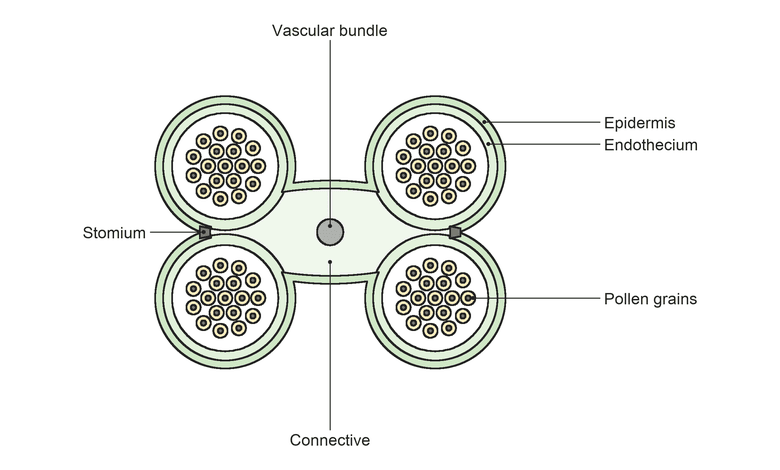
Therefore, the T.S. of a mature anther shows four pollen sacs filled with pollen grains, each bounded by the epidermis and the fibrous endothecium, the stomium in the groove of each lobe, and the connective with its vascular bundle, as labelled in the diagram.
- 183 marks
Question 18
Explain the different types of endosperm in angiosperm.
Solve with AIWritten solution
Solution:
Key idea: The endosperm develops from the triploid primary endosperm nucleus (PEN) formed by triple fusion. Its types are named after how the PEN divides: whether walls form after each division or only later.
Step 1 — Describe nuclear (free-nuclear) endosperm.
The PEN divides repeatedly without forming cell walls, so many free nuclei lie in the cytoplasm of the central cell. Walls may form later from the periphery inwards. This is the most common type, found for example in maize, wheat, rice and coconut. In coconut the coconut water is free-nuclear endosperm and the white kernel is the cellular endosperm formed later.
Step 2 — Describe cellular endosperm.
A cell wall forms after every division of the PEN, right from the first division, so the endosperm is cellular from the start. It is common in gamopetalous dicots such as Petunia and Datura.
Step 3 — Describe helobial endosperm.
The first division of the PEN is followed by a wall that divides the central cell into a large micropylar chamber and a small chalazal chamber. Further divisions in each chamber are mostly free-nuclear at first, and walls may form later. It is an intermediate type, common in monocots. It is named after the order Helobiales, an older name for the group of water plants now placed in the order Alismatales, in which it is especially common.
Therefore, endosperm in angiosperms is of three types: nuclear (free nuclei first), cellular (a wall after every division) and helobial (two unequal chambers after the first division).
- 191 mark
Question 19
Each of the following sub-parts, (i) to (iv) has four choices. Choose the best option in each case:
The flowers which open their petals to expose their reproductive parts to allow pollination are called:
Solve with AIAnswer
(A) Cleistogamous
(B) Geitonogamous
- Correct
(C) Chasmogamous
(D) Autogamous
Answer: (C) Chasmogamous
Key idea: Flowers are named by whether they open: chasmogamous flowers open and expose their anthers and stigma, while cleistogamous flowers never open.
Step 1 — Match the description.
The flowers in the question open their petals and expose their reproductive parts. Such open flowers are called chasmogamous (from Greek chasma, opening). Most flowers are of this type.
Step 2 — Check the other terms.
The other words name either closed flowers or kinds of pollination, not open flowers.
Why the others are wrong:
- (A) Cleistogamous flowers never open, as in some flowers of Viola, Oxalis and Commelina; they can only self-pollinate.
- (B) Geitonogamy is the transfer of pollen to another flower of the same plant; the word describes a kind of pollination, not flowers that open.
- (D) Autogamy is the transfer of pollen to the stigma of the same flower; it is also a kind of pollination, and it is the only kind possible in closed flowers.
Therefore, flowers that open to expose their reproductive parts are called chasmogamous, so the answer is (C).
- 202 marks
Question 20
Draw a labelled diagram of a germinating pollen grain with at least four labellings.
Solve with AIWritten solution
Solution:
Key idea: A pollen grain germinates on a compatible stigma. Its intine grows out through one of the germ pores (thin areas in the exine) as the pollen tube. The vegetative (tube) nucleus and the generative cell move into the tube, and the generative cell divides to form two male gametes (if it has not already done so in the pollen grain).
Step 1 — Draw the pollen grain wall.
We draw a round grain with two wall layers: the thick outer exine, which is broken at the germ pores, and the thin inner intine.
Step 2 — Draw the pollen tube.
The intine grows out through one germ pore as a long tube. We draw the tube coming out of the upper germ pore.
Step 3 — Draw the contents of the tube.
We draw the vegetative (tube) nucleus near the tip of the tube and the two male gametes just behind it.
The labelled diagram is shown below.
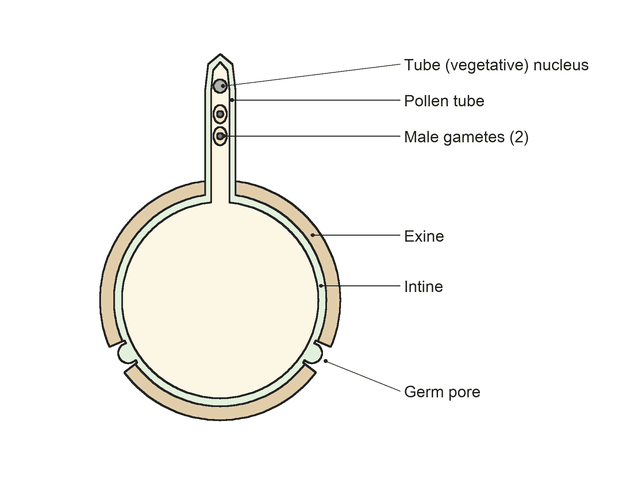
Therefore, a germinating pollen grain shows the exine with germ pores, the intine growing out as the pollen tube, the tube (vegetative) nucleus near the tip and two male gametes, as labelled in the diagram.
- 213 marks
Question 21
Describe the process of double fertilization in angiosperms. What is its significance?
Solve with AIWritten solution
Solution:
Key idea: Flowering plants show double fertilisation: both male gametes of one pollen tube take part in fusions inside the embryo sac, one with the egg and one with the polar nuclei.
Step 1 — Describe the process.
The pollen tube enters the ovule through the micropyle and then enters one of the synergids, guided by the filiform apparatus. There it bursts and releases its two male gametes into the cytoplasm of the synergid.
Syngamy: one male gamete () fuses with the egg cell (). This forms the diploid zygote (), which develops into the embryo.
Triple fusion: the other male gamete () moves to the central cell and fuses with the two polar nuclei (), or with the secondary nucleus formed from them. This forms the triploid primary endosperm nucleus (), which develops into the endosperm.
Since two fusions take place in one embryo sac, the whole event is called double fertilisation.
Step 2 — State its significance.
Double fertilisation is important for three reasons.
- It forms the triploid endosperm, the food tissue that nourishes the growing embryo, and in cereals it is our main food.
- The endosperm forms only when fertilisation has taken place, so the plant does not waste food on ovules that will not form seeds.
- The endosperm carries genes from both parents, which can make it more vigorous in feeding the embryo.
Therefore, double fertilisation is the fusion of one male gamete with the egg (syngamy, giving the 2n zygote) and of the other with the two polar nuclei (triple fusion, giving the 3n primary endosperm nucleus); it provides the endosperm to nourish the embryo and links endosperm formation to fertilisation.
- 221 mark
Question 22
Answer the following questions briefly.
Define perisperm.
Solve with AIWritten solution
Solution:
Key idea: The nucellus is the tissue of the ovule that surrounds the embryo sac. In most seeds it is used up completely while the embryo and endosperm grow.
Step 1 — Recall the exception.
In some seeds a part of the nucellus is not used up and remains in the mature seed.
Step 2 — Define perisperm.
This persistent, leftover nucellus in a seed is called the perisperm; black pepper and beet are examples.
Therefore, perisperm is the residual, persistent nucellus present in some seeds, such as black pepper and beet.
- 232 marks
Question 23
Briefly discuss any two methods by which plants avoid self-pollination.
Solve with AIWritten solution
Solution:
Key idea: Continued self-pollination leads to inbreeding depression, so many flowers have contrivances (outbreeding devices) that discourage self-pollination and favour cross-pollination.
Step 1 — Describe dichogamy (a difference in timing).
In many flowers the anthers and the stigma of the same flower mature at different times, so a flower's own pollen cannot reach a receptive stigma. If the anthers mature first it is called protandry (for example sunflower); if the stigma matures first it is called protogyny (for example Magnolia).
Step 2 — Describe self-incompatibility (a genetic barrier).
In some plants pollen landing on the stigma of the same flower, or of the same plant, cannot germinate or its tube cannot grow down the style, because of a genetic mechanism. So self-pollen cannot fertilise the ovules, even though it reaches the stigma. Cabbage and other members of the mustard family show this, and so does apple, whose orchards need trees of a second variety for fruit to set.
Therefore, two methods by which plants avoid self-pollination are dichogamy (anthers and stigma maturing at different times) and self-incompatibility (self-pollen is prevented from germinating or growing on the pistil).
- 243 marks
Question 24
Draw a neat and well labelled diagram of L.S of an anatropous ovule.
Solve with AIWritten solution
Solution:
Key idea: An anatropous ovule is an inverted ovule: its body is turned through 180°, so the micropyle lies close to the funicle (stalk) and the chalaza lies at the opposite end. Its wall is made of two integuments around the nucellus, which holds the embryo sac.
Step 1 — Draw the outline and the stalk.
We draw an oval ovule body with the funicle attached near the bottom. The point where the funicle joins the body is the hilum. In an anatropous ovule the funicle runs along one side of the body as a ridge called the raphe, up to the chalaza.
Step 2 — Draw the wall layers.
We draw two integuments, the outer and the inner, around the body. They leave a small opening at the lower end, beside the funicle, called the micropyle. The upper end, where the integuments and nucellus arise, is the chalaza.
Step 3 — Draw the nucellus and the embryo sac.
Inside the integuments lies the nucellus, a mass of parenchyma cells. In the nucellus lies the oval embryo sac (female gametophyte), with seven cells and eight nuclei: three antipodal cells at the chalazal end, two polar nuclei in the large central cell, and the egg apparatus (one egg cell and two synergids with the filiform apparatus) at the micropylar end.
The labelled diagram is shown below.
Therefore, the L.S. of an anatropous ovule shows the funicle, hilum and raphe, the outer and inner integuments with the micropyle and chalaza, the nucellus, and the embryo sac with its antipodals, polar nuclei, egg cell and synergids, as labelled in the diagram.
- 251 mark
Question 25
Answer the following questions briefly.
The figure given below shows the early stage of the development of microsporangium.
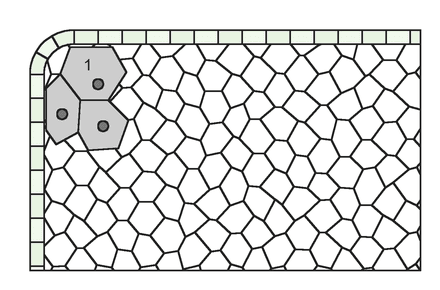
Name the hypodermal cell labelled '1' which divides periclinally.
Solve with AIWritten solution
Solution:
Key idea: A young anther begins as a mass of similar parenchyma cells covered by the epidermis. In each corner, one or more hypodermal cells (just below the epidermis) become larger with dense cytoplasm and big nuclei; these are the archesporial cells.
Step 1 — Identify the cell from the figure.
Cell '1' lies just below the epidermis at the corner of the young anther. It is larger than its neighbours, densely shaded (dense cytoplasm) and has a prominent nucleus, which are the features of an archesporial cell.
Step 2 — Recall what its periclinal division gives.
The archesporial cell divides periclinally (parallel to the surface). The outer daughter, the primary parietal cell, forms the wall layers of the anther; the inner daughter, the primary sporogenous cell, forms the sporogenous tissue.
Therefore, the hypodermal cell labelled '1' is the archesporial cell.
- 262 marks
Question 26
The diagram given below shows the three types of endosperms in angiosperms.
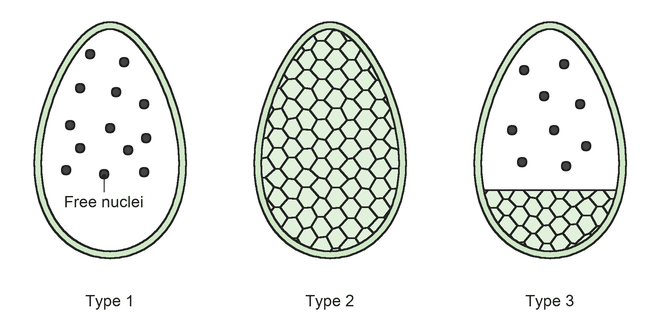
-
Identify the three types of endosperms shown above.
-
Name the type of endosperm which commonly occurs in polypetalous dicots.
Solve with AIWritten solution
Solution:
Key idea: Endosperm types are recognised by how the primary endosperm nucleus divides: free nuclei without walls (nuclear), walls after every division (cellular), or two unequal chambers after the first division (helobial).
Step 1 — (1) Identify Type 1.
Type 1 shows many free nuclei lying in the cytoplasm with no walls between them, so it is nuclear (free-nuclear) endosperm.
Step 2 — (1) Identify Type 2.
Type 2 is made of cells throughout, with a wall around every nucleus, so it is cellular endosperm.
Step 3 — (1) Identify Type 3.
Type 3 is divided into two unequal chambers: a large upper chamber with free nuclei and a small lower chamber. This is helobial endosperm.
Step 4 — (2) Name the type in polypetalous dicots.
Nuclear endosperm is the most common type and is the usual type in polypetalous dicots (dicots with free petals), whereas cellular endosperm is common in gamopetalous dicots and helobial endosperm in monocots.
Therefore, (1) Type 1 is nuclear, Type 2 is cellular and Type 3 is helobial endosperm, and (2) nuclear endosperm commonly occurs in polypetalous dicots.
-
- 273 marks
Question 27
The diagram given below is the L.S. of a typical fruit.
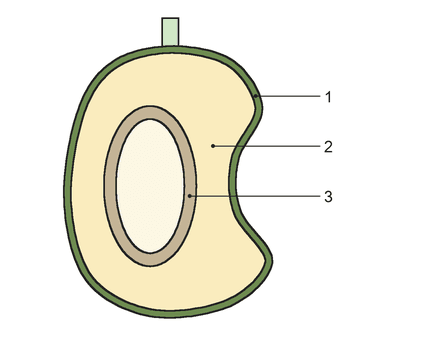
(i) Identify the parts labelled '1', '2' and '3'.
(ii) State the difference between a true fruit and a false fruit.
(iii) What is the significance of the formation of fruit in angiosperms?
Solve with AIWritten solution
Solution:
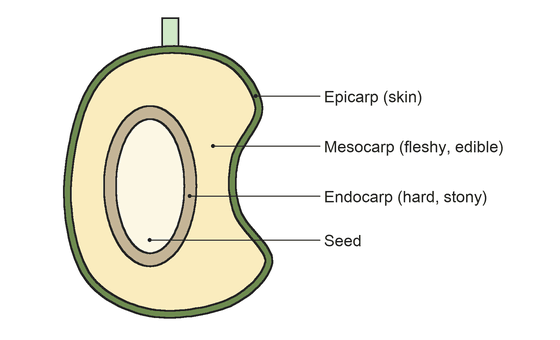
Key idea: A fruit is a ripened ovary. Its wall, the pericarp, develops from the ovary wall and in a fleshy fruit such as mango (a drupe) it is clearly made of three layers: the outer epicarp, the middle mesocarp and the inner endocarp.
Step 1 — (i) Identify the parts labelled 1, 2 and 3.
Part 1 is the thin outer skin, the epicarp. Part 2 is the thick fleshy middle layer, the mesocarp, which is the part we eat in a mango. Part 3 is the hard stony layer around the seed, the endocarp.
The labelled fruit is shown below.
Step 2 — (ii) State the difference between a true fruit and a false fruit.
A true fruit develops only from the ovary of the flower, as in mango and coconut. A false fruit develops from the ovary together with other floral parts, mostly the thalamus, as in apple and strawberry, where the thalamus forms the fleshy part.
Step 3 — (iii) State the significance of fruit formation.
The fruit protects the developing seeds. It also helps in seed dispersal: animals eat fleshy fruits and scatter the seeds, while dry fruits may have wings, hairs or hooks. Fleshy fruits store food, which is useful to animals and to humans.
Therefore, (i) 1 is the epicarp, 2 the mesocarp and 3 the endocarp; (ii) a true fruit develops from the ovary alone, while a false fruit develops from the ovary along with other floral parts such as the thalamus; (iii) fruits protect the seeds and help in their dispersal.
- 283 marks
Question 28
Draw a neat and well labelled diagram of T.S. of anther.
Solve with AIWritten solution
Solution:
Key idea: A typical angiosperm anther is bilobed and dithecous, so its transverse section shows four microsporangia, two in each lobe, joined by a connective with a vascular bundle in the middle. Each microsporangium has a wall of four layers around a central mass of sporogenous tissue.
Step 1 — Draw the outline.
We draw a four-lobed outline with one microsporangium in each lobe. The central tissue joining the lobes is the connective, which carries a vascular bundle.
Step 2 — Draw the four wall layers of each microsporangium, from outside inwards.
The outermost layer is the epidermis (protective). Below it is the endothecium, which develops fibrous thickenings and helps in dehiscence. Next come one to three middle layers, which later degenerate. The innermost layer is the tapetum, whose cells have dense cytoplasm (often more than one nucleus) and nourish the developing pollen grains.
Step 3 — Draw the centre of each microsporangium.
The centre is filled with compactly arranged sporogenous tissue. Its cells act as microspore mother cells and divide by meiosis to form the pollen grains.
The labelled diagram is shown below.
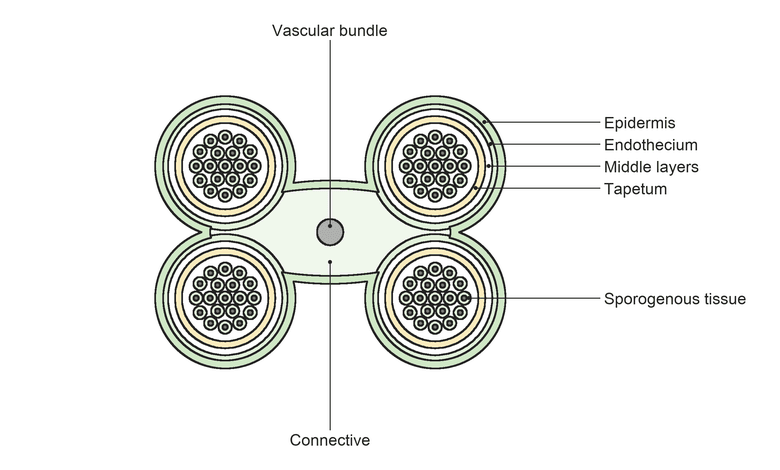
Therefore, the T.S. of an anther shows four microsporangia joined by the connective with its vascular bundle; each microsporangium has the epidermis, endothecium, middle layers and tapetum around the sporogenous tissue, as labelled in the diagram.
- 295 marks
Question 29
Meena had grown Rose and China-rose plants in her garden. She collected pollen grains from China-rose plants and sprinkled them on the stigma of the Rose flowers, as she wanted to grow a hybrid variety of Rose.
a. Will this pollination give the desired results? Give a reason for your answer.
b. What is geitonogamy? Why is it considered equivalent to cross-pollination in ecological context and self-pollination in genetic context?
Solve with AIWritten solution
Solution:
Key idea: A pistil accepts only compatible pollen. Through pollen-pistil interaction the stigma and style "recognise" pollen of the right species and reject pollen of other species. Geitonogamy moves pollen between two flowers of the same plant, so it needs a pollinating agent but uses genetically identical pollen.
Step 1 — (a) Compare the two plants.
Rose (Rosa) belongs to the family Rosaceae, while China-rose (Hibiscus rosa-sinensis) belongs to Malvaceae. Despite the similar common names, they are unrelated plants of different genera and families.
Step 2 — (a) Apply pollen-pistil interaction.
When China-rose pollen lands on a rose stigma, the pistil recognises it as incompatible. Chemical signals between the pollen and the pistil stop the pollen from germinating, or stop the pollen tube from growing down the style. So no male gametes reach the ovules, fertilisation does not occur, and no seeds or hybrid plants are formed.
Step 3 — (b) Define geitonogamy.
Geitonogamy is the transfer of pollen grains from the anther of one flower to the stigma of another flower of the same plant.
Step 4 — (b) Explain why it is ecologically like cross-pollination.
The pollen has to travel from one flower to another, so, as in cross-pollination, a pollinating agent such as an insect or wind is needed. In this functional (ecological) sense it behaves like cross-pollination.
Step 5 — (b) Explain why it is genetically like self-pollination.
All flowers of one plant are formed from the same plant body, so they have identical genes. The pollen therefore brings no new genes, and the result is the same as self-pollination (autogamy). Genetically, it is self-pollination.
Therefore, (a) no, the pollination will not give a hybrid rose, because China-rose pollen is incompatible with the rose pistil and is rejected by pollen-pistil interaction; (b) geitonogamy is pollination between two flowers of the same plant, which needs a pollinating agent like cross-pollination but transfers genetically identical pollen like self-pollination.
- 305 marks
Question 30
Fertilisation is the key process in sexually reproducing organisms and it acts as a vital link between two generations. Flowering plants adopt a unique pattern of sexual reproduction as compared to other organisms.
a. Explain the process of fertilisation in angiosperms.
b. What is the precise location and function of filiform apparatus in the embryo sac of angiosperms?
c. Fruits and seeds are generally formed due to fertilisation. Name the process involved in the production of the following without fertilisation:
-
Fruits
-
Seeds
Solve with AIWritten solution
Solution:
Key idea: Fertilisation in flowering plants starts with pollen germination on the stigma and ends with double fertilisation in the embryo sac. The filiform apparatus of the synergids guides the pollen tube, and fruits or seeds formed without fertilisation are named parthenocarpic fruits and apomictic seeds.
Step 1 — (a) Describe pollen germination and the growth of the pollen tube.
A compatible pollen grain on the stigma absorbs moisture and germinates. Its intine grows out through a germ pore as the pollen tube, carrying the vegetative nucleus and the generative cell (or the two male gametes formed from it). The tube grows down through the style into the ovary and usually enters the ovule through the micropyle.
Step 2 — (a) Describe double fertilisation.
The pollen tube enters the ovule through the micropyle and then enters one of the synergids, guided by the filiform apparatus. There it bursts and releases its two male gametes into the cytoplasm of the synergid.
Syngamy: one male gamete () fuses with the egg cell (). This forms the diploid zygote (), which develops into the embryo.
Triple fusion: the other male gamete () moves to the central cell and fuses with the two polar nuclei (), or with the secondary nucleus formed from them. This forms the triploid primary endosperm nucleus (), which develops into the endosperm.
Since two fusions take place in one embryo sac, the whole event is called double fertilisation.
The labelled embryo sac below shows where the gametes act: the egg and synergids at the micropylar end and the polar nuclei in the central cell.
Step 3 — (b) Give the location of the filiform apparatus.
The filiform apparatus lies at the micropylar tip of each of the two synergids, in the egg apparatus at the micropylar end of the embryo sac. It consists of finger-like ingrowths of the synergid cell wall.
Step 4 — (b) Give its function.
It guides the pollen tube into the synergid, so that the male gametes are released close to the egg and the central cell. The synergids also release chemical signals that attract the tube.
Step 5 — (c) Name the processes.
The production of fruits without fertilisation is parthenocarpy (as in banana). The production of seeds without fertilisation is apomixis.
Therefore, (a) the pollen tube carries two male gametes into a synergid, where one fuses with the egg (syngamy) and the other with the polar nuclei (triple fusion); (b) the filiform apparatus lies at the micropylar end of the synergids and guides the pollen tube into the embryo sac; (c) fruits without fertilisation form by parthenocarpy and seeds without fertilisation by apomixis.
-
- 311 mark
Question 31
Answer the following questions briefly.
A sports person quenched his thirst by drinking some tender coconut water. Name the part of the fruit from where the liquid content is derived.
Solve with AIWritten solution
Solution:
Key idea: Coconut is a fruit whose seed contains endosperm that develops first by free-nuclear divisions.
Step 1 — Recall how coconut endosperm develops.
The primary endosperm nucleus divides many times without forming walls, so thousands of free nuclei float in a liquid. Later, walls form from the outside inwards, giving the white, solid kernel.
Step 2 — Name the part.
The tender coconut water is this liquid, free-nuclear part of the endosperm.
Therefore, tender coconut water is derived from the endosperm (the free-nuclear, liquid endosperm) of the coconut seed.
- 321 mark
Question 32
Answer the following questions briefly.
How many nuclei are present in the central cell of the mature embryo sac of angiosperms before fertilisation?
Solve with AIWritten solution
Solution:
Key idea: A mature embryo sac has 7 cells and 8 nuclei; the large central cell receives one nucleus from each end of the developing sac.
Step 1 — Recall where the central cell's nuclei come from.
During the development of the embryo sac, one nucleus from the micropylar group and one from the chalazal group move to the centre. These are the two polar nuclei.
Step 2 — Count them.
So, before fertilisation, the central cell contains 2 nuclei (the two polar nuclei). In some plants they fuse just before fertilisation to form one diploid secondary nucleus.
Therefore, the central cell of a mature embryo sac contains 2 nuclei (the two polar nuclei) before fertilisation.
- 331 mark
Question 33
Answer the following questions briefly.
A pistillate flower of a tetraploid angiosperm is pollinated by a pollen grain from a staminate flower of a diploid plant.
What would be the level of the ploidy in the endosperm of seeds thus formed?
Solve with AIWritten solution
Solution:
Key idea: The endosperm forms by triple fusion: two polar nuclei from the female parent and one male gamete from the male parent. Each of these is formed by meiosis, so it carries half the ploidy of the plant that produced it.
Step 1 — Find the ploidy of the polar nuclei.
The female (pistillate) plant is tetraploid (). Its megaspore, and so every nucleus of its embryo sac, is formed after meiosis and carries half of .
Step 2 — Find the ploidy of the male gamete.
The male (staminate) plant is diploid (). Its male gamete is formed after meiosis, so it carries .
Step 3 — Add the three nuclei that fuse in triple fusion.
Two polar nuclei and one male gamete fuse.
Watch out: The embryo of this seed is different: egg () + male gamete () gives a zygote.
Therefore, the endosperm of these seeds is pentaploid (5n).
- 345 marks
Question 34
Answer the following questions.
(a) Discuss any three contrivances for prevention of self-pollination in flowering plants.
(b) Oranges can be produced by processes like Apomixis and Polyembryony. State two differences between these processes.
Solve with AIWritten solution
Solution:
Key idea: Contrivances for preventing self-pollination are outbreeding devices that encourage cross-pollination and so avoid inbreeding depression. Apomixis and polyembryony are both unusual ways in which seeds and embryos arise, but they describe different things.
Step 1 — (a) Describe dichogamy.
The anthers and the stigma of a bisexual flower mature at different times, so pollen is not released when the stigma of the same flower is receptive. In protandry the anthers mature first (as in sunflower); in protogyny the stigma matures first (as in Magnolia).
Step 2 — (a) Describe herkogamy.
The anthers and stigma are placed so that pollen of a flower cannot easily reach its own stigma; there is a physical barrier or a difference in position or height. For example, in Calotropis the pollen is held in pollinia that only visiting insects can remove.
Step 3 — (a) Describe self-incompatibility.
Pollen from the same flower, or from other flowers of the same plant, cannot germinate on the stigma or cannot grow its tube down the style, because of a genetic mechanism. Self-pollen therefore cannot fertilise the ovules, as in cabbage and apple.
Another device is unisexuality. Dioecious plants such as papaya, where male and female flowers are on different plants, prevent both autogamy and geitonogamy.
Step 4 — (b) State the first difference.
Apomixis is the formation of seeds without fertilisation. Polyembryony is the presence of more than one embryo in a single seed. So apomixis is about how a seed forms, while polyembryony is about how many embryos a seed contains.
Step 5 — (b) State the second difference.
In apomixis the embryo forms from a diploid cell of the ovule without fertilisation, so it is genetically identical to the mother plant (a clone). In the polyembryony of oranges (Citrus), extra embryos form from nucellar cells, while one embryo usually comes from the fertilised egg. The embryos of one seed can therefore differ genetically: the nucellar ones match the mother, but the zygotic one has genes from both parents.
The two differences are summed up in the table.
Feature Apomixis Polyembryony Meaning Formation of seeds without fertilisation More than one embryo in one seed Genetic make-up of embryos All identical to the mother plant Nucellar embryos identical to the mother; a zygotic embryo, if present, has genes of both parents Note: The two processes can overlap. The nucellar embryos of an orange seed are themselves formed by adventive embryony, which is a kind of apomixis, so one orange seed can show both apomixis and polyembryony.
Therefore, (a) three contrivances against self-pollination are dichogamy, herkogamy and self-incompatibility; (b) apomixis is seed formation without fertilisation and gives embryos identical to the mother, whereas polyembryony is the presence of several embryos in one seed, of which the zygotic one can differ from the mother.
- 351 mark
Question 35
If the number of chromosomes in the cells of the calyx is 16, how many chromosomes will be formed in the endosperm after double fertilisation?
Solve with AIWritten solution
Solution:
Key idea: The calyx is part of the plant body, so its cells are diploid (). The endosperm, formed by triple fusion of two polar nuclei and one male gamete, is triploid ().
Step 1 — Find the haploid number.
The calyx cells have chromosomes, so we halve this.
Step 2 — Find the number in the endosperm.
The endosperm is .
Therefore, the endosperm formed after double fertilisation will have 24 chromosomes.
- 361 mark
Question 36
In a particular plant with bilobed dithecous anther, there were 50 Pollen Mother Cells. Only 25% could develop their pollen tubes.
Calculate the number of pollen grains that would proceed for fertilisation.
Solve with AIWritten solution
Solution:
Key idea: Each pollen mother cell (PMC) divides by meiosis to form a tetrad of four microspores, and each microspore becomes one pollen grain.
Step 1 — Find the number of pollen grains formed.
The anther has 50 pollen mother cells in all, and each gives 4 pollen grains.
Step 2 — Find how many develop pollen tubes.
Only 25 % of these pollen grains develop pollen tubes, and only they can go on to fertilisation.
Note: Here the 50 pollen mother cells are taken as the total for the anther. If 50 were meant for each of the four microsporangia of the bilobed, dithecous anther, there would be 200 PMCs, 800 pollen grains and 200 grains with tubes.
Therefore, 50 pollen grains would proceed for fertilisation.
- 372 marks
Question 37
In a group discussion on pollination, Shubham argued that Cleistogamy was a type of Xenogamy whereas Ameena was of the opinion that it was a kind of Autogamy.
Whose argument is correct? Justify.
Solve with AIWritten solution
Solution:
Key idea: Autogamy is the transfer of pollen from the anthers to the stigma of the same flower. Xenogamy is the transfer of pollen to the stigma of a flower on a different plant. Cleistogamous flowers never open.
Step 1 — Recall what happens in cleistogamous flowers.
In cleistogamous flowers, as in some flowers of Viola, Oxalis and Commelina, the anthers and stigma lie close together inside the closed flower. The anthers dehisce in the closed bud, and their pollen falls on the stigma of the same flower.
Step 2 — Judge each argument.
No pollen can leave or enter a closed flower, so pollen from another plant cannot reach it, and xenogamy is impossible. Pollination is always by the flower's own pollen, which is autogamy.
Therefore, Ameena is correct: cleistogamy is a kind of autogamy, because the flowers never open and are pollinated only by their own pollen, so xenogamy cannot occur.
- 383 marks
Question 38
A researcher compares two embryos, X and Y.
- Embryo X shows equal division of the zygote, forming two cells that are almost identical in size.
- Embryo Y shows an unequal first division and produces a small apical cell and a large basal cell.
(i) Which embryo is likely to develop into a normal dicot embryo?
(ii) What is the fate of:
(a) Apical cell?
(b) Basal cell?
Solve with AIWritten solution
Solution:
Key idea: In a typical dicot (for example Capsella), the zygote divides transversely and unequally into a small apical (terminal) cell towards the chalazal end and a large basal cell towards the micropyle. The two cells have different fates.
Step 1 — (i) Choose the normal embryo.
The normal first division of a dicot zygote is unequal, giving a small apical cell and a large basal cell. Embryo Y shows exactly this, so it is likely to develop into a normal dicot embryo. Embryo X, with two nearly equal cells, does not show this pattern.
Step 2 — (ii)(a) State the fate of the apical cell.
The apical cell divides to form the proembryo, and then the globular and heart-shaped stages. It gives rise to most of the embryo: the two cotyledons, the plumule (epicotyl), the hypocotyl and most of the radicle.
Step 3 — (ii)(b) State the fate of the basal cell.
The basal cell divides to form the suspensor, a row of cells that pushes the embryo into the endosperm and passes food to it. The suspensor cell next to the embryo, called the hypophysis, forms the tip of the radicle and the root cap.
Therefore, (i) embryo Y will develop into a normal dicot embryo; (ii)(a) the apical cell forms the embryo proper (cotyledons, plumule, hypocotyl and most of the radicle), and (b) the basal cell forms the suspensor, whose hypophysis forms the radicle tip and root cap.
- 395 marks
Question 39
(i) Outline three major steps in the process of artificial hybridisation.
(ii) Discuss the role of pollen-pistil interaction in ensuring successful hybrid formation.
Solve with AIWritten solution
Solution:
Key idea: Artificial hybridisation is a crop-improvement method in which only the desired pollen is used to pollinate the stigma of a chosen female parent. Even then a hybrid forms only if the pistil accepts that pollen, which is decided by pollen-pistil interaction.
Step 1 — (i) Describe emasculation.
The two parents with the desired characters are selected first. If the female parent has bisexual flowers, the anthers are removed from its flower buds with forceps before they dehisce. This prevents self-pollination.
Step 2 — (i) Describe bagging.
The emasculated flower is covered with a bag of butter paper. The bag keeps out unwanted pollen from wind or insects, so the stigma is not contaminated. Unisexual female flowers are bagged in the bud stage too, without emasculation.
Step 3 — (i) Describe artificial pollination and rebagging.
When the stigma becomes receptive, pollen collected from the anthers of the chosen male parent is dusted on it. The flower is then bagged again, and the fruit and seeds are allowed to develop; these seeds grow into hybrid plants.
Step 4 — (ii) Explain what pollen-pistil interaction does.
Pollen-pistil interaction is the series of events, from the pollen landing on the stigma until the pollen tube enters the ovule, in which chemicals of the pollen and of the pistil interact. Through it the pistil recognises whether pollen is compatible (of the right kind) or not.
Step 5 — (ii) Explain its role in hybrid formation.
If the pollen is compatible, the pistil lets it germinate, and the pollen tube grows through the style to the ovule and releases the male gametes, so fertilisation and hybrid seeds follow. If the pollen is incompatible, for example from an unrelated species, the pistil stops its germination or tube growth, and no hybrid forms. So breeders must choose compatible parents, and knowledge of this interaction helps them to overcome incompatibility in wide crosses.
Therefore, (i) the three major steps of artificial hybridisation are emasculation, bagging, and artificial pollination with the chosen pollen followed by rebagging; (ii) pollen-pistil interaction makes the pistil accept compatible pollen and reject incompatible pollen, so a hybrid forms only when the chosen parents are compatible.