
Question 262 marksAsked 2024Easy
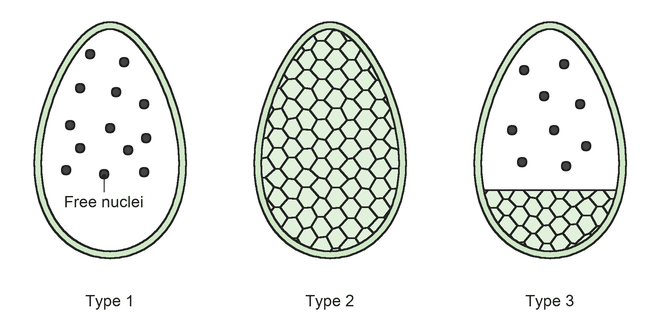
The diagram given below shows the three types of endosperms in angiosperms.
-
Identify the three types of endosperms shown above.
-
Name the type of endosperm which commonly occurs in polypetalous dicots.
Confirming your payment
Sign up now and get 250 free tokens.
Previous Year Questions · Question 26 of 39
The diagram given below shows the three types of endosperms in angiosperms.
Identify the three types of endosperms shown above.
Name the type of endosperm which commonly occurs in polypetalous dicots.
Solution:
Key idea: Endosperm types are recognised by how the primary endosperm nucleus divides: free nuclei without walls (nuclear), walls after every division (cellular), or two unequal chambers after the first division (helobial).
Step 1 — (1) Identify Type 1.
Type 1 shows many free nuclei lying in the cytoplasm with no walls between them, so it is nuclear (free-nuclear) endosperm.
Step 2 — (1) Identify Type 2.
Type 2 is made of cells throughout, with a wall around every nucleus, so it is cellular endosperm.
Step 3 — (1) Identify Type 3.
Type 3 is divided into two unequal chambers: a large upper chamber with free nuclei and a small lower chamber. This is helobial endosperm.
Step 4 — (2) Name the type in polypetalous dicots.
Nuclear endosperm is the most common type and is the usual type in polypetalous dicots (dicots with free petals), whereas cellular endosperm is common in gamopetalous dicots and helobial endosperm in monocots.
Therefore, (1) Type 1 is nuclear, Type 2 is cellular and Type 3 is helobial endosperm, and (2) nuclear endosperm commonly occurs in polypetalous dicots.