Solution:
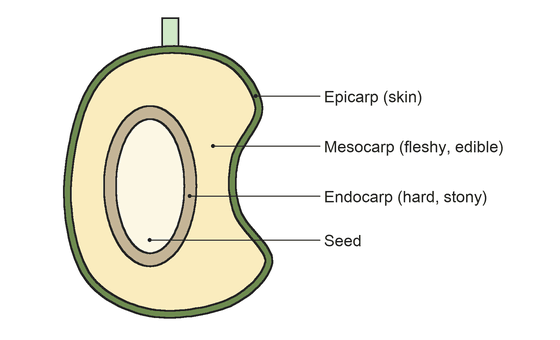
Key idea: A fruit is a ripened ovary. Its wall, the pericarp, develops from the ovary wall and in a fleshy fruit such as mango (a drupe) it is clearly made of three layers: the outer epicarp, the middle mesocarp and the inner endocarp.
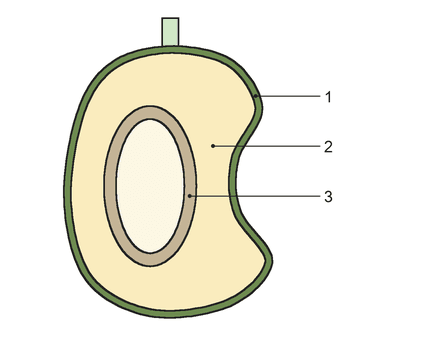
Step 1 — (i) Identify the parts labelled 1, 2 and 3.
Part 1 is the thin outer skin, the epicarp. Part 2 is the thick fleshy middle layer, the mesocarp, which is the part we eat in a mango. Part 3 is the hard stony layer around the seed, the endocarp.
The labelled fruit is shown below.
Step 2 — (ii) State the difference between a true fruit and a false fruit.
A true fruit develops only from the ovary of the flower, as in mango and coconut. A false fruit develops from the ovary together with other floral parts, mostly the thalamus, as in apple and strawberry, where the thalamus forms the fleshy part.
Step 3 — (iii) State the significance of fruit formation.
The fruit protects the developing seeds. It also helps in seed dispersal: animals eat fleshy fruits and scatter the seeds, while dry fruits may have wings, hairs or hooks. Fleshy fruits store food, which is useful to animals and to humans.
Therefore, (i) 1 is the epicarp, 2 the mesocarp and 3 the endocarp; (ii) a true fruit develops from the ovary alone, while a false fruit develops from the ovary along with other floral parts such as the thalamus; (iii) fruits protect the seeds and help in their dispersal.