Solution:
Key idea: Fertilisation in flowering plants starts with pollen germination on the stigma and ends with double fertilisation in the embryo sac. The filiform apparatus of the synergids guides the pollen tube, and fruits or seeds formed without fertilisation are named parthenocarpic fruits and apomictic seeds.
Step 1 — (a) Describe pollen germination and the growth of the pollen tube.
A compatible pollen grain on the stigma absorbs moisture and germinates. Its intine grows out through a germ pore as the pollen tube, carrying the vegetative nucleus and the generative cell (or the two male gametes formed from it). The tube grows down through the style into the ovary and usually enters the ovule through the micropyle.
Step 2 — (a) Describe double fertilisation.
The pollen tube enters the ovule through the micropyle and then enters one of the synergids, guided by the filiform apparatus. There it bursts and releases its two male gametes into the cytoplasm of the synergid.
Syngamy: one male gamete (n) fuses with the egg cell (n). This forms the diploid zygote (2n), which develops into the embryo.
Triple fusion: the other male gamete (n) moves to the central cell and fuses with the two polar nuclei (n+n), or with the secondary nucleus formed from them. This forms the triploid primary endosperm nucleus (3n), which develops into the endosperm.
Since two fusions take place in one embryo sac, the whole event is called double fertilisation.
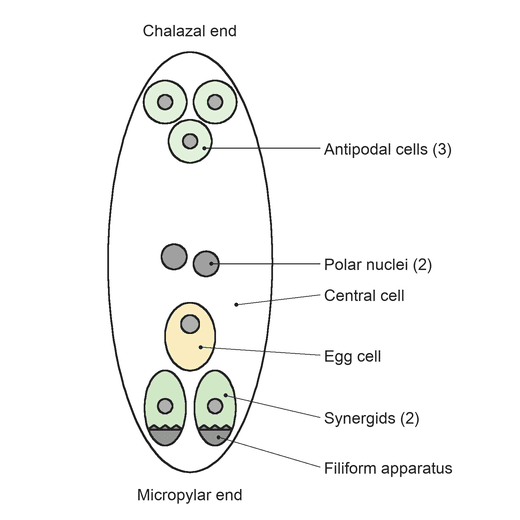
The labelled embryo sac below shows where the gametes act: the egg and synergids at the micropylar end and the polar nuclei in the central cell.
Step 3 — (b) Give the location of the filiform apparatus.
The filiform apparatus lies at the micropylar tip of each of the two synergids, in the egg apparatus at the micropylar end of the embryo sac. It consists of finger-like ingrowths of the synergid cell wall.
Step 4 — (b) Give its function.
It guides the pollen tube into the synergid, so that the male gametes are released close to the egg and the central cell. The synergids also release chemical signals that attract the tube.
Step 5 — (c) Name the processes.
The production of fruits without fertilisation is parthenocarpy (as in banana). The production of seeds without fertilisation is apomixis.
Therefore, (a) the pollen tube carries two male gametes into a synergid, where one fuses with the egg (syngamy) and the other with the polar nuclei (triple fusion); (b) the filiform apparatus lies at the micropylar end of the synergids and guides the pollen tube into the embryo sac; (c) fruits without fertilisation form by parthenocarpy and seeds without fertilisation by apomixis.
