
Question 1295 marksMedium
Draw labelled diagrams
(i) T.S. of bilobed anther
(ii) Internal structure of pollen grain.
Confirming your payment
Sign up now and get 250 free tokens.
Sexual Reproduction in Flowering Plants · Question 129 of 143
Draw labelled diagrams
(i) T.S. of bilobed anther
(ii) Internal structure of pollen grain.
Solution:
Key idea: The anther is the pollen-producing part of the stamen, and the pollen grain it produces is the male gametophyte. A transverse section of the anther shows its four pollen sacs; a section of the pollen grain shows its two-layered wall and its two cells.
Step 1 — (i) Describe the T.S. of a bilobed anther.
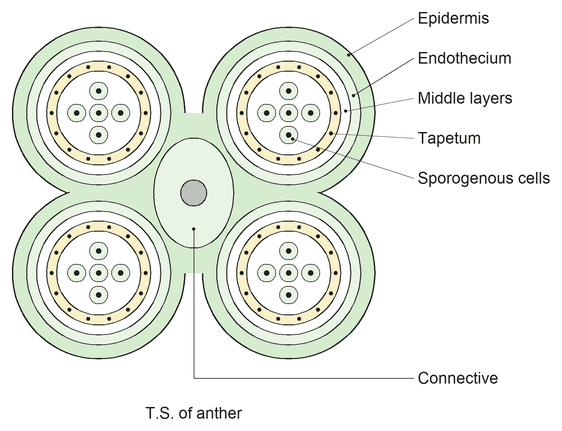
A typical anther is bilobed and dithecous: each of its two lobes has two pollen sacs, so the T.S. shows four pollen sacs at the four corners. The two lobes are joined by the connective, which carries a vascular bundle. Each pollen sac has four wall layers, the epidermis, endothecium, middle layers and tapetum, round a central mass of sporogenous cells.
Step 2 — Draw the T.S. of the anther.
The diagram below shows the T.S. of the anther with the epidermis, endothecium, middle layers, tapetum, sporogenous cells and connective labelled.
Step 3 — (ii) Describe the internal structure of the pollen grain.
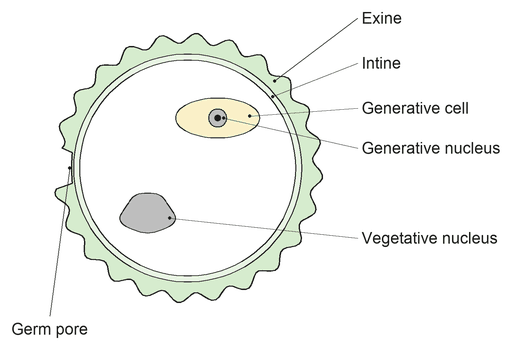
A mature pollen grain has a thick outer exine of sporopollenin, with germ pores where the exine is absent, and a thin inner intine of cellulose and pectin. Inside are a large vegetative cell with an irregular nucleus and a small spindle-shaped generative cell.
Step 4 — Draw the pollen grain.
The diagram below shows a mature two-celled pollen grain in section, with the exine, intine, germ pore, generative cell with its nucleus, and vegetative nucleus labelled.
Therefore, the T.S. of a bilobed anther shows four pollen sacs, each with an epidermis, endothecium, middle layers, tapetum and sporogenous cells, joined by a connective, and a pollen grain shows an exine with germ pores, an intine, a vegetative cell and a generative cell.