
Question 1175 marksMedium
Describe the structure of a pollen grain and the process of its germination.
Confirming your payment
Sign up now and get 250 free tokens.
Sexual Reproduction in Flowering Plants · Question 117 of 143
Describe the structure of a pollen grain and the process of its germination.
Solution:
Key idea: The pollen grain is the male gametophyte. It has a two-layered wall and, when shed, usually two cells. On a compatible stigma it germinates and forms a pollen tube that carries the male gametes to the ovule.
Step 1 — Describe the shape and size of the pollen grain.
Pollen grains are generally spherical and measure about 25 to 50 µm across. Each grain has a two-layered wall and living cells inside.
Step 2 — Describe the exine.
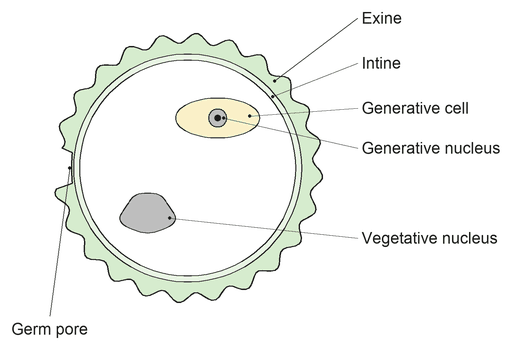
The exine is the thick, hard outer layer. It is made of sporopollenin, the most resistant organic material known: it withstands high temperatures and strong acids and alkalis, and no enzyme that breaks it down is known so far. This is why pollen survives for a very long time and is well preserved as fossils. The surface pattern of the exine, such as spines or ridges, is typical of each species.
Step 3 — Describe the germ pores.
In some places the exine is very thin or absent, because sporopollenin is not laid down there. These places are the germ pores, and the pollen tube comes out through one of them.
Step 4 — Describe the intine.
The intine is the thin, continuous inner layer, made of cellulose and pectin. When the pollen grain germinates, the intine grows out through a germ pore as the pollen tube.
Step 5 — Describe the cells inside the grain.
A mature pollen grain usually has two cells. The vegetative cell is large, has plenty of stored food and a large, irregular nucleus. The generative cell is small and spindle-shaped, with dense cytoplasm, and floats in the cytoplasm of the vegetative cell. In over 60 % of flowering plants pollen is shed at this two-celled stage; in the rest the generative cell divides first into two male gametes, and the pollen is shed at the three-celled stage.
Step 6 — Show the structure in a diagram.
The diagram below shows a mature two-celled pollen grain in section, with its parts labelled.
Step 7 — Explain how germination begins on the stigma.
When a pollen grain lands on the stigma, the pistil checks whether it is compatible, that is, of the same species and not rejected by self-incompatibility. A compatible grain takes up water and nutrients from the stigma surface, and the intine, with the contents of the grain, comes out through a germ pore as the pollen tube.
Step 8 — Describe the growth of the pollen tube.
The pollen tube grows only at its tip and makes its way through the tissues of the stigma and style, using enzymes and food from the pistil. The vegetative (tube) nucleus and the generative cell move into the tube. The tube is guided towards the ovule by chemical signals, mainly small proteins released by the synergids of the embryo sac; calcium and boron in the stigma and style help the tube to grow.
Step 9 — Describe how the male gametes reach the embryo sac.
If the pollen was shed at the two-celled stage, the generative cell divides by mitosis inside the tube to form two male gametes. The tube enters the ovule, usually through the micropyle, passes into one synergid through its filiform apparatus and releases the two male gametes there. The tube nucleus then degenerates.
Therefore, a pollen grain has a tough sporopollenin exine with germ pores, a thin cellulose and pectin intine, and a vegetative and a generative cell; on a compatible stigma its intine grows out through a germ pore as a pollen tube, which carries two male gametes to the embryo sac.