
Question 1275 marksMedium
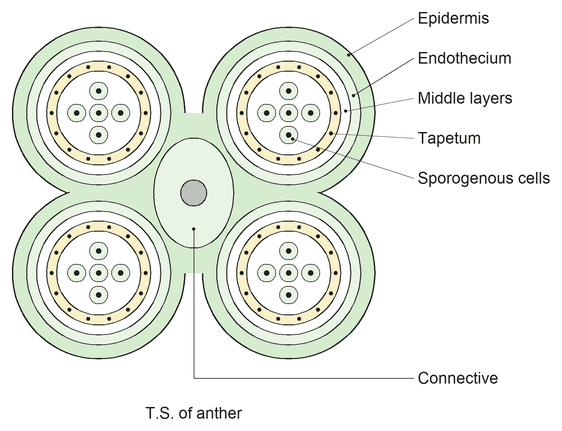
Draw a diagram of the transverse section of an angiospermic anther. Label any six parts.
Confirming your payment
Sign up now and get 250 free tokens.
Sexual Reproduction in Flowering Plants · Question 127 of 143
Draw a diagram of the transverse section of an angiospermic anther. Label any six parts.
Solution:
Key idea: The anther is the pollen-producing part of the stamen. In transverse section a young anther shows four pollen sacs (microsporangia), each with four wall layers round a central mass of sporogenous cells, and a central connective.
Step 1 — Describe the outline of the section.
A typical anther is bilobed and dithecous: each of its two lobes has two pollen sacs, so the T.S. shows four pollen sacs at the four corners. The two lobes are joined by the connective, which carries a vascular bundle.
Step 2 — Draw the section.
The diagram below shows the T.S. of a young anther with six parts labelled: the epidermis, endothecium, middle layers, tapetum, sporogenous cells and connective.
Step 3 — Explain the outer wall layers.
The epidermis is the outermost protective layer. Below it the endothecium has fibrous thickenings in its cell walls, which help the anther to split open when it dries. The middle layers, two to three layers of cells, protect the sac and usually break down as the anther matures.
Step 4 — Explain the tapetum.
The tapetum is the innermost wall layer. Its cells have dense cytoplasm and often more than one nucleus, and they nourish the developing pollen grains.
Step 5 — Explain the sporogenous cells and connective.
The sporogenous cells fill the centre of each pollen sac; they act as pollen mother cells and form pollen grains by meiosis. The connective is the sterile tissue that joins the two lobes and carries the vascular bundle that supplies the anther.
Therefore, the T.S. of an anther shows four pollen sacs, each with an epidermis, endothecium, middle layers and tapetum round the sporogenous cells, joined by a central connective.