
Opening your dashboard
Class 12 Biology Chapter 2 Sexual Reproduction in Flowering Plants: Practice Questions
134 questions on Chapter 2, each worked through on its own page with the AI tutor. Class 12 Biology, ICSE 2026-27.
134 questions
1–7 marks · Mixed difficulty
- 11 mark
Question 1
A vertical section of a flower shows that the cup-shaped thalamus is fused with the wall of the ovary, and the sepals, petals and stamens arise from above the ovary. Which description fits this flower?
- 21 mark
Question 2
In an inflorescence, the main axis ends in a flower that opens first. Below it a branch arises on each side, each branch ends in a flower, and the same pattern repeats. Which inflorescence is this?
- 33 marks
Question 3
The figure shows an inflorescence. The numbers on the flowers show the order in which they opened.
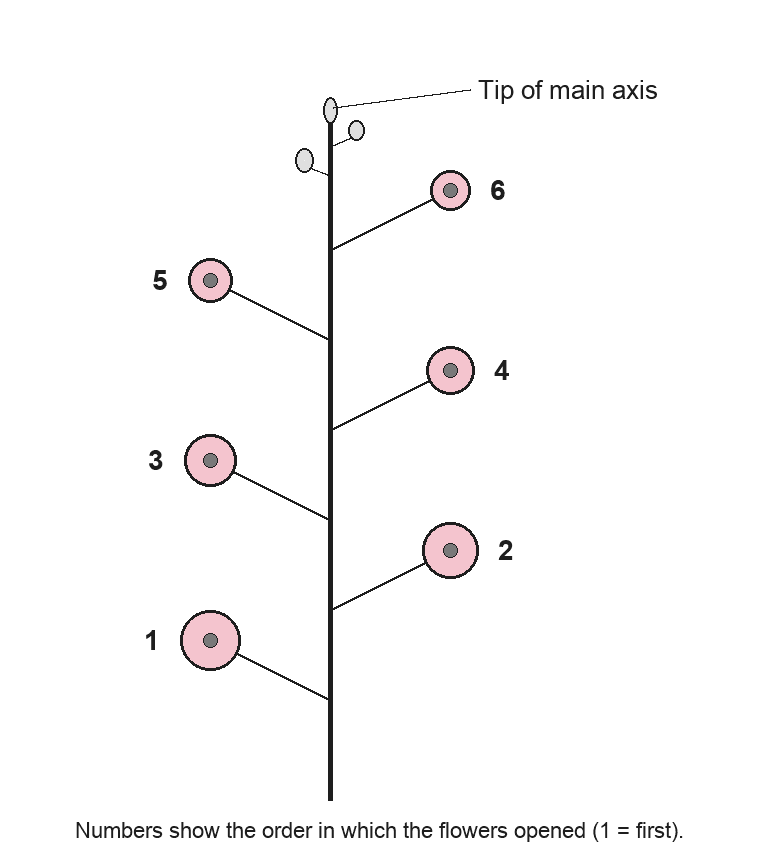
(a) Is this inflorescence racemose or cymose?
(b) Give two features visible in the figure that support your answer.
- 44 marks
Question 4
A flower (hypothetical description) has six stamens, four with long filaments and two with short filaments. Each anther has two lobes and is attached to its filament at its base. The pistil is made of two carpels that are fused together.
Give the term for:
(a) the relative length of the stamens;
(b) the number of lobes of the anther;
(c) the way the anther is attached to the filament;
(d) the number and fusion of the carpels.
- 51 mark
Question 5
In a mutant plant (hypothetical example), the epidermis, endothecium and middle layers of the anther wall develop normally, but the innermost wall layer fails to form. Which job is most directly affected?
- 61 mark
Question 6
An anther has four microsporangia, and each microsporangium has 50 pollen mother cells (hypothetical data). If every pollen mother cell completes meiosis and every microspore becomes a pollen grain, how many male gametes can these pollen grains form in all?
- 72 marks
Question 7
A doctor in Delhi notices that many patients come with asthma and bronchitis in the season when carrot grass is in flower.
(a) Give the botanical name of carrot grass and state how it reached India.
(b) What kind of disorders can the pollen grains of such plants cause?
- 82 marks
Question 8
A plant breeder collects pollen grains from a rice plant at 9 a.m. and reaches a distant field at 11 a.m. to dust them on the stigmas of other rice plants (hypothetical example).
(a) Is the pollen likely to bring about pollination? Give a reason.
(b) Would the answer be the same for pollen of some members of Fabaceae carried in the same way? Explain.
- 93 marks
Question 9
A pollen grain is found to have three cells at the time it is shed.
(a) Name the three cells.
(b) From which cell, and by which kind of division, did two of these cells arise?
(c) Is shedding at this stage the more common or the less common condition in angiosperms? Support your answer.
- 101 mark
Question 10
In an ovule, the body is curved so that the micropyle and the chalaza do not lie on the same straight line, while the embryo sac inside is only slightly curved. Which type of ovule is it, and where is it found?
- 111 mark
Question 11
A mature embryo sac in which the two polar nuclei have already fused (before fertilisation) contains:
- 123 marks
Question 12
In three plants P, Q and R (hypothetical plants), the embryo sac develops as follows:
P: from one megaspore nucleus.
Q: from two megaspore nuclei.
R: from four megaspore nuclei.
Name the type of embryo sac in each plant and give one example of a plant showing each type.
- 134 marks
Question 13
The figure shows a mature embryo sac of an angiosperm.
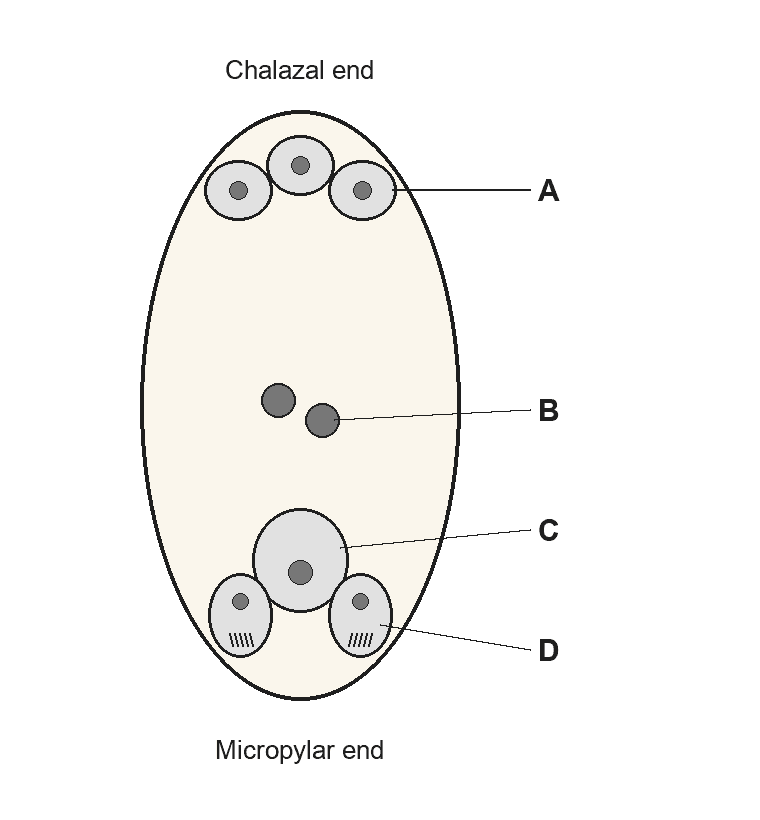
Identify the parts A, B, C and D, and give one feature or role of each.
- 141 mark
Question 14
Which statement correctly compares pollination in Vallisneria and in Ceratophyllum demersum?
- 151 mark
Question 15
A farmer lets a crop with bisexual flowers self-pollinate for several generations. What is the most likely result?
- 162 marks
Question 16
Give reasons: Male wasps visit the flowers of Ophrys and, in doing so, pollinate them.
- 172 marks
Question 17
The Yucca plant and the moth that pollinates it cannot complete their life cycles without each other. Explain how each depends on the other.
- 183 marks
Question 18
A student on a field trip records the features of three flowers, P, Q and R (hypothetical observations).
Flower Features recorded P Small, green, no scent or nectar; stamens hang outside; stigma large and feathery Q Large, white, opens at night; strong fragrance R Large, pale, opens at night; copious nectar with a fruity odour; enormous number of stamens Name the most likely pollinating agent of each flower and give the scientific term for each kind of pollination.
- 191 mark
Question 19
In the bisexual flowers of a plant (hypothetical observation), the stigma becomes receptive two days before the anthers of the same flower release their pollen. Which term and example fit this?
- 203 marks
Question 20
Draw labelled diagrams of the two kinds of flowers found in Primula (primrose). Name the condition shown.
- 211 mark
Question 21
A section of an ovule shows that the pollen tube has entered through the chalaza, not through the micropyle. Which term and plant fit this observation?
- 221 mark
Question 22
In a plant whose pollen grains are shed at the two-celled stage, which nucleus lies at the growing tip of the pollen tube, and what finally happens to it?
- 232 marks
Question 23
In a school laboratory (hypothetical experiment), pollen of a sunflower is dusted on the receptive stigma of a pea flower, and pollen from another pea plant is dusted on a second pea flower.
(a) On which stigma will the pollen germinate? Give a reason.
(b) What enables the pistil to accept one kind of pollen and reject the other?
- 243 marks
Question 24
Give reasons:
(a) The pollen tube grows down through the style towards the ovary.
(b) The pollen tube is able to pass through the solid tissues of the stigma and style.
(c) Inside the ovule, the pollen tube enters one of the synergids.
- 251 mark
Question 25
A plant breeder plans to cross two varieties of a crop whose plants bear only unisexual flowers. Which step of the usual artificial hybridisation procedure can the breeder leave out?
- 263 marks
Question 26
A student wrote the following steps for crossing two varieties of a plant that has bisexual flowers.
Step 1: Remove the anthers from the flowers after the anthers have ripened.
Step 2: Leave the emasculated flowers uncovered so that the stigma stays open to the air.
Step 3: Dust the stigma with pollen of the desired variety and leave the flower uncovered until the seeds form.
Point out the mistake in each step. Give the correct practice and the reason for it.
- 272 marks
Question 27
In a hybridisation trial (hypothetical example), a breeder emasculated 50 flower buds of a variety with bisexual flowers but, by mistake, bagged only 30 of them. When the stigmas matured, all 50 flowers were dusted with pollen of the desired variety. Seeds from which group can be relied upon to be the desired hybrid? Give two reasons.
- 281 mark
Question 28
In a flowering plant (hypothetical example), each leaf cell has chromosomes. How many chromosomes will be present in the zygote and in the primary endosperm nucleus respectively?
- 291 mark
Question 29
How many haploid nuclei in all take part in the fusions of double fertilisation in one embryo sac?
- 303 marks
Question 30
The figure shows an embryo sac just after a pollen tube has entered it.
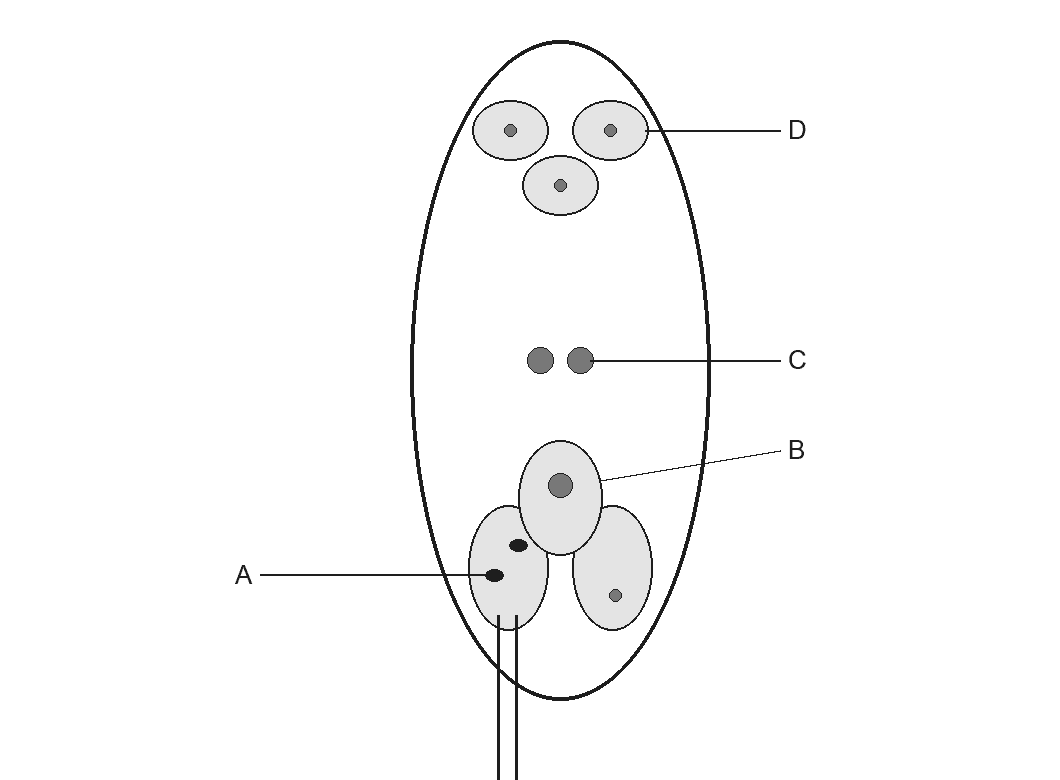
(a) Identify A, B, C and D.
(b) Which parts fuse to form the zygote? State the ploidy of the zygote.
(c) Which parts fuse to form the primary endosperm nucleus? State its ploidy and what it develops into.
- 312 marks
Question 31
Suppose (hypothetical case) that in an ovule only syngamy took place and the second male gamete failed to fuse with the polar nuclei. Predict what would happen to (a) the endosperm and (b) the development of the embryo. Give a reason for each.
- 321 mark
Question 32
Which sequence correctly shows the development of a dicot embryo from the zygote?
- 331 mark
Question 33
In a developing dicot embryo, the few cells of the embryo nearest the suspensor give rise to which parts?
- 343 marks
Question 34
A student studied endosperm development in three seeds, P, Q and R (hypothetical observations).
P: The primary endosperm nucleus divides repeatedly with no walls; the nuclei lie at the periphery around a large central vacuole, and walls form later from the periphery towards the centre.
Q: The first mitotic division is followed by a wall that forms two unequal cells; the next divisions are free nuclear and walls form later.
R: Every nuclear division is followed by cytokinesis right from the beginning.
Name the type of endosperm development in each seed. Which of the three types is the most common?
- 353 marks
Question 35
Draw labelled diagrams of the globular and heart-shaped stages of a dicot embryo. Label the embryo, suspensor and basal cell, and mark the end that faces the micropyle.
- 362 marks
Question 36
Tomato, brinjal, lady's finger and cucumber are sold as vegetables. Give two reasons why a botanist calls them fruits.
- 371 mark
Question 37
Gram seeds are soaked in water before they germinate. Through which structure does water enter the seed?
- 381 mark
Question 38
A seed has a single cotyledon, and no endosperm is left in it at maturity. Which seed could it be?
- 394 marks
Question 39
The figure shows a soaked gram seed split open.
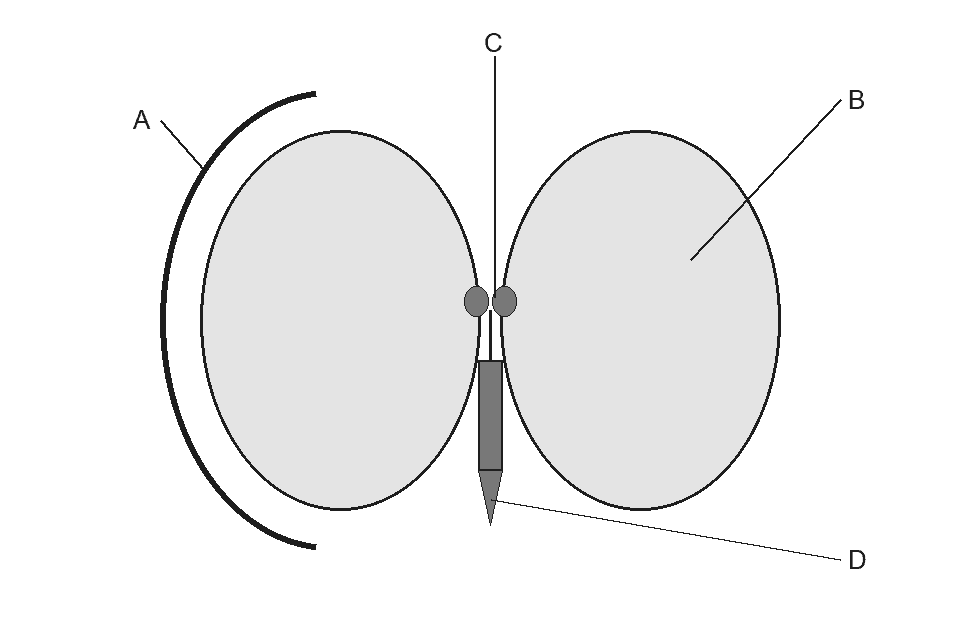
Identify the parts A, B, C and D, and state one role of each.
- 402 marks
Question 40
A farmer dries the grain harvested this season and stores it in sacks to sow next season. Explain two features of mature seeds that make such storage possible.
- 412 marks
Question 41
When a maize grain germinates, the coleoptile comes out of the soil and turns green, but the coleorhiza stays inside the soil. Explain this difference on the basis of what each sheath encloses.
- 421 mark
Question 42
Moringa and ash both have winged structures that help in dispersal by wind. Which statement about the origin of their wings is correct?
- 431 mark
Question 43
A dry fruit does not split open at maturity. It has one seed, and its pericarp is free from the seed coat. To which type does it belong?
- 444 marks
Question 44
On a school field trip (hypothetical example), students noted the following. For each, name the agent or mechanism of dispersal and the feature that suits it.
(a) Coconut fruits washed up on a beach far from any coconut palm.
(b) Xanthium fruits stuck to a dog's fur.
(c) Poppy capsules on long stalks swaying in the wind.
(d) Orchid seeds as fine as dust.
- 452 marks
Question 45
Seeds of a forest tree that simply drop under the parent tree usually grow into weak seedlings. Give two reasons why dispersal of seeds away from the parent plant helps the species.
- 463 marks
Question 46
After pollination the ovary of a flower usually does not drop off, and after fertilisation it grows many times in size — a pumpkin ovary grows about 20 times in two weeks.
(a) What prevents the ovary from falling off after pollination?
(b) Which substances does the growing seed synthesise?
(c) How do these substances turn the ovary into the fruit?
- 471 mark
Question 47
In a mango seed, an embryo develops directly from a cell of the nucellus, without any fertilisation. A plant raised from this embryo will be
- 484 marks
Question 48
When a single lemon seed was sown (hypothetical observation), three seedlings came up from it.
(a) Name this condition.
(b) Describe three ways in which more than one embryo can arise in one seed.
- 493 marks
Question 49
An orange seed contains a zygotic embryo and also an extra embryo formed from cells of the nucellus. Compare the two embryos in (a) their origin, (b) whether fusion of gametes is involved, and (c) where each embryo begins to form.
- 501 mark
Question 50
Arrangement of nuclei in normal dicot embryo sac is
- 511 mark
Question 51
An anther generally has
- 521 mark
Question 52
Each microspore mother cell gives rise to
- 531 mark
Question 53
Each microspore develops into
- 541 mark
Question 54
Anemophily refers to pollination by
- 551 mark
Question 55
When pollen grains of a flower are transferred to the stigma of another flower on the same plant, it is known as
- 561 mark
Question 56
A small pore at one end of ovule is known as
- 571 mark
Question 57
An embryo sac has
- 581 mark
Question 58
The nuclei present in the centre of the embryo sac are called
- 591 mark
Question 59
Pollination in Vallisneria is by
- 601 mark
Question 60
Pollination by bats is known as
- 611 mark
Question 61
Each pollen tube has
- 621 mark
Question 62
Endosperm of the seed develops from the
- 631 mark
Question 63
Self-incompatibility due to the genotype of the pollen grain is termed as
- 641 mark
Question 64
The fruit of mango is a
- 651 mark
Question 65
On maturity an ovule forms a
- 661 mark
Question 66
Pineapple is an example of
- 671 mark
Question 67
A diploid female plant is crossed with tetraploid male. The ploidy of endosperm will be
- 681 mark
Question 68
Double fertilisation involves fertilisation of
- 691 mark
Question 69
Cleistogamous flowers are
- 701 mark
Question 70
A flower having both stamens and carpels is
- 711 mark
Question 71
A plant part having two generations is
- 721 mark
Question 72
Tetradynamous androecium is found in
- 731 mark
Question 73
Edible part of mango is
- 741 mark
Question 74
Endosperm is consumed by developing embryo in
- 751 mark
Question 75
Unisexuality of flowers prevents
- 761 mark
Question 76
Which one of the following prevents cross-pollination?
- 771 mark
Question 77
Most common type of ovule in which an ovule bends along the funicle so that the micropyle is close to hilum.
- 781 mark
Question 78
An embryo is formed by the
- 791 mark
Question 79
Androecium is a collection of ______.
- 801 mark
Question 80
Each stamen is a modified ______.
- 811 mark
Question 81
A generative nucleus gives rise to ______ as a result of mitotic divisions.
- 821 mark
Question 82
Wind-pollinated flowers generally have ______ stigma.
- 831 mark
Question 83
Primary endosperm nucleus is formed by the fusion of ______ and ______.
- 841 mark
Question 84
A true fruit develops from the ______.
- 851 mark
Question 85
As the ovary mature, ovules develop into ______ and zygote into ______.
- 861 mark
Question 86
Triploid nucleus undergoes mitotic divisions to form ______.
- 871 mark
Question 87
The non-albuminous seeds have food stored in ______.
- 881 mark
Question 88
The multilayered body of the ovule is called ______.
- 891 mark
Question 89
A functional megaspore undergoes mitotic divisions to form 8 haploid nuclei.
- 901 mark
Question 90
Tapetum is a thick outermost layer of pollen sac.
- 911 mark
Question 91
On maturity each pollen contains to a small vegetative cell and a large generative cell.
- 921 mark
Question 92
A megaspore mother cell is a diploid cell that undergoes meiotic division.
- 931 mark
Question 93
Vallisneria had flowers modified for wind pollination.
- 941 mark
Question 94
Pollen tube is positively chemotropic and negatively aerotropic.
- 951 mark
Question 95
Formation of a diploid zygote and triploid nucleus is called double fertilisation.
- 961 mark
Question 96
The edible part in coconut is the mesocarp.
- 971 mark
Question 97
The fruits developed by parthenocarpy are seedless.
- 981 mark
Question 98
Protogyny ensures self fertilisation.
- 997 marks
Question 99
Match the following:
Column A Column B 1. Raceme with sessile flowers (a) Catkin 2. Spike with fleshy axis (b) Umbel 3. Equal flower stalks from the same point (c) Spike 4. Flattened convex receptacle bearing stalkless flowers (d) Cyathium 5. Spike with pendulous axis (e) Spadix 6. Cup-shaped involucre with single female flower (f) Corymb 7. Flower stalks of varying length on a shortened raceme axis (g) Capitulum - 1001 mark
Question 100
An arrangement when filaments of the stamens join together to form two bundles.
- 1011 mark
Question 101
A special tissue of inner wall of ovary to which ovules are attached.
- 1021 mark
Question 102
An ovule that is straight with funicle, chalaza and micropyle in the same vertical line.
- 1031 mark
Question 103
Outer thick and tough sculptured layer of pollen grains.
- 1041 mark
Question 104
A multicarpellary condition when the carpels are free.
- 1051 mark
Question 105
Self-pollination in which pollens from one flower are deposited to another flower present on a different plant.
- 1061 mark
Question 106
In an embryo, the part of embryonal axis above the level of cotyledons.
- 1071 mark
Question 107
A resting stage of seed when all its metabolic activities are greatly reduced.
- 1081 mark
Question 108
When a diploid cell of an ovule from nucellus or megaspore develops into an embryo.
- 1091 mark
Question 109
The protective layers of ovule.
- 1101 mark
Question 110
Assertion (A): The megaspore mother cell divides meiotically to produce four megaspores.
Reason (R): One functional megaspore develops into a female gametophyte.
- 1111 mark
Question 111
Assertion (A): A typical microsporangium of angiosperms is generally surrounded by four wall layers.
Reason (R): The outer three wall layers perform the function of protection and help in dehiscence of anther to release the pollen and the innermost layer called tapetum nourishes the pollen grains.
- 1121 mark
Question 112
Assertion (A): Hydrophily is a major mode of pollination in most of the aquatic plants in angiosperms.
Reason (R): All aquatic dicot and monocot plants require water for the transport of male gametes and for fertilisation.
- 1131 mark
Question 113
Assertion (A): Double fertilisation is a characteristic feature of angiosperms.
Reason (R): Double fertilisation leads to the formation of zygote and primary endosperm nucleus.
- 1141 mark
Question 114
Assertion (A): Xenogamy is pollination between flowers on different plants.
Reason (R): Cross-pollination can occur by various agencies like wind, water, air or animals.
- 1151 mark
Question 115
Assertion (A): A dicot embryo consists of an embryonal axis and cotyledons.
Reason (R): Cotyledons provide food for the developing embryo during seed germination.
- 1161 mark
Question 116
Assertion (A): Nuclear endosperm is formed by successive nuclear divisions without cell wall formation.
Reason (R): The coconut water from tender coconut is cellular endosperm and surrounding white kernel is free nuclear endosperm.
- 1171 mark
Question 117
Assertion (A): The exine of a pollen grain is made up of a resistant material called sporopollenin.
Reason (R): Pollen grain intine has prominent apertures called germ pores where sporopollenin is absent.
- 1181 mark
Question 118
Assertion (A): Apomixis is a special type of reproduction where seeds are formed without fertilisation.
Reason (R): In apomixis a diploid egg is formed without reductional division and develops into an embryo without fertilisation.
- 1191 mark
Question 119
Assertion (A): An embryo sac has three cells called egg apparatus towards the micropylar end, three cells called antipodals on the chalazal end and a large central cell with two nuclei.
Reason (R): 2-Nucleate embryo sac undergoes two sequential mitotic divisions and results in the formation of 4-nucleate and later the 8-nucleate stage of embryo sac.
- 1202 marks
Question 120
Mention two strategies evolved to prevent self-pollination in flowers.
- 1212 marks
Question 121
Why do you think the zygote is dormant for some time in a fertilised ovule?
- 1222 marks
Question 122
If one can induce parthenocarpy through the application of growth substances, which fruits would you select to induce parthenocarpy and why?
- 1231 mark
Question 123
Can snails pollinate the flowers? What do you call such a pollination?
- 1241 mark
Question 124
What is the technique employed to preserve pollen grains for germplasm collection?
- 1252 marks
Question 125
What are pollen baskets?
- 1262 marks
Question 126
All the aquatic plants cannot use water for pollination - do you agree with this statement? Why?
- 1272 marks
Question 127
Give reason: Flowers in Salvia plants show stamens with lever mechanisms.
- 1281 mark
Question 128
The flowers which open their petals to expose their reproductive parts to allow pollination are called:
- 1291 mark
Question 129
Define Parthenocarpy.
- 1301 mark
Question 130
Give a reason for the following:
Pollen grains of wind pollinated flowers are produced in large quantities.
- 1311 mark
Question 131
Define perisperm.
- 1321 mark
Question 132
Give a term for the following:
Fusion of male gamete and secondary nucleus in angiosperms.
- 1332 marks
Question 133
State four features of flowers pollinated by insects.
- 1342 marks
Question 134
Briefly discuss any two methods by which plants avoid self-pollination.