
Question 1195 marksMedium
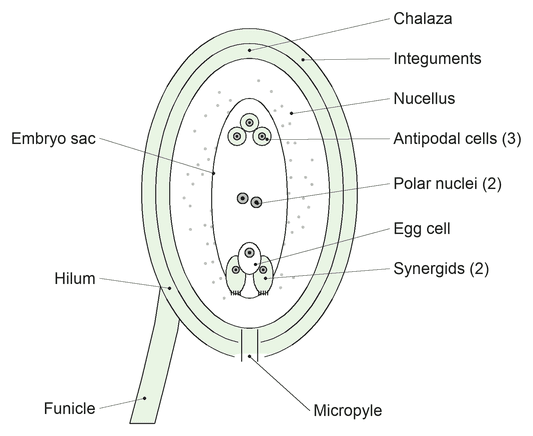
Draw a well-labelled diagram of a mature ovule, showing its internal structure.
Confirming your payment
Sign up now and get 250 free tokens.
Sexual Reproduction in Flowering Plants · Question 119 of 143
Draw a well-labelled diagram of a mature ovule, showing its internal structure.
Solution:
Key idea: The ovule (megasporangium) is the structure that becomes the seed after fertilisation. In section it shows a stalk, protective coats, the nucellus and, inside the nucellus, the embryo sac (female gametophyte). The commonest type is anatropous: its body is turned over so that the micropyle lies close to the funicle.
Step 1 — Draw the ovule.
The labelled diagram below shows a longitudinal section of a mature anatropous ovule. Its labelled parts are the funicle, hilum, integuments, micropyle, chalaza, nucellus and the embryo sac with its antipodal cells, polar nuclei (which fuse to form the definitive nucleus), egg cell and synergids.
Step 2 — Explain the funicle and hilum.
The funicle is the stalk that attaches the ovule to the placenta; it carries water and food to the ovule through a vascular strand. The hilum is the point where the body of the ovule joins the funicle. In an anatropous ovule part of the funicle is fused along the side of the ovule as a ridge called the raphe.
Step 3 — Explain the integuments and micropyle.
One or two integuments (outer and inner) cover and protect the nucellus; after fertilisation they form the seed coats. They leave a small opening at the tip, the micropyle, through which the pollen tube usually enters and, later, water enters the seed at germination.
Step 4 — Explain the chalaza.
The chalaza is the basal end of the ovule, opposite the micropyle, where the integuments and the nucellus join.
Step 5 — Explain the nucellus.
The nucellus is the main body of the ovule, a mass of cells with reserve food. It is covered by the integuments and holds and nourishes the embryo sac.
Step 6 — Describe the embryo sac.
The embryo sac lies in the nucellus. At its micropylar end is the egg apparatus, an egg cell between two synergids that bear the filiform apparatus. At its chalazal end are three antipodal cells. In the large central cell are two polar nuclei, which may fuse before fertilisation to form the diploid definitive (secondary) nucleus.
Therefore, a mature anatropous ovule in section shows the funicle, hilum, integuments, micropyle, chalaza and nucellus, with the seven-celled embryo sac (egg apparatus, central cell and antipodal cells) inside the nucellus.